Home
Class 12
PHYSICS
A tank contains two different liquids wh...

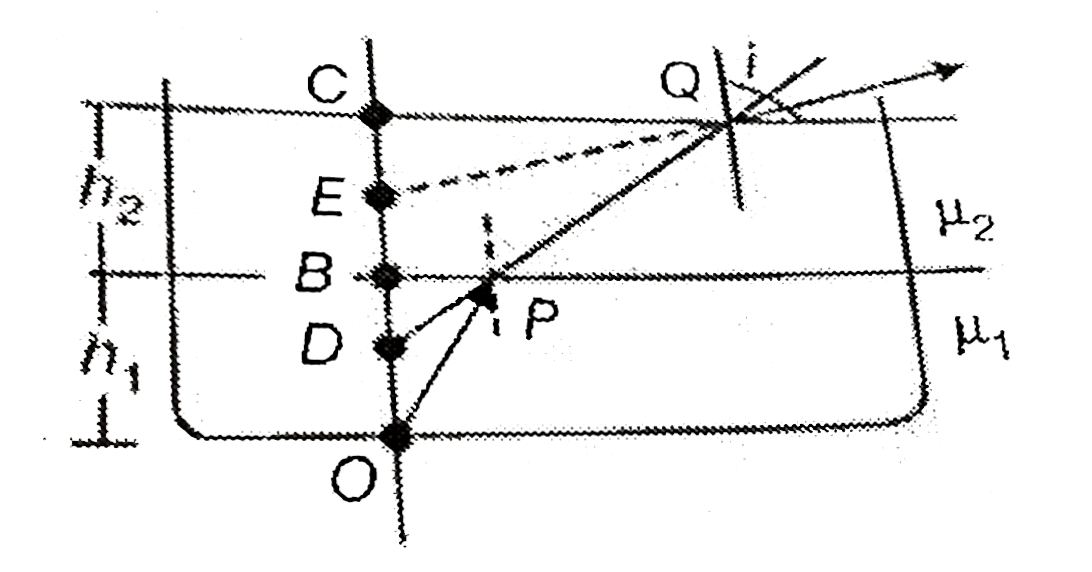
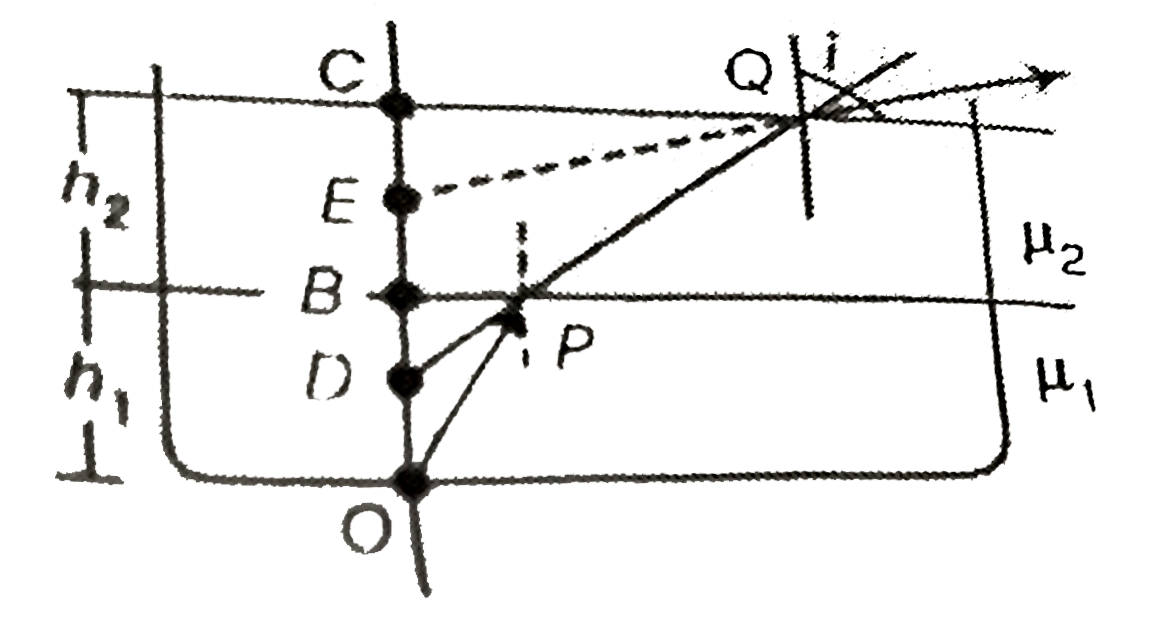
A tank contains two different liquids which do not mix with each other. The lower and upper liquid are at depth `h_(1)` and `h_(2)` respectively and of refractive indices `mu_(1)` and `mu_(2)`. An object `O` is located at the bottom, when see vertically from above. Locate the position of image of the object `O` as seen from above.

A

`(h_(1))/(mu_(1))-(h_(2))/(mu_(2))`

B

`(h_(1))/(mu_(1))+(h_(2))/(mu_(2))`

C

`(h_(1))/(mu_(1))+(h_(2))/(mu_(1))`

D

`(h_(1))/(mu_(2))-(h_(2))/(mu_(1))`

Text Solution

Verified by Experts

(b) Let `/_BOP=/_i,/_BDP=/_r,/_CEQ=/_i'`

Refractrion at `P`
`mu_(1)sin i=mu_(2) sin r`
`(mu_(1))/(mu_(2))=(sin r)/(sin i)=(tan r)/(tan i)=(h_(1))/(BD)`
`implies BD=(h_(1)mu_(2))/(mu_(1))`
At `Q,mu_(2) sin r =sin i'`
`mu_(1)=(sin i')/(sin r)+(tan i')/(tan r)=(BD+BC)/(CE)`
`implies CE=(DB+BC)/(mu_(2))=(h_(1))/(m_(1))+(h_(2))/(mu_(2))`
Promotional Banner

Topper's Solved these Questions

  • QUESTION-PAPERS-2018

    BITSAT GUIDE|Exercise PHYSICS|40 Videos
  • SEMICONDUCTOR DEVICES AND LOGIC GATES

    BITSAT GUIDE|Exercise BITSAT Archives|5 Videos

Similar Questions

Explore conceptually related problems

An object is located at the bottom of a tank containing two immiscible liquids and is seen vertically from above. The lower and upper liquids are of depths h_1 and h_2 respectively and of refractive indices mu_1 and mu_2 respectively. Locate the position of the image of the object O from the surface.

When an object is made to float in two different liquids of density d_(1)andd_(2) , the lengths of the object seen above the liquid surface are l_(1)andl_(2) , respectively. Which of the following is the correct alternative ?

In a spherical paper weight (R = 10 cm) made of glass of refractive index mu = (3)/(2) , an object is embedded at a distance 5 cm from its centre. What is the apparent position of the object when seen from the opposite side (see figure)?

A curved surface of radius R separates two medium of refractive indices mu_(1) "and" mu_(2) as shown in figures A and B . Identity the correct statement(s) related to the formation of images of a real object O placed at x from the pole of the concave surface, as shown in figure B

A curved surface of radius R separates two medium of refractive indices mu_(1) "and" mu_(2) as shown in figures A and B . Choose the correct statement(s) related to the virtual image formed by object O placed at a distance x, as shown in figure

When an object is at .distances of mu_(1) and mu_(2) from the poles of a concave mirror, images of the same size are formed. The - focal length, of the mirror is

BITSAT GUIDE-RAY OPTICS-All Questions
  1. A small coin is resting on the bottom of a beaker filled with a liquid...

    Text Solution

    |

  2. Considering normal incident of ray, find equivalent refractive index o...

    Text Solution

    |

  3. A tank contains two different liquids which do not mix with each other...

    Text Solution

    |

  4. A fish rising up vertically toward the surface of water with speed 3m...

    Text Solution

    |

  5. A telescope consists of two lenses of focal lengths 10cm and 1cm. Calc...

    Text Solution

    |

  6. A glass prism of refractive index 1.5 is immersed in water (refractive...

    Text Solution

    |

  7. If the resolution limit of the eye is 1 minute and at a distance x km ...

    Text Solution

    |

  8. A ray incident at a point at an angle of incidence of 60^(@) enters a ...

    Text Solution

    |

  9. An object appraches a convergent lens from the left of the lens with a...

    Text Solution

    |

  10. A concave lens and a convex lens have same focal length of 20 cm and b...

    Text Solution

    |

  11. A source of light lies on the angle bisector of two plane mirrors incl...

    Text Solution

    |

  12. On the axis of a spherical mirror of focal length f a short linear obj...

    Text Solution

    |

  13. The speed at which the image of the luminous point object is moving, i...

    Text Solution

    |

  14. A thin convergent glass lens (mug=1.5) has a power of +5.0D. When this...

    Text Solution

    |

  15. The reflective surface is given by y=2 sinx. The reflective surface is...

    Text Solution

    |

  16. With a concave mirror, an object is placed at a distance x(1) from the...

    Text Solution

    |

  17. An electromagnetic radiation of frequency v, wavelength lamda, travell...

    Text Solution

    |

  18. When a glass slab is placed on a cross made on a sheet, the cross appe...

    Text Solution

    |

  19. A layered lens is made of materials indicated by shades in the figure....

    Text Solution

    |

  20. Resolving power of a telescope will be more, fi the diameter (a) of th...

    Text Solution

    |