

Home
Class 12
PHYSICS
A plastic rod has been formed into a cir...

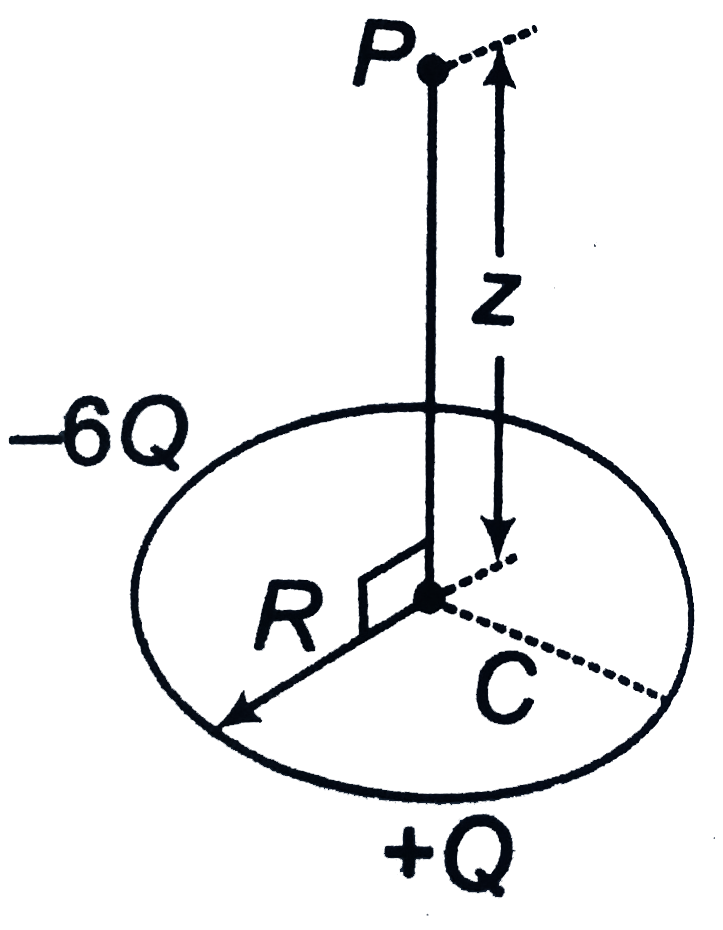
A plastic rod has been formed into a circle of radius R. It has a positive charge `+Q` uniformly distributed along one-quarter of its circumference and a negative charge of ` -6Q` uniformly distributed along the rest of the circumference (figure). With V = 0 at infinity, what is the electric potential `-6Q`
(a) at the centre C of the circle and
(b) at point P, which is on the central axis of the circle at distance z from the centre?

Promotional Banner

Similar Questions

Explore conceptually related problems

A thin glass rod is bent into a semicircle of radius r. A charge +Q is uniformly distributed along the upper half, and a charge -Q is uniformly distributed along the lower half, as shown in fig. The electric field E at P, the center of the semicircle, is

Calculate potential on the axis of a ring due to charge Q uniformly distributed along the ring of radius R.

Calculate potential on the axis of a ring due to charge Q uniformly distributed along the ring of radius R.

Calculate potential on the axis of a ring due to charge Q uniformly distributed along the ring of radius R.

Calculate potential on the axis of a ring due to charge Q uniformly distributed along the ring of readius R.

Calculate potential on the axis of a disc of radius R due to a charge Q uniformly distributed on its surface.

Calculate potential on the axis of a disc of radius R due to a charge Q uniformly distributed on its surface.

A charge of 500 muC is distributed uniformly over the circumference of a ring of radius 25 cm. What will be be electric potential at the centre of ring?

A positive charge Q is uniformly distributed along the length L of a rod. It is bent in the shape of a square. Calculate electric field intensity at the centre of the square.

Positive charge Q is uniformly distributed across a thin rod of length L. The rod is then bent in the form of a semicircle. What will be the electric potential at the centre of curvature of semicircle formed?