Home
Class 12
BIOLOGY
Sickle- cell anaemia is an autosome link...

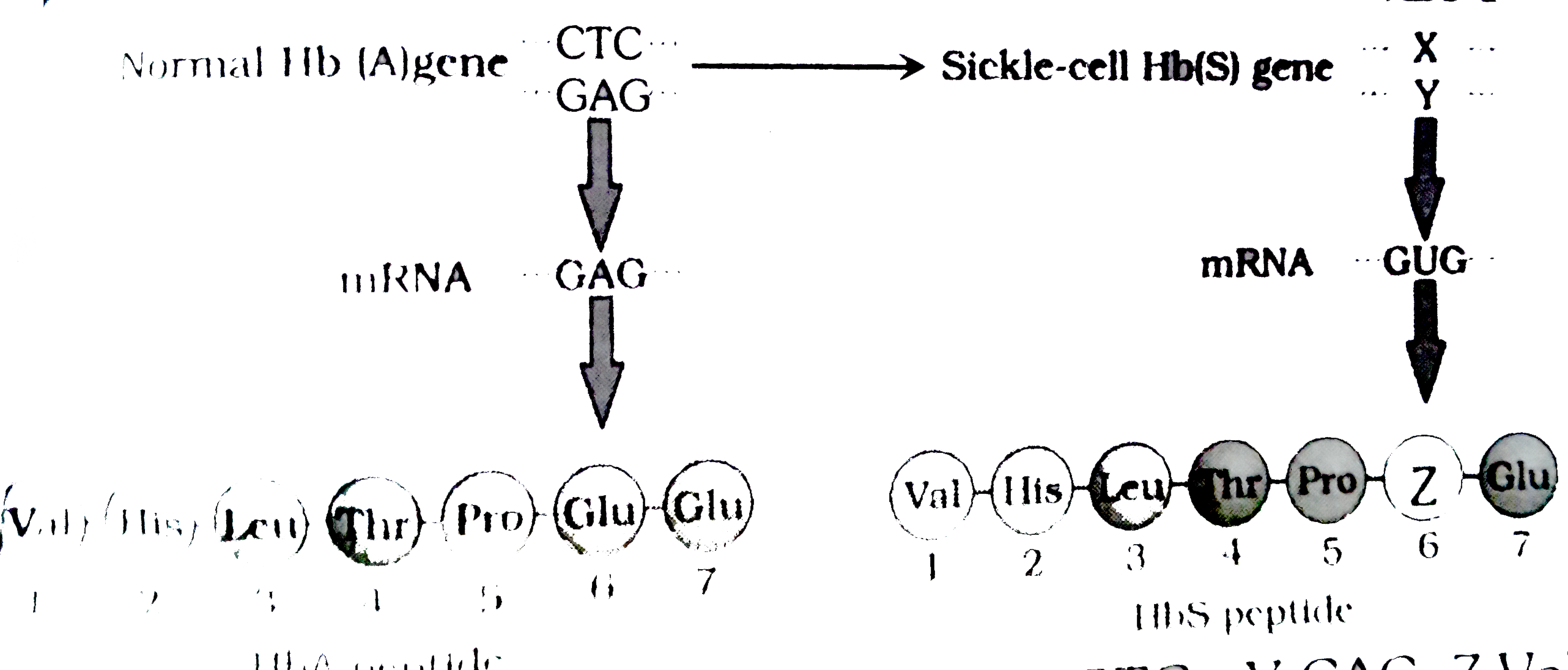
Sickle- cell anaemia is an autosome linked recessive trait that can be transmitted from parents to the offspring when both the partners are carrier for all the gene (or heterozygous ).The disease is controlled by a single pair of allele,`Hb^(A)` & `Hb^(S)`. Out of the three possible genotypes only homozygous individuals for HbS `(Hb^(s) Hb^(s))` are lethal. Select the right option in which X,Y and Z are correctly identified

A

X-CAC,-Y GTG, Z His

B

X - y GTG, - Y CAC, Z Val

C

X - CAC, - Y GTG,Z Phe

D

X - CAC, - Y GTG, Z Val

Text Solution

Verified by Experts

The correct Answer is:

D
Promotional Banner

Topper's Solved these Questions

  • MOLECULAR BASIS OF INHERITANCE

    ERRORLESS |Exercise Molecular Basis Of Inheritance|469 Videos
  • REPRODUCTION IN ORGANISMS

    ERRORLESS |Exercise Reproduction In Organisms|116 Videos

Similar Questions

Explore conceptually related problems

Sickle cell anemia is a genetic disorder where the body produces an abnormal hemoglobin called hemoglobin S. Red blood cells are normally flexible and round, but when the hemoglobin is defective, blood cells take on a “sickle” or crescent shape. Sickle cell anemia is caused by mutations in a gene called HBB. It is an inherited blood disorder that occurs if both the maternal and paternal copies of the HBB gene are defective. In other words, if an individual receives just one copy of the defective HBB gene, either from mother or father, then the individual has no sickle cell anemia but has what is called “sickle cell trait”. People with sickle cell trait usually do not have any symptoms or problems but they can pass the mutated gene onto their children. There are three inheritance scenarios that can lead to a child having sickle cell anemia: - Both parents have sickle cell trait - One parent has sickle cell anemia and the other has sickle cell trait - Both parents have sickle cell anemia If one parent has sickle cell anemia and the other has sickle cell trait, there is __________that their children will have sickle cell anemia and ___________will have sickle cell trait.

Sickle cell anemia is a genetic disorder where the body produces an abnormal hemoglobin called hemoglobin S. Red blood cells are normally flexible and round, but when the hemoglobin is defective, blood cells take on a “sickle” or crescent shape. Sickle cell anemia is caused by mutations in a gene called HBB. It is an inherited blood disorder that occurs if both the maternal and paternal copies of the HBB gene are defective. In other words, if an individual receives just one copy of the defective HBB gene, either from mother or father, then the individual has no sickle cell anemia but has what is called “sickle cell trait”. People with sickle cell trait usually do not have any symptoms or problems but they can pass the mutated gene onto their children. There are three inheritance scenarios that can lead to a child having sickle cell anemia: - Both parents have sickle cell trait - One parent has sickle cell anemia and the other has sickle cell trait - Both parents have sickle cell anemia If both parents have sickle cell trait, then there is _______________of the child having sickle cell trait.

Sickle cell anemia is a genetic disorder where the body produces an abnormal hemoglobin called hemoglobin S. Red blood cells are normally flexible and round, but when the hemoglobin is defective, blood cells take on a “sickle” or crescent shape. Sickle cell anemia is caused by mutations in a gene called HBB. It is an inherited blood disorder that occurs if both the maternal and paternal copies of the HBB gene are defective. In other words, if an individual receives just one copy of the defective HBB gene, either from mother or father, then the individual has no sickle cell anemia but has what is called “sickle cell trait”. People with sickle cell trait usually do not have any symptoms or problems but they can pass the mutated gene onto their children. There are three inheritance scenarios that can lead to a child having sickle cell anemia: - Both parents have sickle cell trait - One parent has sickle cell anemia and the other has sickle cell trait - Both parents have sickle cell anemia If both parents have sickle cell trait, then there is _______________of the child having sickle cell anemia.

Sickle cell anemia is a genetic disorder where the body produces an abnormal hemoglobin called hemoglobin S. Red blood cells are normally flexible and round, but when the hemoglobin is defective, blood cells take on a “sickle” or crescent shape. Sickle cell anemia is caused by mutations in a gene called HBB. It is an inherited blood disorder that occurs if both the maternal and paternal copies of the HBB gene are defective. In other words, if an individual receives just one copy of the defective HBB gene, either from mother or father, then the individual has no sickle cell anemia but has what is called “sickle cell trait”. People with sickle cell trait usually do not have any symptoms or problems but they can pass the mutated gene onto their children. There are three inheritance scenarios that can lead to a child having sickle cell anemia: - Both parents have sickle cell trait - One parent has sickle cell anemia and the other has sickle cell trait - Both parents have sickle cell anemia Sickle cell anemia is a/ an ______________________ disease.

Sickle cell anemia is a genetic disorder where the body produces an abnormal hemoglobin called hemoglobin S. Red blood cells are normally flexible and round, but when the hemoglobin is defective, blood cells take on a “sickle” or crescent shape. Sickle cell anemia is caused by mutations in a gene called HBB. It is an inherited blood disorder that occurs if both the maternal and paternal copies of the HBB gene are defective. In other words, if an individual receives just one copy of the defective HBB gene, either from mother or father, then the individual has no sickle cell anemia but has what is called “sickle cell trait”. People with sickle cell trait usually do not have any symptoms or problems but they can pass the mutated gene onto their children. There are three inheritance scenarios that can lead to a child having sickle cell anemia: - Both parents have sickle cell trait - One parent has sickle cell anemia and the other has sickle cell trait - Both parents have sickle cell anemia The following statements are drawn as conclusions from the above data (Kenya). I. Patients with SCD (Sickle Cell Disease) are less likely to be infected with malaria. II. Patients with SCD (Sickle Cell Disease) are more likely to be infected with malaria. III. Over the years the percentage of people infected with malaria has been decreasing. IV. Year 2000 saw the largest percentage difference between malaria patients with and without SCD. Choose from below the correct alternative.

Assertion : The person heterozygous for sickle- cell trait produces both normal (Hb^(A)) and abnormal haemoglobin (Hb^(S)) . Reason : Huamn normal allele and the sickle allele are codominant.

Given below are assertion and reason. Point out if both are true with reason being correct explanation (A), both are true but reason is not correct explanation (B), assertion is true but reason is wrong ( C) and both are wrong (D). Assertion. Hb^(s)Hb^(s) is homozygous condition of sickle cell anaemia. Reason. It occurs due to substitution of glutamic acid by valine at sixth position in beta -chain of haemoglobin.

ERRORLESS -PRINCIPLES OF INHERITANCE AND VARIATION-Principles Of Inheritance And Variation
  1. The idea of mutations was brought forth by

    Text Solution

    |

  2. Edward syndrome is on account of ………….

    Text Solution

    |

  3. Sickle- cell anaemia is an autosome linked recessive trait that can be...

    Text Solution

    |

  4. Pick out the correct statements (i) Haemophilia is a sex-linked rece...

    Text Solution

    |

  5. Match column I with column II and find the correct answer

    Text Solution

    |

  6. Height is

    Text Solution

    |

  7. Which one of the following is not a mutagen

    Text Solution

    |

  8. Rate of mutation is affected by

    Text Solution

    |

  9. A mutation is most likely to have a selective advantage in evolution i...

    Text Solution

    |

  10. Which one of the following is a wrong statement regarding mutations

    Text Solution

    |

  11. The gene for diabetes mellitus is

    Text Solution

    |

  12. Gynaecomastia is the symptom of

    Text Solution

    |

  13. Which of the following is the main category of mutation

    Text Solution

    |

  14. In human beings, multiple genes are involved in the inheritance of

    Text Solution

    |

  15. The formation of multivalents at meiosis in diploid organism is dua to

    Text Solution

    |

  16. Mental retardation in man, associated with sex chromosomal abnormality...

    Text Solution

    |

  17. If chromosome complement 44+XY of a gamete mother cell suffers a non-d...

    Text Solution

    |

  18. If haploid chromosome number in a cell is 12. The monosomic number wil...

    Text Solution

    |

  19. Normally DNA molecule has A-T, G-C pairing. However, these bases can e...

    Text Solution

    |

  20. Who reported that Down's syndrome is due to extra 21st chromosome

    Text Solution

    |
