Home
Class 12
PHYSICS
The magnitude of the force (in newtons) ...

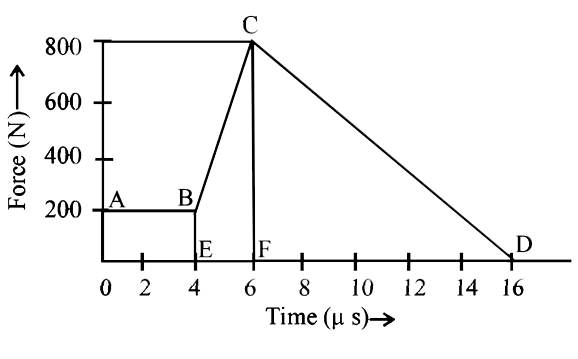
The magnitude of the force (in newtons) acting on a body varies with time t (in micro seconds) as shown in the fig AB, BC and CD are straight line segments. The magnitude of the total impulse of the force on the body from `t= 4 mus` to `t=16 mus` is ….Ns

A

`6xx10^(-3)Ns`

B

`5.0xx10^(-3)Ns`

C

`8.4xx10^(-3)Ns`

D

`7.6xx10^(-3)Ns`

Text Solution

Verified by Experts

The correct Answer is:

B
Promotional Banner

Topper's Solved these Questions

  • NEET MOCK TEST 12

    NTA MOCK TESTS|Exercise PHYSICS|45 Videos
  • NEET MOCK TEST 14

    NTA MOCK TESTS|Exercise PHYSICS|45 Videos

Similar Questions

Explore conceptually related problems

The magnitude of force (in Newtons) acting on a body varies with time (in micro second) as shown in the figure. The magnitude of total impulse of the force on the body from t = 4μs to t = 16μs is –

Power of a force acting on a block varies with time t as shown in figure. Then, angle between force acting on the block and its velocity is

A force acting on a body of mass 2 kg varies with time as shown in fig.5.11. Find impulse of the force.

Kinetic energy of a particle moving in a straight line is proportional to the time t. The magnitude of the force acting on the particle is :

The magnitude of force acting on a particle moving along x-axis varies with time (t) as shown in figure. If at t = 0 the velocity of particle is v_(0) , then its velocity at t=T_(0) will be

A force acting on a body of mass 2 kg varies with time as shown in fig . 20 find impulse of the force and final velocity of the body.

If the kinetic energy of a body is directly proportional to time t, the magnitude of the force acting on the body is

The displacement y (in metres) of a body varies with time t ( in seconds ) as y= (-2)/(3) t^(2)+16t-12 . How long does the body take to come to rest ?

NTA MOCK TESTS-NEET MOCK TEST 13-MCQs (PHYSICS)
  1. An earthquake generates both transverse (S) and longitudinal (P) sound...

    Text Solution

    |

  2. A pendulum has time period T for small oscillations. An obstacle P is ...

    Text Solution

    |

  3. A body is projected up with a velocity equal to 3//4th of the escape v...

    Text Solution

    |

  4. If the density of a planet is constant, then the curve between value o...

    Text Solution

    |

  5. Why are electric field lines perpendicular at a point on an equipotent...

    Text Solution

    |

  6. Three rods each of length L and mass M are placed along X, Y and Z axi...

    Text Solution

    |

  7. A uniform circular disc placed on a horizontal rough surface has initi...

    Text Solution

    |

  8. A ball of mass m approaches a wall of mass M (M>>m), with speed 2 ms^(...

    Text Solution

    |

  9. Consider the nuclear reaction X^(200)toA^(110)+B^(80)+10n^(1). If the ...

    Text Solution

    |

  10. The magnitude of the force (in newtons) acting on a body varies with t...

    Text Solution

    |

  11. Mass is non-uniformly distributed over the rod of length l, its linear...

    Text Solution

    |

  12. A hydrogen atom moving at a speed v absorbs a photon of wavelength 122...

    Text Solution

    |

  13. In a common emitter amplifier, using output reisistance of 5000 ohm an...

    Text Solution

    |

  14. Identify the operation performed by the circuit given below-

    Text Solution

    |

  15. The electric field and the electric potential at a point are E and V r...

    Text Solution

    |

  16. Initially K(1) is closed, now if K(2) is also closed, find heat dissip...

    Text Solution

    |

  17. All the bulbs below are identical. Which bulb(s) shine(s) most brightl...

    Text Solution

    |

  18. An electron moving with a velocity v along the positive x-axis approac...

    Text Solution

    |

  19. A circular coil carrying current I is placed in a region of uniform ma...

    Text Solution

    |

  20. The material suitable for making electromagnets should have

    Text Solution

    |
