Home
Class 11
CHEMISTRY
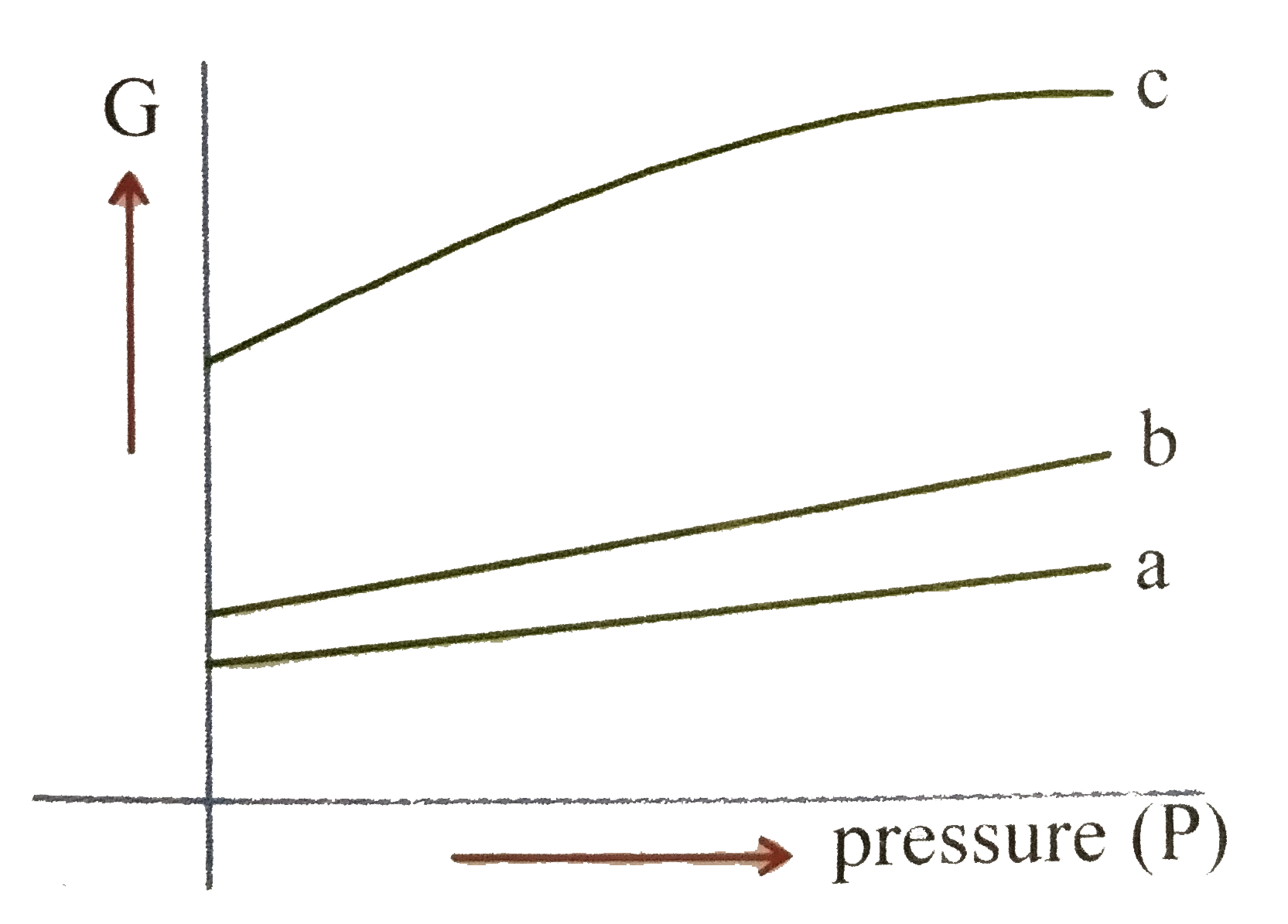
The following curve represnets the varia...

The following curve represnets the variation of Gibbs function 'G' with pressure at constant temperature.

Correct match of given plots with the physical state of a substance is

A

c- solid, a - gas, b - liquid

B

c - gas, b- liequid, a - solid

C

a - liquid, b - solide, c - gas

D

c - gas, b - solid, a - liquid

Text Solution

Verified by Experts

The correct Answer is:

B

`S_("gas") gt S_("liq") gt S_("solid")`
Promotional Banner

Topper's Solved these Questions

  • THERMODYNAMICS

    NARAYNA|Exercise Passages|13 Videos
  • THERMODYNAMICS

    NARAYNA|Exercise Matching type|6 Videos
  • THERMODYNAMICS

    NARAYNA|Exercise Level -V|106 Videos
  • STRUCTURE OF ATOM

    NARAYNA|Exercise EXERCISE - IV EXEMPLAR PROBLEMS|24 Videos

Similar Questions

Explore conceptually related problems

The curve showing the variation of adorpton with pressure at constant temperature is called :

For gaseous state at constant temperature which of the following plot is correct?

Which of the following curve is incorrect for given amount of an ideal gas at constant temperature ?

Which one of the following given graphs represents the variation of rate constant (k) with temperature (t) for an endothermic reaction ?

Which one of the following given graphs represents the variation of rate constant (k) with temperature (f) for an endothermic reaction ?

The variation of solubility of four different gases (G1, G2, etc.) in a given solvent with pressure at a constant temperature is shown in the plot. The gas with the highest value of Henrys law constant is

Plots showing the variation of the rate constant (k) with temperature (T) are given below. The plot that follows the Arrhenius equation is

Which of the following graph represents the variation of amount of chemisorption of a gas by a solid with temperature under constant pressure?

The curve drawn below shows the variations of P as a function of 1//V for a fixed mass and temperature of an ideal gas. It follows from the curve that:

NARAYNA-THERMODYNAMICS-Level-VI
  1. In conversion of lime-stone to lime, CaCO(3(s)) to CaO((s)) + CO(2(g...

    Text Solution

    |

  2. The change in free energy accompainied by the isothermal reversible ex...

    Text Solution

    |

  3. The following curve represnets the variation of Gibbs function 'G' wit...

    Text Solution

    |

  4. Which correctly represents the entropy (s) of an isolated system duri...

    Text Solution

    |

  5. One mole of an ideal monoatomic gas expands isothermally against const...

    Text Solution

    |

  6. At 1000 K water vapour at 1 atm has been found to be dissociated into ...

    Text Solution

    |

  7. Which of the following graphs best illustrates the variation of entrop...

    Text Solution

    |

  8. During winters, moisture condenses in the form of dew and can be seen ...

    Text Solution

    |

  9. A reactions is spontaneous if

    Text Solution

    |

  10. Which of the following expressions are correct for an ideal gas ?

    Text Solution

    |

  11. Which of the following expression are incorrect for a perfect gas ?

    Text Solution

    |

  12. For an ideal gas, an illustration of three different paths A(B+C) and ...

    Text Solution

    |

  13. For an ideal gas, an illustratio of three different paths A(B+C) and (...

    Text Solution

    |

  14. For an ideal gas, an illustration of the different paths, A (B + C) an...

    Text Solution

    |

  15. Standard Gibb's energy of reaction (Delta(r )G^(@)) at a certain temp...

    Text Solution

    |

  16. Standard Gibb's energy of reaction (Delta(r )G^(@)) at a certain temp...

    Text Solution

    |

  17. Standard Gibb's energy of reaction (Delta(r )G^(@)) at a certain temp...

    Text Solution

    |

  18. Standard Gibb's energy of reaction (Delta(r )G^(@)) at a certain temp...

    Text Solution

    |

  19. Standard Gibb's energy of reaction (Delta(r )G^(@)) at a certain temp...

    Text Solution

    |

  20. 9.0 gm ice 0^(@)C is mixed with 36 gm of water at 50^(@)C in a thermal...

    Text Solution

    |
