Home
Class 11
CHEMISTRY
For an ideal gas, an illustration of the...

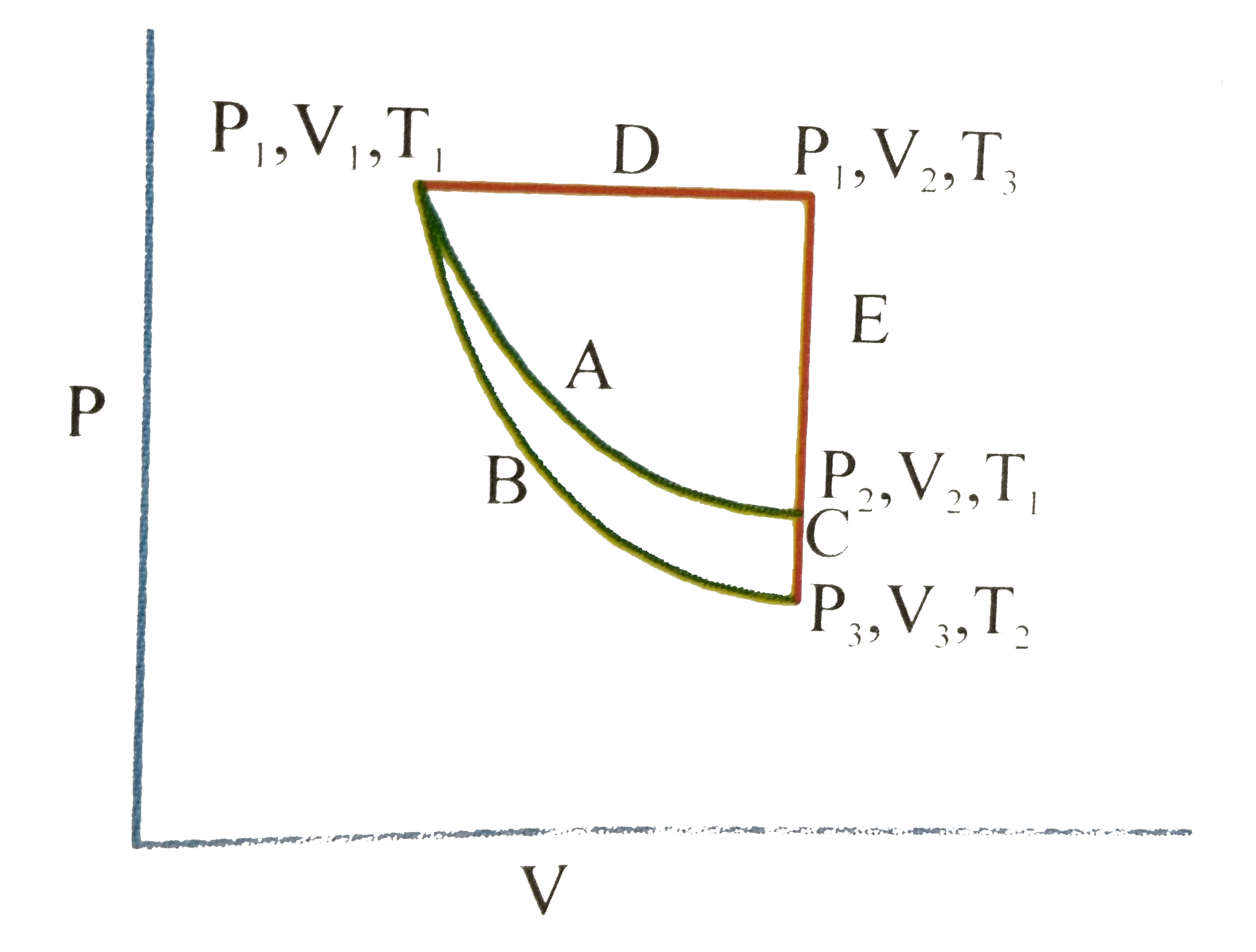
For an ideal gas, an illustration of the different paths, A `(B + C)` and `(D + E)` from an intial state `P_(1), V_(1), T_(1)` to a final state `P_(2), V_(2), T_(1)` as shown in the given figure.

Path (A) represents a reversible isothernal expanison from `P_(1)V_(1)` to `P_(2)V_(2)`. Path `(B + C)` represents a reversible adiabatic expansion (B) from `P_(1), V_(1), T_(1)` to `P_(3), V_(2), T_(2)` followed by reversible heating the gas at constant volume (C) from `P_(3), V_(2), T_(2)` to `P_(2), V_(2) T_(1)` to `P_(1) , V_(2), T_(3)` followed by reversible cooling at a constant volume `V_(2)` (E) from `P_(1), V_(2), T_(3)` to `P_(2), V_(2), T_(1)`
What is `Delta S` for path `(D + E)` ?

A

zero

B

`underset(T_(1))overset(T_(2))int (C_(V)(T))/(T) dT`

C

`-nR ln. (V_(2))/(V_(1))`

D

`nR ln. (V_(2))/(V_(1))`

Text Solution

Verified by Experts

The correct Answer is:

D

path (A) : isothermal `(Delta U = 0)`
`q_(rev) = w = nRT_(1) ln. (v_(2))/(v_(1))`
path `(B + C) : q_(rev) = 0 + (-nR ln.(v_(2))/(v_(1)))`
path `(D + E)`:
`(Delta S)_("sys") = nR ln.(v_(2))/(v_(1)) + .^(n)C_(V) ln. (T_(2))/(T_(1)) = nR ln. (v_(2))/(v_(1))`
Promotional Banner

Topper's Solved these Questions

  • THERMODYNAMICS

    NARAYNA|Exercise Passages|13 Videos
  • THERMODYNAMICS

    NARAYNA|Exercise Matching type|6 Videos
  • THERMODYNAMICS

    NARAYNA|Exercise Level -V|106 Videos
  • STRUCTURE OF ATOM

    NARAYNA|Exercise EXERCISE - IV EXEMPLAR PROBLEMS|24 Videos

Similar Questions

Explore conceptually related problems

For an ideal gas, an illustratio of three different paths A(B+C) and (D+E) from an initial state P_(1), V_(1), T_(1) to a final state P_(2), V_(2),T_(1) is shown in the given figure. Path A represents a reversible isothermal expansion form P_(1),V_(1) to P_(2),V_(2) , Path (B+C) represents a reversible adiabatic expansion (B) from P_(1),V_(1),T_(1)to P_(3),V_(2),T_(2) followed by reversible heating the gas at constant volume (C) from P_(3),V_(2),T_(2) to P_(2),V_(2),T_(1) . Path (D+E) represents a reversible expansion at constant pressure P_(1)(D) from P_(1),V_(1),T_(1) to P_(1),V_(2),T_(3) followed by a reversible cooling at constant volume V_(2)(E) from P_(1),V_(2),T_(3) to P_(2),V_(2),T_(1) . What is q_(rev) , for path (B +C) ?

For an ideal gas, an illustratio of three different paths A(B+C) and (D+E) from an initial state P_(1), V_(1), T_(1) to a final state P_(2), V_(2),T_(1) is shown in the given figure. Path A represents a reversible isothermal expansion form P_(1),V_(1) to P_(2),V_(2) , Path (B+C) represents a reversible adiabatic expansion (B) from P_(1),V_(1),T_(1)to P_(3),V_(2),T_(2) followed by reversible heating the gas at constant volume (C) from P_(3),V_(2),T_(2) to P_(2),V_(2),T_(1) . Path (D+E) represents a reversible expansion at constant pressure P_(1)(D) from P_(1),V_(1),T_(1) to P_(1),V_(2),T_(3) followed by a reversible cooling at constant volume V_(2)(E) from P_(1),V_(2),T_(3) to P_(2),V_(2),T_(1) . What is q_(rev) , for path (D+E) ?

For an ideal gas, an illustratio of three different paths A(B+C) and (D+E) from an initial state P_(1), V_(1), T_(1) to a final state P_(2), V_(2),T_(1) is shown in the given figure. Path A represents a reversible isothermal expansion form P_(1),V_(1) to P_(2),V_(2) , Path (B+C) represents a reversible adiabatic expansion (B) from P_(1),V_(1),T_(1)to P_(3),V_(2),T_(2) followed by reversible heating the gas at constant volume (C) from P_(3),V_(2),T_(2) to P_(2),V_(2),T_(1) . Path (D+E) represents a reversible expansion at constant pressure P_(1)(D) from P_(1),V_(1),T_(1) to P_(1),V_(2),T_(3) followed by a reversible cooling at constant volume V_(2)(E) from P_(1),V_(2),T_(3) to P_(2),V_(2),T_(1) . What is DeltaS for path (D +E) ?

For an ideal gas, an illustratio of three different paths A(B+C) and (D+E) from an initial state P_(1), V_(1), T_(1) to a final state P_(2), V_(2),T_(1) is shown in the given figure. Path A represents a reversible isothermal expansion form P_(1),V_(1) to P_(2),V_(2) , Path (B+C) represents a reversible adiabatic expansion (B) from P_(1),V_(1),T_(1)to P_(3),V_(2),T_(2) followed by reversible heating the gas at constant volume (C) from P_(3),V_(2),T_(2) to P_(2),V_(2),T_(1) . Path (D+E) represents a reversible expansion at constant pressure P_(1)(D) from P_(1),V_(1),T_(1) to P_(1),V_(2),T_(3) followed by a reversible cooling at constant volume V_(2)(E) from P_(1),V_(2),T_(3) to P_(2),V_(2),T_(1) . What is q_(rev) , for path (A) ?

For an ideal gas, an illustratio of three different paths A(B+C) and (D+E) from an initial state P_(1), V_(1), T_(1) to a final state P_(2), V_(2),T_(1) is shown in the given figure. Path A represents a reversible isothermal expansion form P_(1),V_(1) to P_(2),V_(2) , Path (B+C) represents a reversible adiabatic expansion (B) from P_(1),V_(1),T_(1)to P_(3),V_(2),T_(2) followed by reversible heating the gas at constant volume (C) from P_(3),V_(2),T_(2) to P_(2),V_(2),T_(1) . Path (D+E) represents a reversible expansion at constant pressure P_(1)(D) from P_(1),V_(1),T_(1) to P_(1),V_(2),T_(3) followed by a reversible cooling at constant volume V_(2)(E) from P_(1),V_(2),T_(3) to P_(2),V_(2),T_(1) . What is DeltaS for path A ?

A gas with (c_(p))/(c_(V))=gamma goes from an intial state (p_(1), V_(1), T_(1)) to a final state (p_(2), V_(2), T_(2)) through an adiabatic process. The work done by the gas is

A system changes from the state (P_(1), V_(1)) to (P_(2) , V_(2)) as shown in the figure below. What is the work done by the system –

NARAYNA-THERMODYNAMICS-Level-VI
  1. For an ideal gas, an illustration of three different paths A(B+C) and ...

    Text Solution

    |

  2. For an ideal gas, an illustratio of three different paths A(B+C) and (...

    Text Solution

    |

  3. For an ideal gas, an illustration of the different paths, A (B + C) an...

    Text Solution

    |

  4. Standard Gibb's energy of reaction (Delta(r )G^(@)) at a certain temp...

    Text Solution

    |

  5. Standard Gibb's energy of reaction (Delta(r )G^(@)) at a certain temp...

    Text Solution

    |

  6. Standard Gibb's energy of reaction (Delta(r )G^(@)) at a certain temp...

    Text Solution

    |

  7. Standard Gibb's energy of reaction (Delta(r )G^(@)) at a certain temp...

    Text Solution

    |

  8. Standard Gibb's energy of reaction (Delta(r )G^(@)) at a certain temp...

    Text Solution

    |

  9. 9.0 gm ice 0^(@)C is mixed with 36 gm of water at 50^(@)C in a thermal...

    Text Solution

    |

  10. 9.0 gm ice 0^(@)C is mixed with 36 gm of water at 50^(@)C in a thermal...

    Text Solution

    |

  11. 9.0 gm ice 0^(@)C is mixed with 36 gm of water at 50^(@)C in a thermal...

    Text Solution

    |

  12. 9.0 gm ice 0^(@)C is mixed with 36 gm of water at 50^(@)C in a thermal...

    Text Solution

    |

  13. Liquid water freezes at 273 K under external pressure of 1 atm. The pr...

    Text Solution

    |

  14. Liquid water freezes at 273 K under external pressure of 1 atm. The pr...

    Text Solution

    |

  15. The relation between change in internal energy(DeltaE)change in enthal...

    Text Solution

    |

  16. The relation between change in internal energy(DeltaE)change in enthal...

    Text Solution

    |

  17. The relation between change in internal energy(DeltaE)change in enthal...

    Text Solution

    |

  18. For a reversible reaction at constant temperature and at constant pres...

    Text Solution

    |

  19. For a reversible reaction at constant temperature and at constant pres...

    Text Solution

    |

  20. For a reversible reaction at constant temperature and at constant pres...

    Text Solution

    |
