Home
Class 11
CHEMISTRY
A fixed mass 'm' of a gas is subjected t...

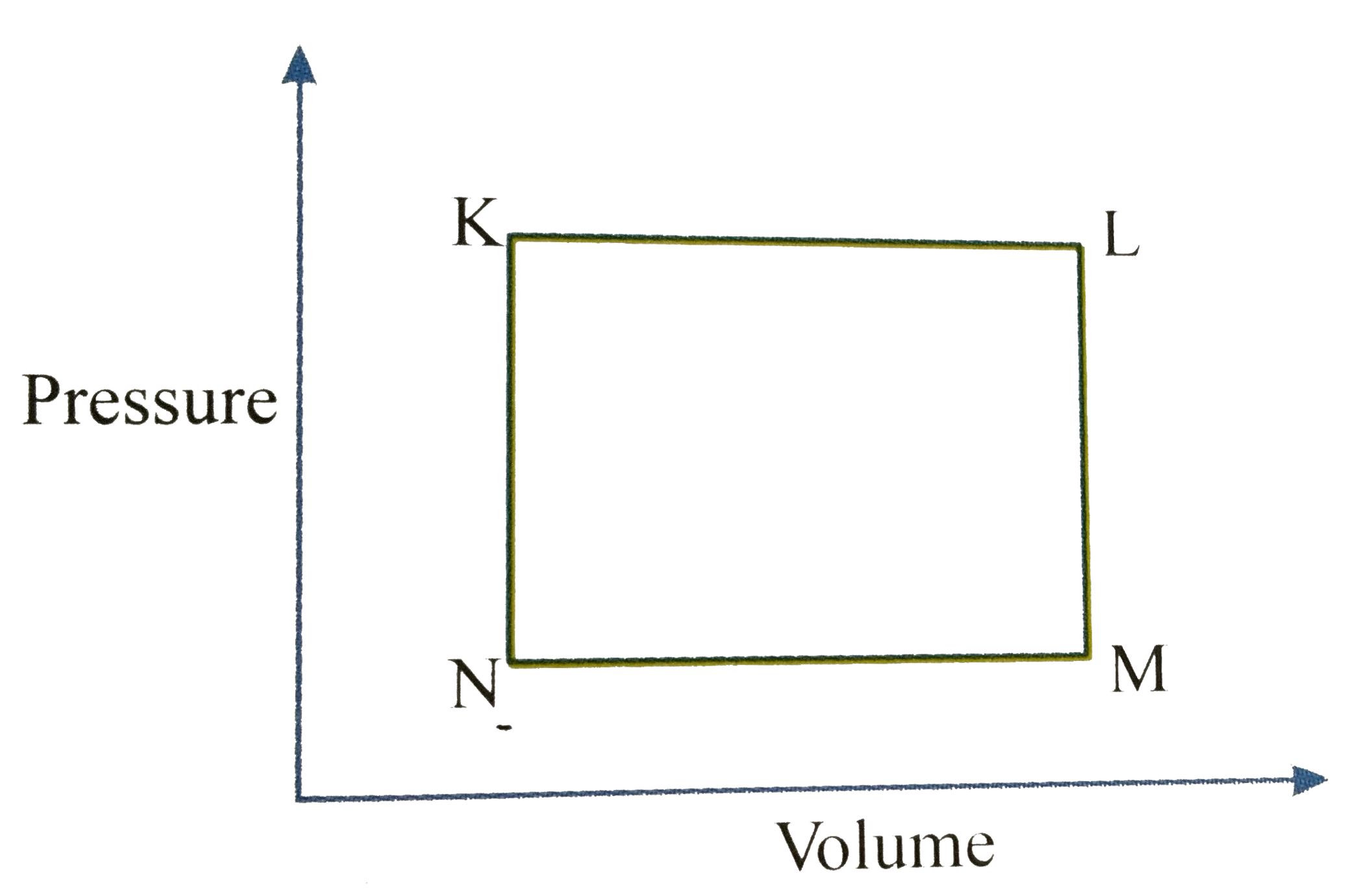
A fixed mass 'm' of a gas is subjected to transformation of states from K to L to M to N and back to K as shown in the figure

The pair of isochoric process among the tranformation of states is

A

K to L and L to M

B

L to M and N to K

C

L to M and M to N

D

M to N and N to K

Text Solution

Verified by Experts

The correct Answer is:

B

`L rarr M " & " N rarr K` are isochoric process
Promotional Banner

Topper's Solved these Questions

  • THERMODYNAMICS

    NARAYNA|Exercise Passages|13 Videos
  • THERMODYNAMICS

    NARAYNA|Exercise Matching type|6 Videos
  • THERMODYNAMICS

    NARAYNA|Exercise Level -V|106 Videos
  • STRUCTURE OF ATOM

    NARAYNA|Exercise EXERCISE - IV EXEMPLAR PROBLEMS|24 Videos

Similar Questions

Explore conceptually related problems

A fixed mass m of a gas is subjected to transfromation of states from K to L to M and back to K as shown in the figure. The pair of isochoric processes among the transfromation of states is

The pair of isochoric among the transformation of state is :

A fixed mass m of a gas is subjected to transformation of states from K to L to M to N and back to K as shown in the figure. The succeeding operation that enable this transformation of state are

A fixed mass m of a gas is subjected to transformation of state: K to L to M and black to K as shown in the figure. The succeeding operations that enabel this transformation of state are

An ideal gas goes from the state i to the state int as shown in .the work done by the gas during the process

A block of mass m compresses a spring iof stifffness k through a distacne l//2 as shown in the figure .If the block is not fixed to the spring the period of motion of the block is

A gas has been subjected to a cycle of isochoric, isothermal process 1-2-3-4-1 as shown in the figure. The graph for this cycle on P-T diagram is

An ideal gas change from state a to state b as shown in Fig. what is the work done by the gas in the process?

NARAYNA-THERMODYNAMICS-Level-VI
  1. Benzene and naphthalene form an ideal solution at room temperature. Fo...

    Text Solution

    |

  2. A fixed mass m of a gas is subjected to transformation of state: K to ...

    Text Solution

    |

  3. A fixed mass 'm' of a gas is subjected to transformation of states fro...

    Text Solution

    |

  4. One mole of a monatomic ideal gas is taken through a cycle ABCDA as s...

    Text Solution

    |

  5. Match the transformations In column I with appropriate options in colu...

    Text Solution

    |

  6. Assertion (A): The endothermic reactions are favoured at lower tempera...

    Text Solution

    |

  7. Assertion: The heat absorbed during the isothermal expansion of an ide...

    Text Solution

    |

  8. Assertion (A): For every chemical reaction at equilibrium, standard Gi...

    Text Solution

    |

  9. Statement-1: There is a natural asymmetry between work to heat and con...

    Text Solution

    |

  10. One mole of an ideal gas is taken from a to b along two paths denoted ...

    Text Solution

    |

  11. For a liquid the vapour pressure is given by "log"(10) P = (-400)/(T) ...

    Text Solution

    |

  12. A system is said to be………..if it can neither exchange matter nor energ...

    Text Solution

    |

  13. The heat content of the products is more than that of the reactants in...

    Text Solution

    |

  14. Enthalpy is an ……………….. property.

    Text Solution

    |

  15. The first law of thermodynamics is not adequate in predicting the dire...

    Text Solution

    |

  16. Heat capacity of a diatomic gas is higher than that of a monoatomic ga...

    Text Solution

    |

  17. An athelete is given 100g of glucose (C(6)H(12)O(6)) of energy equival...

    Text Solution

    |

  18. The standard ethelpy of combustion at 25^(@)C of hydrogen, cyclohexene...

    Text Solution

    |

  19. Using the data (all values are in kilocalorie per mole at 25^(@)C) giv...

    Text Solution

    |

  20. A gas mixture of 3.67L of ethylene and methane on complete combustion ...

    Text Solution

    |
