Home
Class 12
PHYSICS
Three small conducting spheres each of r...

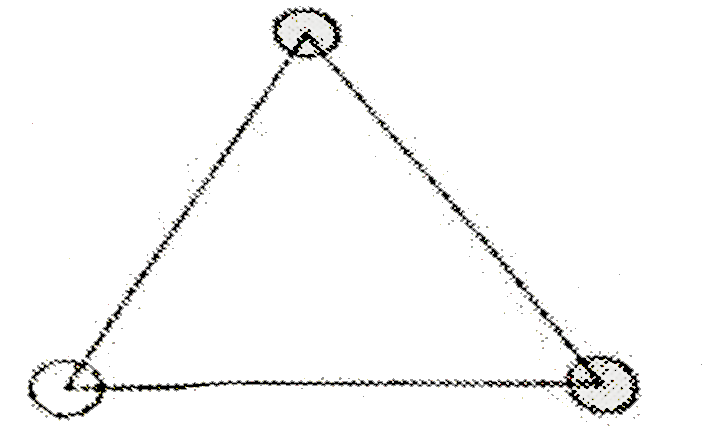
Three small conducting spheres each of radius a and charge q is placed at the corners of an equilateral triangle of side lenth /. The side lenth / is considerably larger than dimensions of the spheres. Find the electrical potential energy of system.

A

`(3q^(2))/(4piepsi_(0))((1)/(2a)+(1)/(/))`

B

`(3q^(2))/(4piepsi_(0)l)

C

`(3q^(2))/(8piepsi_(0)a)`

D

None of these

Text Solution

Verified by Experts

figure
Promotional Banner

Topper's Solved these Questions

  • GAUSS LAW AND ELECTRIC POTENTIAL THEORY

    BITSAT GUIDE|Exercise BITSTAT ARCHIVES|4 Videos
  • FLUID MECHANICS

    BITSAT GUIDE|Exercise BITSAT Achives|15 Videos
  • MAGNETIC FIELD

    BITSAT GUIDE|Exercise All Questions|52 Videos

Similar Questions

Explore conceptually related problems

Three points charges are placed at the corners of an equilateral triangle of side L as shown in the figure:

Charge of 5 mu C each are placed at the corners of an equilateral triangle of side 10 cm. Then the force on each charge is :-

Three charges each 20muC are placed at the corners of an equilateral triangle of side 0.4m The potential energy of the system is

Three particle each of mass m are placed at the corners of equilateral triangle of side l Which of the following is/are correct ?

Three identical point charges Q are placed at the three corners of an equilateral triangle of side length a. Find the electric potential at points O and M due to the three charges.

Three point charges 3nC, 6nC and 6nC are placed at the corners of an equilateral triangle of side 0.1 m. The potential energy of the system is

Three equal charges Q are placed at the three corners of an equilateral triangle of side length a. Work done in shifting a charge q from infinity to the centroid of the triangle is

Consider the charges q,q and -q placed at the vertices of an equilateral triangle of each side l. What is the force on each charge ?

Three point masses, each of mass m , are placed at the corners of an equilateral triangle of side L . The moment of inertia of this system about an axis along one side of the triangle is

