Home
Class 12
PHYSICS
Two point charge q(1) = -10xx10^(-6) C "...

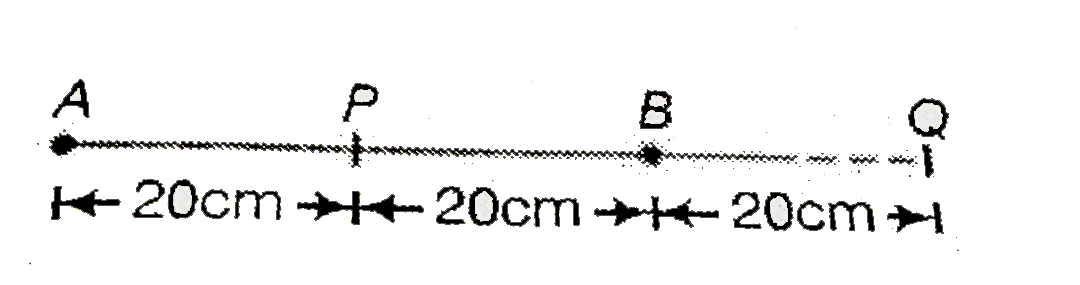
Two point charge `q_(1) = -10xx10^(-6) C " and "q_(2)=15xx10^(-6)` are 40 cm apart as shown in figure. Find the potential difference between the point P and Q.

A

`-945xx10^(3)` V

B

`-1000xx10^(3)` V

C

`-880xx10^(3)` V

D

None of these

Text Solution

Verified by Experts

Promotional Banner

Topper's Solved these Questions

  • GAUSS LAW AND ELECTRIC POTENTIAL THEORY

    BITSAT GUIDE|Exercise BITSTAT ARCHIVES|4 Videos
  • FLUID MECHANICS

    BITSAT GUIDE|Exercise BITSAT Achives|15 Videos
  • MAGNETIC FIELD

    BITSAT GUIDE|Exercise All Questions|52 Videos

Similar Questions

Explore conceptually related problems

Two point charges q_(1)=2xx10^(-3) C and q_(2)=-3xx10^(-6) C are separated by a distance x = 10 cm. Find the magnitude and nature of the force between the two charges.

If point charges Q_(1) = 2xx 10^(-7) C and Q_(2) = 3 xx 10^(-7) C are at 30 cm separation, then find electrostatic force between them

Two point charges, q_(1)=10xx10^(-8)C and q_(2)=-2xx10-8C are separated by a distance of 60 cm in air. (i) Find at what distance from the 1st charge, q_(1) , would the electric potential be zero. (ii) Also calculate the electrostatic potential energy of the system.

Two charges q_(1)=+2xx10^(-8)C and q_(3)=-0.4xx10^(-8)C are placed 60cm apart, as shown in fig. A third charge q_(3)=+0.2xx10^(-8)C is moved along the arc of a circle of radius 80 cm from C to D. Compute the percentage change in the energy of the system.

Two point charges 20xx10^(-6)C and -4xx10^(-6)C are separated by a distance of 50cm in air, Find (i) the point on line joining the charges, where the electrostatic potential is zero (ii) Also, Calculate the electrostatic potential energy of the system.

In an isolated parallel plate capacitor of capacitance C the four surfaces have charges Q_(1), Q_(2), Q_(3) and Q_(4) as shown in the figure. The potential difference between the plates is :

Two point charges +10^(-7) C and -10^(-7)C are placed at A and B 20 cm apart as shown in the figure. Calculate the electric field at C, 20 cm apart from both A and B.

