Home
Class 12
PHYSICS
Two positively charged particles each ha...

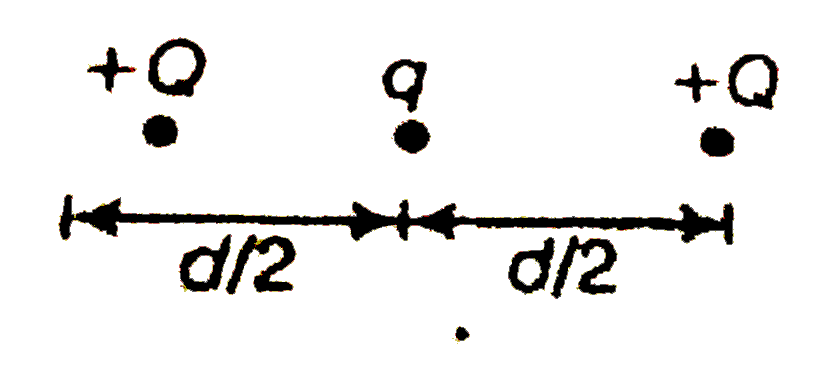
Two positively charged particles each having charge `Q` and are `d` distance apart. A third charge is introduced in midway on the line joining the two charges. Find the nature and magnitude of third charge so that the system is in equilibrium.

A

`q=(Q)/4`

B

`q=Q/4`

C

`q=(3Q)/4`

D

`q=-(3Q)/4`

Text Solution

Verified by Experts

(a) Condition for equilibrium
`(kQ^(2))/(d^(2))+(kqQ)/((d//2)^(2))=0implies(kQ)/(d^(2))(Q+4q)=0`
`q=(-Q)/4`
Promotional Banner

Topper's Solved these Questions

  • ELECTRIC CAPACITOR

    BITSAT GUIDE|Exercise BITSAT archives|6 Videos
  • ELECTROMAGNETIC INDUCTION

    BITSAT GUIDE|Exercise All Questions|33 Videos

Similar Questions

Explore conceptually related problems

Two point charges +9e and +e are kept at a distance 'a' from each other. A third charge is placed at a distance 'x' from +9e on the line joining the above two charges. For the third charge to be in equilibrium 'x' is

Two particles (free to move) with charges +q and +4q are a distance L apart. A third charge is placed so that the entire system is in equilibrium. (a) Find the location, magnitude and sign of the third charge. (b) Show that the equilibrium is unstable.

Two equal charges, +Q each, are at a distance r from each other. A third charge is placed on the line joining the above two charges such that all these charges are in equilibrium. Find q, in terms of Q.

Two point charges +q and -q are placed a distance x apart. A third charge is so placed that al the three charges are in equilibrium. Then

Two point charges+ q and-q are placed at distanced apart. What are the points at which the resultant field is parallel to the line joining the two charges ?

Two charges -10C and + 10 C are placed 10 cm apart. Potential at the centre of the line joining the two charges is

Two force point charges +q and +4q are a distance l apart. A third charge q_(1) is so placed that the entire system is in equilibrium. Find the location, magnitude and sign of the third charge.

Two point charges +4q and +q are placed at a distance L apart. A third charge Q is so placed that all the three charges are in equilibrium. Then location. And magnitude of the third charge will be

A particle of mass m and charge +q is located midway between two fixed charged particles each having a charge +q and at a distance 2L apart. Assuming that the middle charge moves along the line joining the fixed charges, calculate the frequency of oscillation when it is displaced slightly.

Two fixed charges are as shown. Where should the third charge be placed so that its in equilibrium?

BITSAT GUIDE-ELECTRIC CHARGE-All Questions
  1. A sure test of electification is

    Text Solution

    |

  2. In relativistic mechanics m=(m(0))/(sqrt((1-(v^(2))/(c^(2)))) the equi...

    Text Solution

    |

  3. Two positively charged particles each having charge Q and are d distan...

    Text Solution

    |

  4. As shown in the adjoining figure two charge particles each having char...

    Text Solution

    |

  5. Charge +2Q and -Q are placed as shown in figure. The point at which ...

    Text Solution

    |

  6. Two equal and oppositely charged particles are kept at some distance a...

    Text Solution

    |

  7. Two bodies A and B of definite shape are placed near one another. Elec...

    Text Solution

    |

  8. If sigma= surface charge density epsilon= electric ermittivity the dim...

    Text Solution

    |

  9. What is the magnitude of a point charge due to which the electric fiel...

    Text Solution

    |

  10. A charged particle of mass m and charge q is released from rest the po...

    Text Solution

    |

  11. An infinite plane sheet of positive charge has surface charge density ...

    Text Solution

    |

  12. A dimensionless body having a phsical quantity varies as 1//r^(2), whe...

    Text Solution

    |

  13. The electric field inside a conductor

    Text Solution

    |

  14. A point charge Q is situated at point B on the ground. A point charge ...

    Text Solution

    |

  15. Two point charges q(1) and q(2) are released from rest in a gravity fr...

    Text Solution

    |

  16. Six point charges are arrange at the vertices of a regular hexagon of ...

    Text Solution

    |

  17. A positive charged particle P enters the region between two parallel p...

    Text Solution

    |

  18. A point charge Q is placed at the centre of a circular wire of radius ...

    Text Solution

    |

  19. A small element l cut from a circular ring of radius a and lamda charg...

    Text Solution

    |

  20. A circular ring carries a uniformly distributed positive charge and li...

    Text Solution

    |

