Home
Class 12
CHEMISTRY
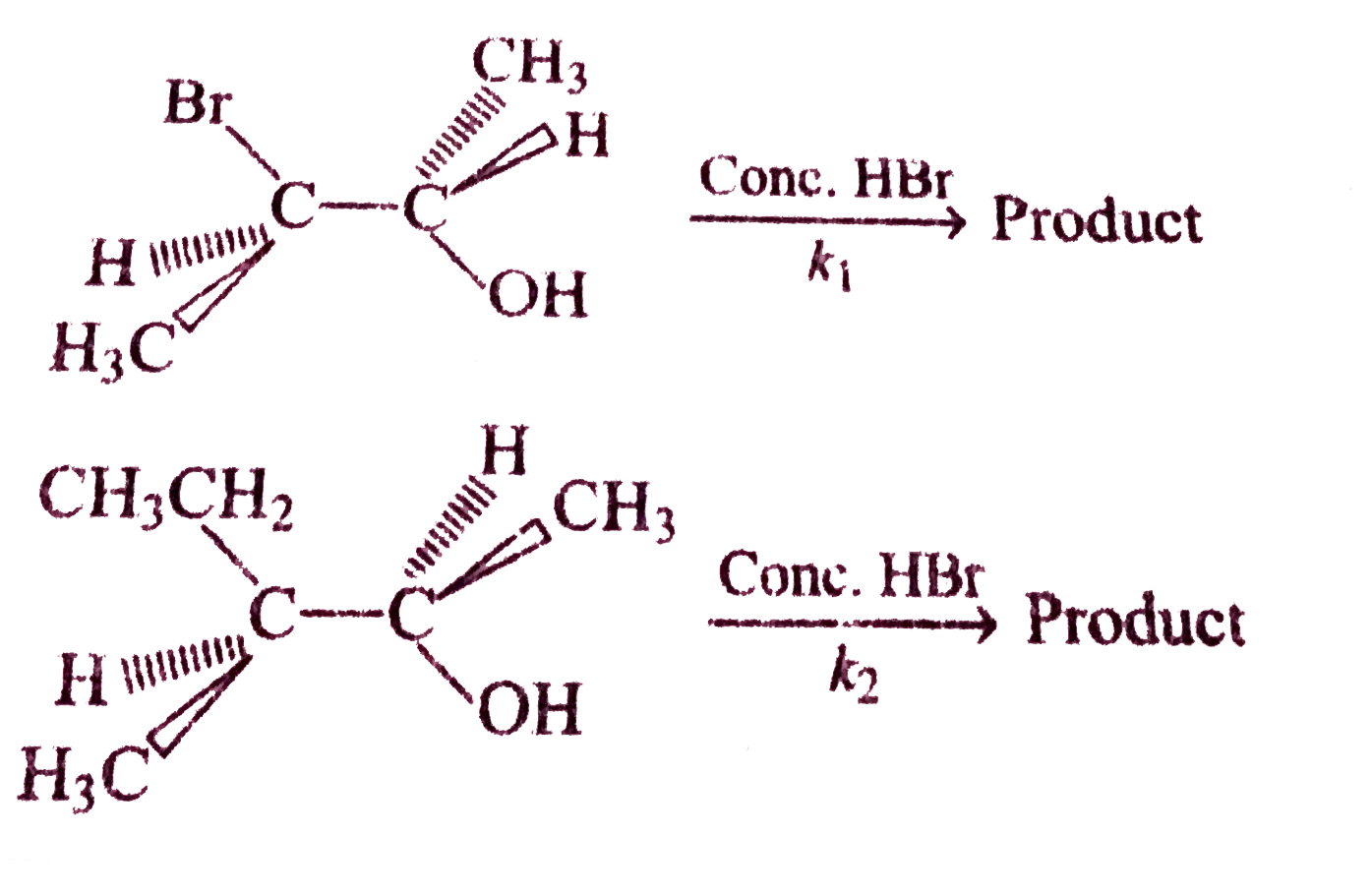
-OH group is substituted by -Br. The slo...


-OH group is substituted by -Br. The slowest step is dehydration. Which of the following is correct comparison of rate constant `K_(1) and K_(2)`?

A

`k_(1)=k_(2)`

B

`k_(1)gtk_(2)`

C

`k_(1)ltk_(2)`

D

cannot be predict

Text Solution

Verified by Experts

The correct Answer is:

C
Promotional Banner

Similar Questions

Explore conceptually related problems

The forward reaction rate for the nitric oxide-oxygen reaction 2NO+O_(2) rarr 2NO_(2) has the rate law as: Rate = k[NO]^(2)[O_(2)] . If the mechanism is assumed to be: 2NO+O overset(k_(eq))hArr , (rapid equilibration) N_(2)O_(2) + O_(2) overset(k_(2))rarr 2NO_(2) (slow step), then which of the following is (are) correct? (I) Rate constant = k_(eq)k_(2) , (II) [N_(2)O_(2)] = k_(eq)[NO]^(2) (III) [N_(2)O_(2)] = k_(eq)[NO] , (IV) Rate constant = k_(2) The correct option is

which of the following option is correct with respect to comparison of Henry's constant K_(H) of different gases at different temperatures?

The rate and mechamical reaction are studied in chemical kinetics. The elementary reactions are single step reaction having no mechanism. The order of reaction and molecularity are same for elementary reactions. The rate of forward reaction aA + bBrarr cC+dD is given as: rate =((dx)/(dt))=-1/a(d[A])/(dt)=-1/b(d[B])/(dt)=1/c(d[C])/(dt)=1/d(d[D])/(dt) or expression can be written as : rate =K_(1)[A]^(a)[B]^(b)-K_(2)[C]^(c )[D]^(d) . At equilibrium, rate = 0 . The constants K, K_(1), K_(2) are rate constants of respective reaction. In case of reactions governed by two or more steps reaction mechanism, the rate is given by the slowest step of mechanism. At the point of intersection of the two curve shown for the reaction: Ararr nB the concentration of B is given by:

The rate and mechamical reaction are studied in chemical kinetics. The elementary reactions are single step reaction having no mechanism. The order of reaction and molecularity are same for elementary reactions. The rate of forward reaction aA + bBrarr cC+dD is given as: rate =((dx)/(dt))=-1/a(d[A])/(dt)=-1/b(d[B])/(dt)=1/c(d[C])/(dt)=1/d(d[D])/(dt) or expression can be written as : rate =K_(1)[A]^(a)[B]^(b)-K_(2)[C]^(c )[D]^(d) . At equilibrium, rate = 0 . The constants K, K_(1), K_(2) are rate constants of respective reaction. In case of reactions governed by two or more steps reaction mechanism, the rate is given by the slowest step of mechanism. The rate of formation of SO_(3) in the following reaction, 2SO_(2)+O_(2)rarr 2SO_(3) is 10 g sec^(-1) The rate of disappearance of O_(2) will be:

The rate law expresison is given for a typical reaction, n_(1)A + n_(2) B rarrP as r = k[A]^(n)[B]^(n2) . The reaction completes only in one step and A and B are present in the solution. If the reaction occurs in more than one step, then the rate law is expressed by consdering the slowest step, i.e., for S_(N)l reaction r = k[RX] . If the eraction occurs in more than one step and the rates of the steps involved are comparable, then steady state approximation is conisdered, i.e., the rate of formation of intermediate is always equal to the rate of decompoistion of the intermediate. Conisder the reaction: [[I_(2) underset(k_(1))overset(k_(2))hArr2I("rapid equilibrium")],[H_(2)+2I overset(k_(3))rarr 2HI("slow")]] Which of the following expresison is correct?

The rate law expresison is given for a typical reaction, n_(1)A + n_(2) B rarrP as r = k[A]^(n)[B]^(n2) . The reaction completes only in one step and A and B are present in the solution. If the reaction occurs in more than one step, then the rate law is expressed by consdering the slowest step, i.e., for S_(N)l reaction r = k[RX] . If the eraction occurs in more than one step and the rates of the steps involved are comparable, then steady state approximation is conisdered, i.e., the rate of formation of intermediate is always equal to the rate of decompoistion of the intermediate. Conisder the reaction: [[I_(2) underset(k_(1))overset(k_(2))hArr2I("rapid equilibrium")],[H_(2)+2I overset(k_(3))rarr 2HI("slow")]] If we increase the concentration of I_(2) two times, then the rate of formation of HI will

The rate and mechamical reaction are studied in chemical kinetics. The elementary reactions are single step reaction having no mechanism. The order of reaction and molecularity are same for elementary reactions. The rate of forward reaction aA + bBrarr cC+dD is given as: rate =((dx)/(dt))=-1/a(d[A])/(dt)=-1/b(d[B])/(dt)=1/c(d[C])/(dt)=1/d(d[D])/(dt) or expression can be written as : rate =K_(1)[A]^(a)[B]^(b)-K_(2)[C]^(c )[D]^(d) . At equilibrium, rate = 0 . The constants K, K_(1), K_(2) are rate constants of respective reaction. In case of reactions governed by two or more steps reaction mechanism, the rate is given by the slowest step of mechanism. For the reaction, 2NO+Br_(2) hArr 2NOBr , the mechanism is given in two steps: (1) NO+Br_(2) overset("fast")(hArr)NOBr_(2) (2) NOBr_(2)+NO overset("slow")(rarr)2NOBr The rate expression for the reaction is:

K_(a_(1)), K_(a_(2)) and K_(a_(3)) are the three dissociation constants of H_3PO_4 . Which of the following is a correct order
