

Home
Class 12
CHEMISTRY
a. For the reaction Given : Ag^(o+)(aq...

a. For the reaction
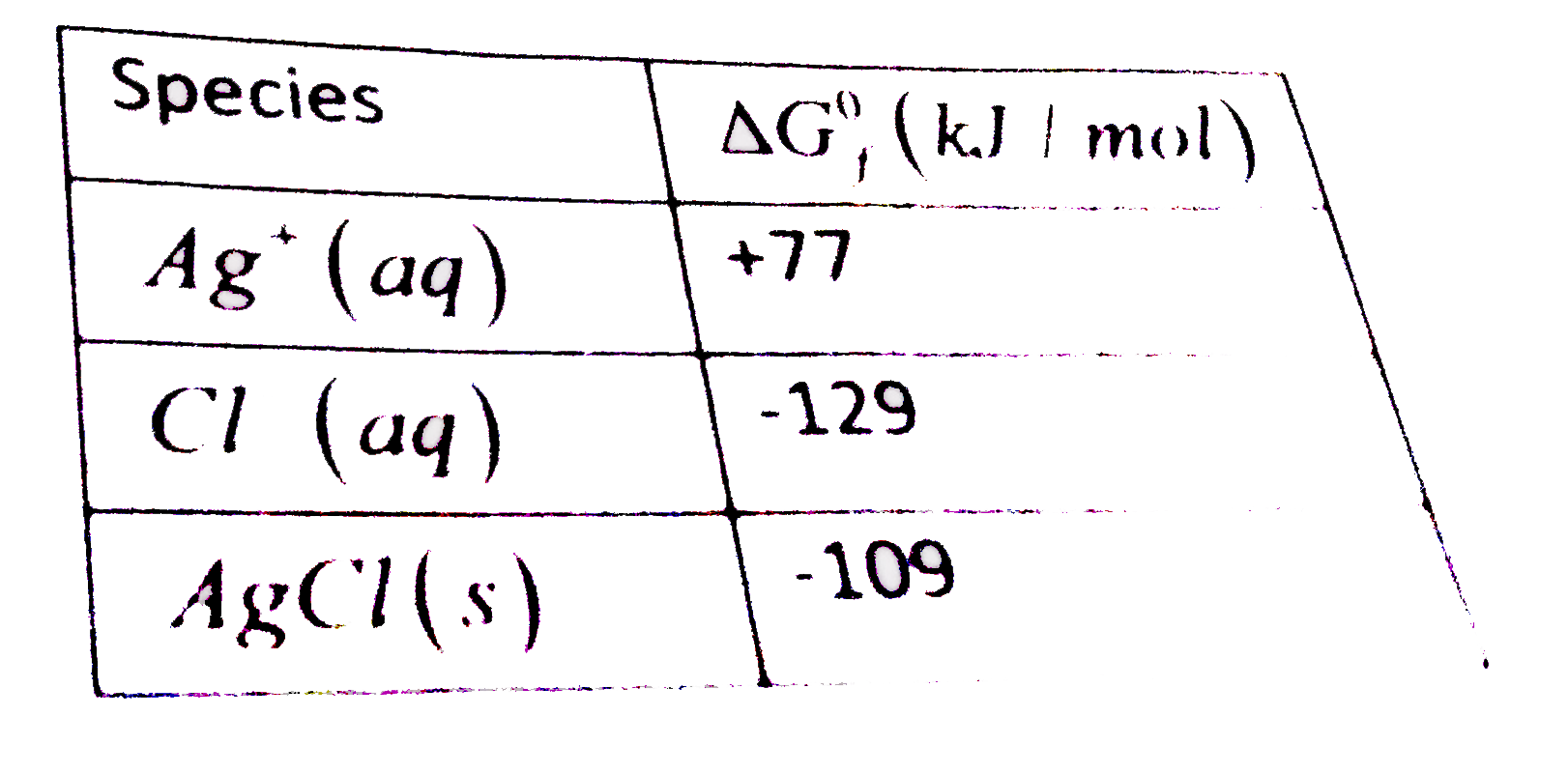
Given : `Ag^(o+)(aq)+Cl^(o+)(aq)rarr AgCl(s)`

Write the cell representation of above reaction and calculat `E_("cell")^(@)` at 298K.
Also find the solubility product of AgCl.
b. If `6.539xx10^(-2)g` of metallic zinc is added to 100ml saturated solution of AgCl. Find the value of
`log_(10).([Zn^(2+)])/([Ag^(+)]^(2))`
How many moles of Ag will be preciptated in the above reaction. Given that
`Ag^(+)+e^(-)rarrAg, E^(@)=0.80V`
`Zn^(2+)+2e^(-)rarr Zn,E^(@)=-0.76V`

Text Solution

Verified by Experts

a From the given details, the reactions can be written as: At anode:
`Ag(s) +Cl^(-)(aq) rarr AgCl (s)+e^(-)`
At anode: `Ag^(+)(aq) +e^(-) rarr Ag(s)`
Complete reaction
`Ag^(+)(aq)+Cl^(-)(aq) rarr AgCl (s)`
Hence cell representation is
`Ag(s)//AgCl//Cl^(-)(aq)//Ag^(+)(aq)//Ag(s)`
`DeltaG^(@) = DeltaG_(f)^(@) (AgCl) -[DeltaG_(f)^(@) (Ag^(+))+DeltaG_(f)^(@) (Cl^(-))]`
`=- 109 - (-129 +77) =- 57 kJ//mol`
We know that `DeltaG^(@) =- nFE_(cell)^(@)`
`-57000 = - 1 xx 96500 xx E_(cell)^(@)`
`( :. n=` electron transferred = 1)
`E_(cell)^(@) = (57000)/(96500) = 0.59` volts
Again `E_(cell)^(@) = (0.0591)/(n)logK_(c)`
or `K_(cell)^(@) = (0.0591)/(1)log.(AgCl)/([Ag^(+)][Cl^(-)])`
`E_(cell)^(@) = (0.0591)/(1)log ((1)/(k_(sp)))`
`:. k_(sp) = 10^(-10)`
b. When Zn is added to 100ml of saturated `AgCl` solution.
`2Ag^(+) + Zn(s) underset(larr)(rarr)2Ag(s) + Zn^(2+)`
`Ag^(+) +e^(-) underset(larr)(rarr)Ag: E^(@) = 0.80V`
`Zn^(2+) +2e^(-) underset(larr)(rarr) Zn, E^(@) =- 0.76V`
`E_(cell)^(@) = E_(Ag^(+)(s))^(@) - E_(Zn^(2+)//ZN(s))^(@) = 1.56V`
`E_(cell)^(@) = (0.059)/(n)log_(10). ([Zn^(2+)])/([Ag^(+)]^(2))`
`rArr 1.56 = (0.059)/(2)log_(10).([Zn^(2+)])/([Ag^(+)]^(2))`
`rArr log_(10).([Zn^(2+)])/([Ag+]^(2)) = 52.9`
As the value of equilibrium constant is very high so the reaction moves in forward direction completely.
`[Ag^(+)]` from `(a) = sqrt(10^(-10)) = 10^(-5)`
`[ : K_(sp) = 10^(-10) = [Ag^(+)] [Cl^(-)]]`
`:. Ag^(+)` in 100ml of solution
`= (10^(-5) xx 100)/(1000) = 10^(-6) mol`
Promotional Banner

Topper's Solved these Questions

  • ELECTRO CHEMISTRY

    NARAYNA|Exercise LEVEL-VI|71 Videos
  • 15TH GROUP ELEMENTS

    NARAYNA|Exercise EXERCISE - 4 (NCERT EXEMPLERS/HOTs)|27 Videos

Similar Questions

Explore conceptually related problems

The cell reaction Zn(s)+2Ag^(+)(aq)rarrZn^(2+)(aq)+Ag(s) is best represented by

NARAYNA- ELECTRO CHEMISTRY-SUBJECTIVE QUESTIONS
  1. Two students use same stock solution of ZnSO(4) and a solution of CuSO...

    Text Solution

    |

  2. Find the equilibrium constant that the reaction In^(2+)+Cu^(2+)under...

    Text Solution

    |

  3. a. For the reaction Given : Ag^(o+)(aq)+Cl^(o+)(aq)rarr AgCl(s) ...

    Text Solution

    |

  4. We have taken a saturated solution of AgBr,K(sp) of AgBr is 12xx10^(-1...

    Text Solution

    |

  5. Tollen reagent is used for the detection of aldehydes. When a solution...

    Text Solution

    |

  6. Tollen reagent is used for the detection of aldehydes. When a solution...

    Text Solution

    |

  7. Tollen reagent is used for the detection of aldehydes. When a solution...

    Text Solution

    |

  8. Redox reactions play a pivotal role in chemistry and biology. The valu...

    Text Solution

    |

  9. Redox reactions play a pivotal role in chemistry and biology. The valu...

    Text Solution

    |

  10. Redox reactions play a pivotal role in chemistry and biology. The valu...

    Text Solution

    |

  11. The concentration of potassium ions inside a biological cell is at lea...

    Text Solution

    |

  12. The concentration of potassium ions inside a biological cell is at lea...

    Text Solution

    |

  13. The electrochemical cell shown below is a concentration cell M//M^(...

    Text Solution

    |

  14. The electrochemical cell shown below is a concentration cell. M|M^(2+)...

    Text Solution

    |

  15. Cd amalgam is prepared by electrolysis of a solution of CdCl(2) using ...

    Text Solution

    |

  16. The standard oxidation potential of Ni//Ni^(2+) electrode is 0.236V. I...

    Text Solution

    |

  17. Molar conductance of saturated BaSO(4) solution is 400 ohm^(-1)cm^(2)m...

    Text Solution

    |

  18. At equimolar concentration of Fe^(+2)//Fe^(+3), what must [Ag^(+)] be ...

    Text Solution

    |

  19. 3 ampere current was passed through an aqueous solution of an unknown ...

    Text Solution

    |

  20. An aqeous solution of X is added slowly to an aqueous solution of Y as...

    Text Solution

    |