Home
Class 12
CHEMISTRY
An aqeous solution of X is added slowly ...

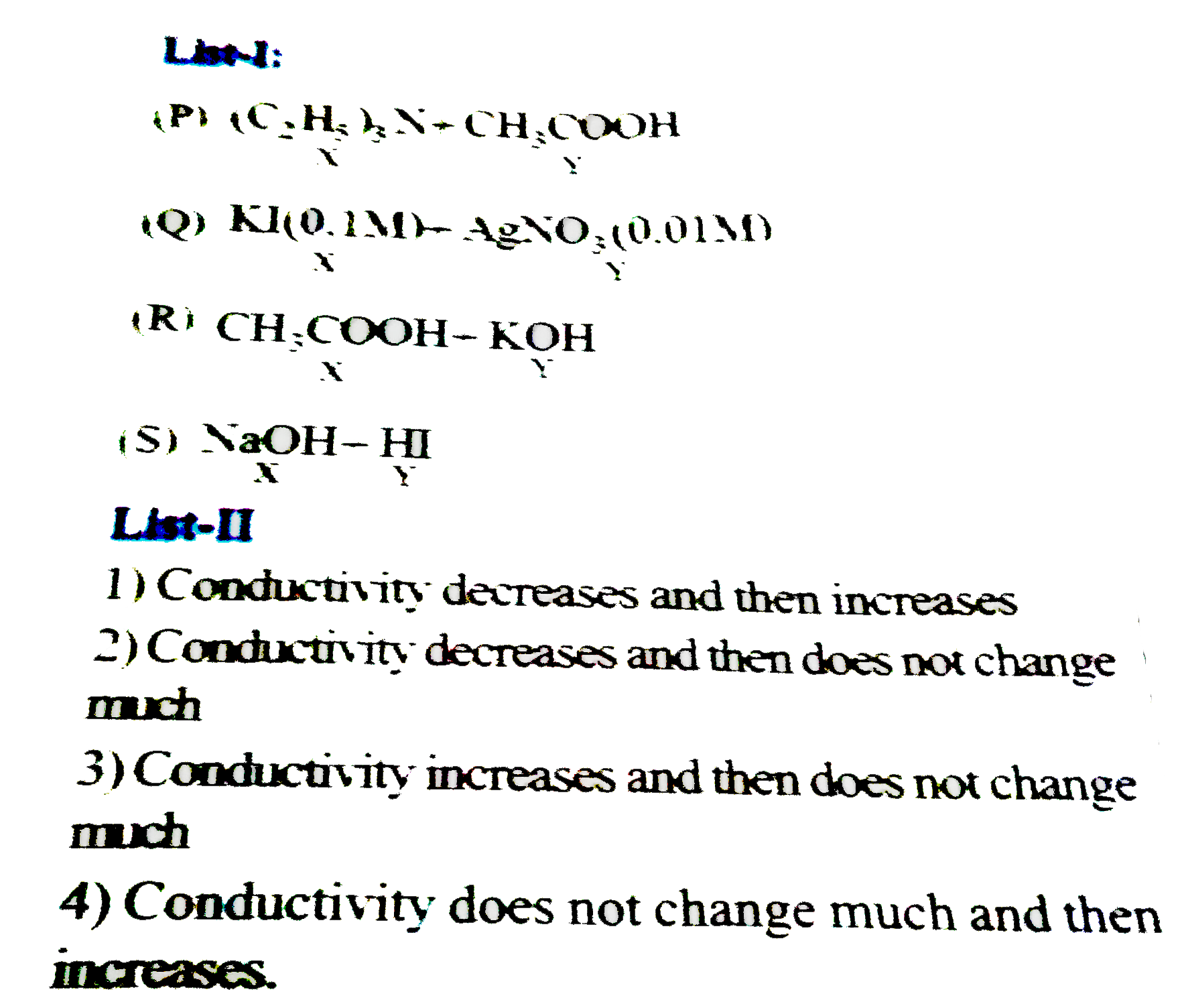
An aqeous solution of X is added slowly to an aqueous solution of Y as shown in List-I. The variation in conductivity of these reaction in List-II. Match List-I with List-II and select the correct answer using the code given below the lists:

A

`{:(P,Q,R,S),(3,4,2,1):}`

B

`{:(P,Q,R,S),(4,3,2,1):}`

C

`{:(P,Q,R,S),(2,3,4,1):}`

D

`{:(P,Q,R,S),(1,4,3,2):}`

Text Solution

Verified by Experts

The correct Answer is:

A

`(P) underset(x)(C_(2)H_(5))_(3) N + underset(Y)(CH_(3)COOH)rarr (C_(2)H_(5))_(3) NHCH_(3) COO^(-)`
Initially conductivity increases due to ion formation after that it becomes practially constant because X alone can not form ions. Hence (3) is the correct match.
`(Q) underset(x)(Ki(0.1M))+underset(Y)(AgNO_(3)(0.01M))rarr AgI darr +KNO_(3)`
Number of ions in the solution remains constant until all the `AgNO_(3)` precipitated as `AgI`. therefore conductance increases due to increase in number of ions. Hence (4) is correct match. (R) Initially conductance decreases due to the decrease in the number of `bar(O)H` ions tthereafter it slowly increases due to the increases in number of `H^(+)` ions. Hence (2) is the correct match. (S) Initially it decreases due to decrease in `H^(+)` ions and then increases due to the increases in `bar(O)H` ions. Hence (1) is the correct match.
Promotional Banner

Topper's Solved these Questions

  • ELECTRO CHEMISTRY

    NARAYNA|Exercise LEVEL-VI|71 Videos
  • 15TH GROUP ELEMENTS

    NARAYNA|Exercise EXERCISE - 4 (NCERT EXEMPLERS/HOTs)|27 Videos

Similar Questions

Explore conceptually related problems

Match List-I with List-II and select the correct answer using the codes given below the lists:

Match List-I with List-II and select the correct answer using the codes given below the lists:

Match List-I with List-II and select the correct answer using the codes given below the lists:

Match List-I with List-II and select the correct answer using the codes given below the lists:

Match List-I with List-II and select the correct answer using the codes given below the lists:

Match List-I with List-II and select the correct answer using the codes given below the lists:

Match List-I with List-II and select the correct answer using the codes given below the lists:

Match List-I with List-II and select the correct answer using the codes given below the lists

NARAYNA- ELECTRO CHEMISTRY-SUBJECTIVE QUESTIONS
  1. Find the equilibrium constant that the reaction In^(2+)+Cu^(2+)under...

    Text Solution

    |

  2. a. For the reaction Given : Ag^(o+)(aq)+Cl^(o+)(aq)rarr AgCl(s) ...

    Text Solution

    |

  3. We have taken a saturated solution of AgBr,K(sp) of AgBr is 12xx10^(-1...

    Text Solution

    |

  4. Tollen reagent is used for the detection of aldehydes. When a solution...

    Text Solution

    |

  5. Tollen reagent is used for the detection of aldehydes. When a solution...

    Text Solution

    |

  6. Tollen reagent is used for the detection of aldehydes. When a solution...

    Text Solution

    |

  7. Redox reactions play a pivotal role in chemistry and biology. The valu...

    Text Solution

    |

  8. Redox reactions play a pivotal role in chemistry and biology. The valu...

    Text Solution

    |

  9. Redox reactions play a pivotal role in chemistry and biology. The valu...

    Text Solution

    |

  10. The concentration of potassium ions inside a biological cell is at lea...

    Text Solution

    |

  11. The concentration of potassium ions inside a biological cell is at lea...

    Text Solution

    |

  12. The electrochemical cell shown below is a concentration cell M//M^(...

    Text Solution

    |

  13. The electrochemical cell shown below is a concentration cell. M|M^(2+)...

    Text Solution

    |

  14. Cd amalgam is prepared by electrolysis of a solution of CdCl(2) using ...

    Text Solution

    |

  15. The standard oxidation potential of Ni//Ni^(2+) electrode is 0.236V. I...

    Text Solution

    |

  16. Molar conductance of saturated BaSO(4) solution is 400 ohm^(-1)cm^(2)m...

    Text Solution

    |

  17. At equimolar concentration of Fe^(+2)//Fe^(+3), what must [Ag^(+)] be ...

    Text Solution

    |

  18. 3 ampere current was passed through an aqueous solution of an unknown ...

    Text Solution

    |

  19. An aqeous solution of X is added slowly to an aqueous solution of Y as...

    Text Solution

    |

  20. The standard reduction potential data at 25^(@)C is given below E^(@...

    Text Solution

    |
