Home
Class 12
CHEMISTRY
Double salts are addition compounds whic...

Double salts are addition compounds which lose their identity in aqueous solution whereas complexes which are also addition compounds do not lose their identity in aqueous solution. The coordination compounds show isomerism and find applications in photography, qualitative analysis, metallurgy, water purification and in the treatment of various diseases .
Which of the following statement is true for the complex `[Co(NH_(3))_(4)Br_(2)]NO_(2)` ?

A

It shows ionisation , linkage and geometrical isomerism.

B

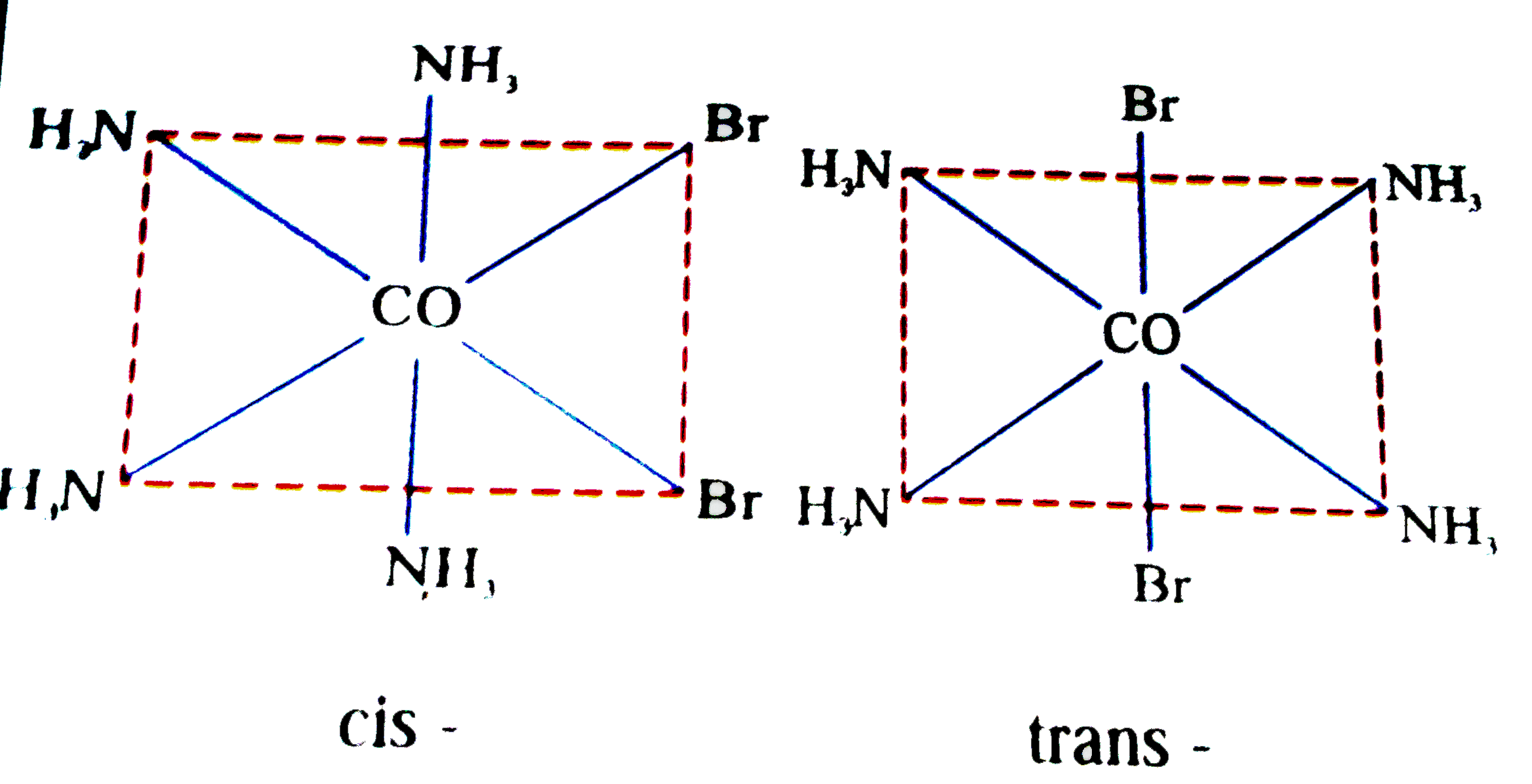
It does not show optical isomerism because its cis and trans forms each have at least one plane of symmetry.

C

Its ionisation isomers cannot be differenatiated symmetry

D

(A) and (B) both.

Text Solution

Verified by Experts

(D)
It shows geometrical isomerism but not optical isomerism due to the presence of at least one plane of symmetry.
`{Co(NH_(3))_(4)Br_(2)]NO_(2)` and `[Co(NH_(3))_(4)BrNO_(2)]` Br are isomers and later complex reacts with `AgNO_(3)` solution to give pale yellow ppt. `[Co(NH_(3))_(4)BrNO_(2)]Br `and `[Co(NH_(3))_(4)BrONO]Br` are linkage isomers.
Promotional Banner

Topper's Solved these Questions

  • COORDINATION COMPLEXES

    NARAYNA|Exercise Comprehension-2|3 Videos
  • COORDINATION COMPLEXES

    NARAYNA|Exercise Comprehension-3|3 Videos
  • COORDINATION COMPLEXES

    NARAYNA|Exercise EXERCISE-9|13 Videos
  • CO-ORDINATE COMPOUNDS

    NARAYNA|Exercise Exercise-4|60 Videos
  • D - BLOCK ELEMENTS

    NARAYNA|Exercise CHECK YOUR GRASP|7 Videos

Similar Questions

Explore conceptually related problems

Double salts are addition compounds which lose their identity in aqueous solution whereas complexes which are also addition compounds do not lose their identity in aqueous solution. The coordination compounds show isomerism and find applications in photography, qualitative analysis, metallurgy, water purification and in the treatment of various diseases . Which of the following statment is incorrect ?

Double salts are addition compounds which lose their identify in aqueous solution whereas complexes which are also addition compounds do not lose their identify in aqueous solution. The coordination compounds show isomerism and find application in photography , qualitative analysis, metallurgy, water purification and in the treatment of various diseases. Which of the following statement is true for the complex, [Co(NH_(3))_(4)Br_(2)]NO_(2) ?

Double salts are addition compounds which lose their identify in aqueous solution whereas complexes which are also addition compounds do not lose their identify in aqueous solution. The coordination compounds show isomerism and find application in photography , qualitative analysis, metallurgy, water purification and in the treatment of various diseases. Which of the following statement is incorrect ?

Double salts are addition compounds which lose their identity in aqueous solution whereas complexes which are also addition compounds do not lose their identity in aqueous solution. The coordination compounds show isomerism and find applications in photography, qualitative analysis, metallurgy, water purification and in the treatment of various diseases . Choose the correct option if the complex [PtCl_(2)(en)_(2)]^(2+) .

Double salts are addition compounds which lose their identity in aqueous solution whereas complexes which are also addition compounds do not lose their identity in aqeous solution. The coordination compounds show isomerism and find applications in photography , qualitative analysis, metallurgy , water purification and in the treatment of various diseases. Choose the correct option for the complex [PtCl_(2)(en)_(2)]^(2+)

Double salts are addition compounds which lose their identify in aqueous solution whereas complexes which are also addition compounds do not lose their identify in aqueous solution. The coordination compounds show isomerism and find application in photography , qualitative analysis, metallurgy, water purification and in the treatment of various diseases. Choose the correct option for the complex [Pt Cl_(2)(en)_(2)]^(2+) .