Home
Class 12
BIOLOGY
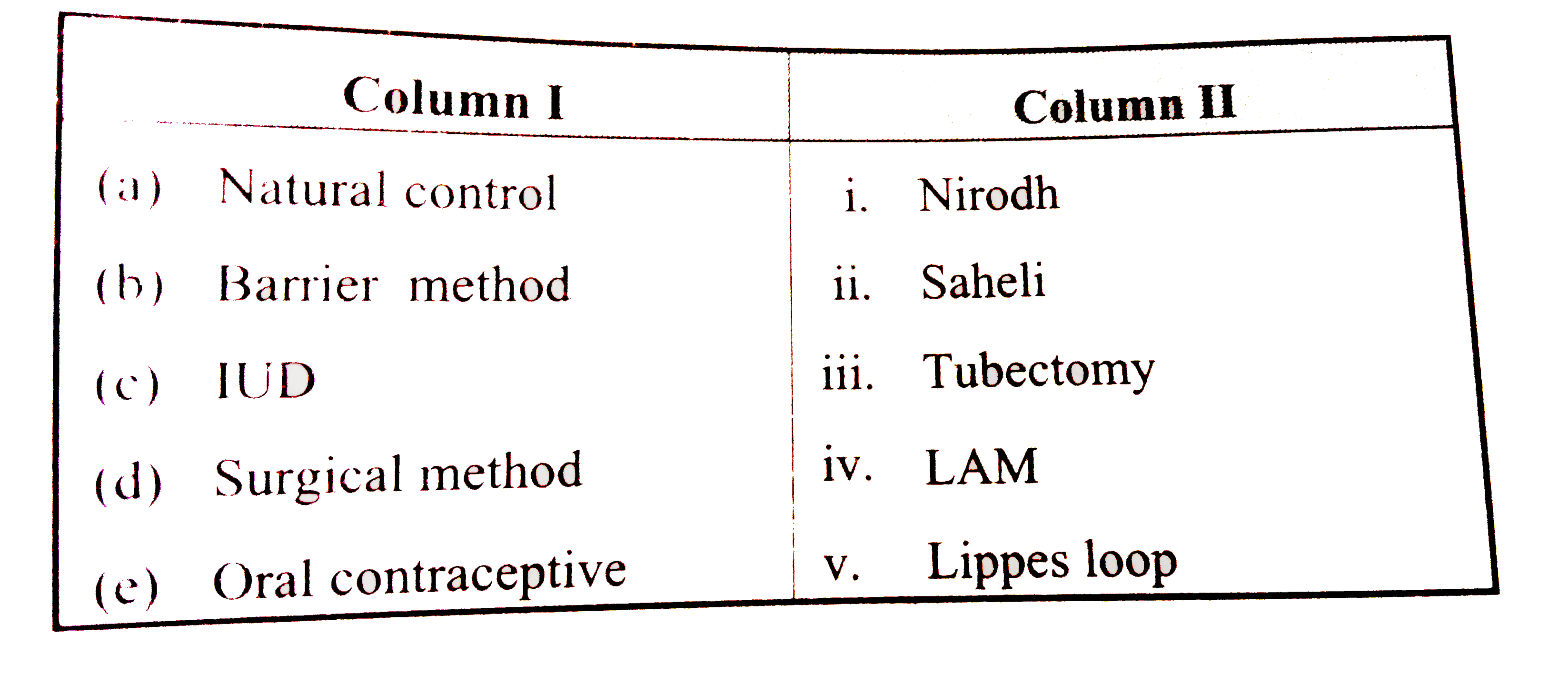
Match the column I with column II, choos...

Match the column I with column II, choose the answer which gives the correct combination of the two columns:

A

`{:("(a)","(b)","(c)","(d)","(e)"),("(ii)","(iv)","(v)","(iv)","(iii)"):}`

B

`{:("(a)","(b)","(c)","(d)","(e)"),("(ii)","(iv)","(iii)","(v)","(i)"):}`

C

`{:("(a)","(b)","(c)","(d)","(e)"),("(iv)","(i)","(v)","(iii)","(ii)"):}`

D

`{:("(a)","(b)","(c)","(d)","(e)"),("(iv)","(i)","(v)","(ii)","(iii)"):}`

Text Solution

Verified by Experts

The correct Answer is:

C
Promotional Banner

Topper's Solved these Questions

  • REPRODUCTIVE HEALTH

    GRB PUBLICATION|Exercise Assertion -Reason Type Questions|36 Videos
  • REPRODUCTION IN ORGANISMS

    GRB PUBLICATION|Exercise EXEMPLAR PROBLEMS|33 Videos
  • SEXUAL REPRODUCTION IN FLOWERING PLANTS

    GRB PUBLICATION|Exercise NCERT Corner|23 Videos

Similar Questions

Explore conceptually related problems

Match the column I with the column II, choose the answer which gives the correct combination of the two columns:

Match the column I with the column II, choose the answer which gives the correct combination fo the two columns :

Match column I with column II , choose the answer Which given the correct combination of the alphabets of the two columns

Match the type of the fruits in column I with the examples listed in column II choose the anser which gives the correct combination of the two columns

Match the types of fruits listed in Column I with the examples listed in Column II . Choose the answer which gives the correct combination of the two columns {:(,"Column I",,"Column II"),("A.","Capsule",1.,"Paddy"),("B.","Berry",2.,"Mango"),("C.","Drupe",3.,"Sunflower"),("D.","Cypsela",4.,"Tomato"),(,,5.,"Lady's finger"):}

Match column I with column II and choose the correct answer

Match the names of disease listed under column I when meaning given under column II, choose the answer which gives the correct combination of the alphabets of the columns

Match the structure listed under column -I with the functional names given under column - II , choose the answer which gives the correct combination of the alphabets of the two columns .

Match the excretory organs listed under column I with the animals given under column II. Choose the answer which gives the correct combination of alphabets of two columns.

GRB PUBLICATION-REPRODUCTIVE HEALTH-Assertion -Reason Type Questions
  1. Match the column I with column II, choose the answer which gives the c...

    Text Solution

    |

  2. (A) : Each and every organism is capable to live only for a limited pe...

    Text Solution

    |

  3. (A): Each organism has adopted its own mechanism of reproduction. (R...

    Text Solution

    |

  4. (A) : A spore is a small , microsocpic , unicellular reproductive bod...

    Text Solution

    |

  5. (A) : Sexual reproduction involves the formation and union of two game...

    Text Solution

    |

  6. (A): A haploid parent products gametes by meiotic divi-soin. (R) Maj...

    Text Solution

    |

  7. (A): In majority of algae, fishes and amphibians external fertilizatio...

    Text Solution

    |

  8. (A): Sexually reproducing organisms begin life as a single cell. (R)...

    Text Solution

    |

  9. (A) : Parthenogenesis means the growth and development of an egg witho...

    Text Solution

    |

  10. (A) : Lower plants usually reproduce by asexual means. (R) : It help...

    Text Solution

    |

  11. (A): Progressive degeneration of sexuality is a primitive character in...

    Text Solution

    |

  12. (A) : Accessory organs of the flowers are sterile parts. (R) : They ...

    Text Solution

    |

  13. (A) : Pollens are produced in microsporangia after meiotic divison. ...

    Text Solution

    |

  14. (A) : Exine of pollen is chiefly made up of sporopollenin. (R): Spor...

    Text Solution

    |

  15. (A) : Ovule is an integumented megasporangium . (R) It does not dehi...

    Text Solution

    |

  16. (A) : Incampylotropous type the body of ovule is horseshoe shaped. (...

    Text Solution

    |

  17. (A) : Cleistogamous flowers are ususally self pollinated. (R) : Thes...

    Text Solution

    |

  18. (A) : All graminaceous flowers are always wing pollinated. (R) : The...

    Text Solution

    |

  19. (A) : Insect visit flowers to collect honey. (R): Attraction of flow...

    Text Solution

    |

  20. (A) : Mammalian ova produces an emzyme hyaluronidase. (R): This enzy...

    Text Solution

    |

  21. (A) : Testes of mammals are present outside abdomnial cavity in scrota...

    Text Solution

    |
