Home
Class 11
CHEMISTRY
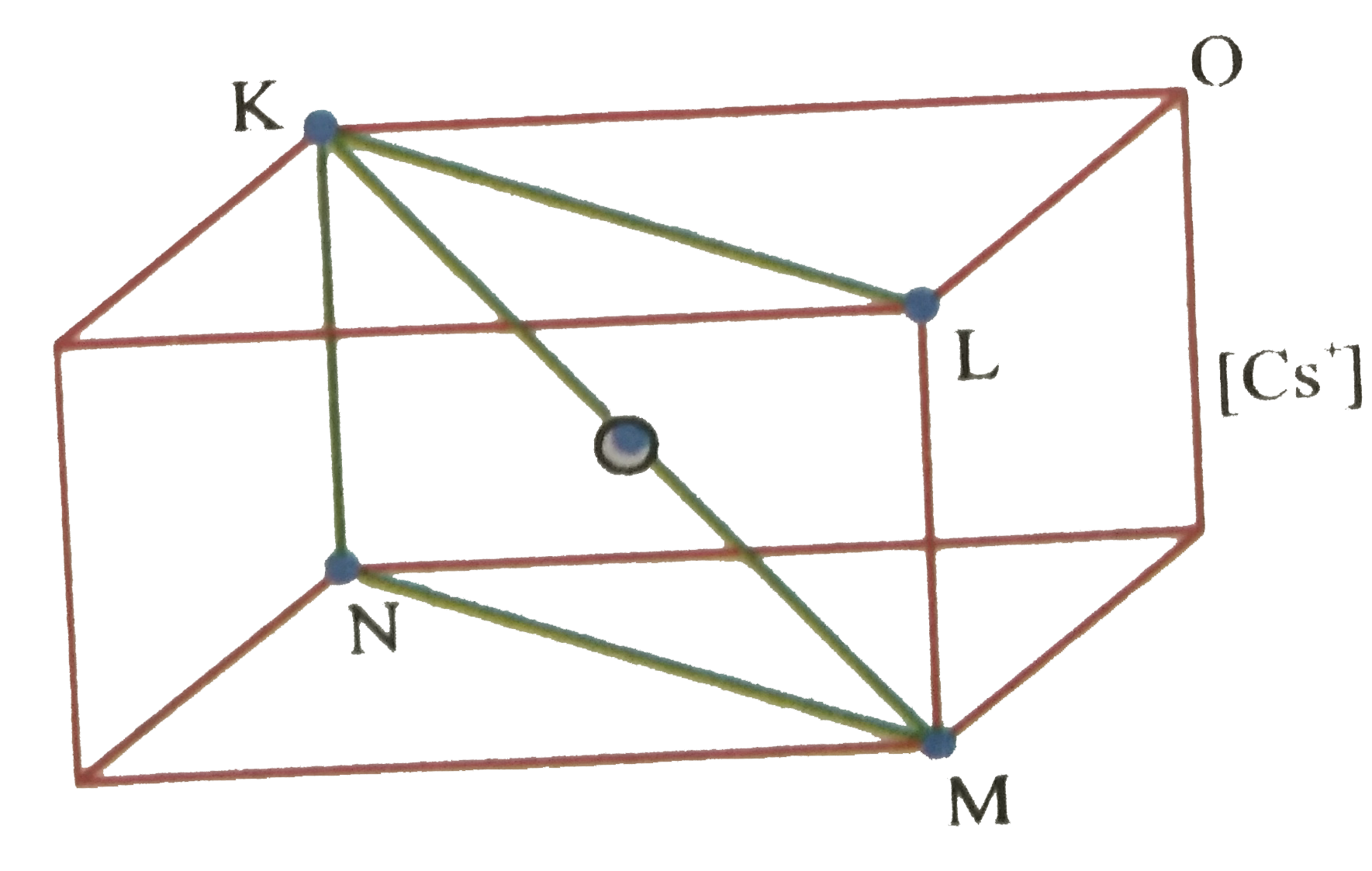
CsCl structure is given below , Assign a...

CsCl structure is given below , Assign all contact with cation and anions are also contact with neighbouring anion [KLMN vertical diagonal plane KLO right angle triangle ]

`(r_(Cl^(-)))/(r_(Cl^(-)))`

A

`0.734`

B

`0.99`

C

`1.36`

D

`0.225`

Text Solution

Verified by Experts

The correct Answer is:

C

`KM^(2)=KL^(2)+LM^(2)=3a^(2)`
`(r_(Cs)+r_(Cl^(-)))^(2)=3a^(2)` But `a=2r_(Cl^(-))(r_(Cl^(+)))/(r_(Cl^(-)))=1.36`
Promotional Banner

Similar Questions

Explore conceptually related problems

The CsCl type structure is exhibited by alkali halides only when the radius of the cation is large enough to keep touching its eight nearst neighbour aniion. Below what minimum raiton of cation of anion radii (r^(+)//r^(-)) this contact is prevented

A circumcircle is a circle which passes through all vertices of a triangle and an incircle is a circle which is inscribed in a triangle touching all sides of a triangle. Let ABC be a right angled triangle whose radius of circumcircle is 5 and its one side AB = 6. The radius of incircle of triangle ABC is r. The value of r is

A circumcircle is a circle which passes through all vertices of a triangle and an incircle is a circle which is inscribed in a triangle touching all sides of a triangle. Let ABC be a right-angled triangle whose radius of the circumcircle is 5 and its one side AB = 6. The radius of incircle of triangle ABC is r. Area of Delta ABC is

Pauling give method to calculate univalent ion radii by assuming that (i) In ionic crystal (let M^(+)X^(-)) cations and anions are is contact of eac other and sum of their radii is equal to interionic distance, i.e., d_((M^(+)-X^(-)) = r_(M^(+) +r_(X^(-)) (ii) The radius of an ion having noble gas configuration is inversely proportional to the effective nuclear charge felt at the periphery of the ion, i.e., r_((M^(+))) = (C)/(Z_(eff(M^(+)))) and r_((X^(-))) = (C)/(Z_(eff(X^(-)))) Here C is constant of proportionality whose value depends on electronic configuration of ion. Thus, d_((M^(+)-X^(-))) =(C)/(Z_(eff(M^(+)))) +(C)/(Z_(eff(X^(-)))) pm Z_(eff) is the effective nuclear charge whose value can be calculated by the formula: Z_(eff) = Z - sigma . Here sigma is shielding constant and for neon, the value of sigma when calculate by Slater's rule is found to be 4.5 The value of univalent radii for F^(-) as calculated by Pauling method is (given that interionic distance of NaF = 231 pm):

Pauling give method to calculate univalent ion radii by assuming that (i) In ionic crystal (let M^(+)X^(-)) cations and anions are is contact of eac other and sum of their radii is equal to interionic distance, i.e., d_((M^(+)-X^(-))) = r_(M^(+) +r_(X^(-)) (ii) The radius of an ion having noble gas configuration is inversely proportional to the effective nuclear charge felt at the periphery of the ion, i.e., r_((M^(+))) = (C)/(Z_(eff(M^(+)))) and r_((X^(-))) = (C)/(Z_(eff(X^(-)))) Here C is constant of proportionality whose value depends on electronic configuration of ion. Thus, d_((M^(+)-X^(-))) =(C)/(Z_(eff(M^(+)))) +(C)/(Z_(eff(X^(-)))) pm Z_(eff) is the effective nuclear charge whose value can be calculated by the formula: Z_(eff) = Z - sigma . Here sigma is shielding constant and for neon, the value of sigma when calculate by Slater's rule is found to be 4.5 The value of 'C' for Na^(+), Mg^(2+) and Al^(3+) will be in the order:
