Home
Class 12
PHYSICS
Three particle A, B and C situated at th...

Three particle A, B and C situated at the vertices of an equilateral triangle starts moving simultaneously at a constant speed "v" in the direction of adjacent particle, which falls ahead in the anti-clockwise direction. If "a" be the side of the triangle, then find the time when they meet

Text Solution

Verified by Experts
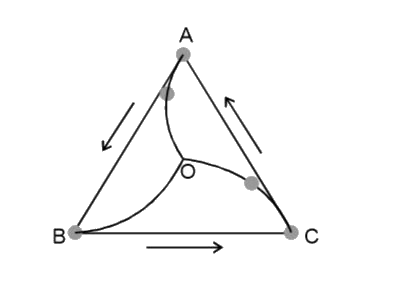
Here, particle "A" follows "B", "B" follows "C" and "C" follows "A". The direction of motion of each particle keeps changing as motion of each particle is always directed towards other particle. The situa- tion after a time "t" is shown in the figure with a possible outline of path followed by the particles before they meet

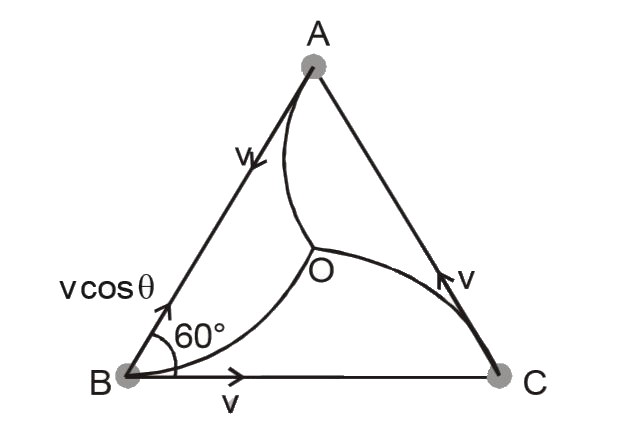
This problem appears to be complex as the path of motion is difficult to be defined. But, it has a simple solution in component analysis. Let us consider the pair "A" and "B". The initial component of velocities in the direction of line joining the initial position of the two particles is "v" and "vcos`theta`" as shown in the figure here :

The component velocities are directed towards eachother. Now, considering the linear (one dimensional) motion in the direction of AB, the relative velocity of "A" with respect to "B" is :
`v_(AB)=v_A-v_B`
`v_AB=v-(-vcostheta)=v+costheta`
In equilteral triangle , `theta=60^(@)`
`V_(AB)=v+cos60^(@)=v+v/2=(3v)/2`
The time taken to cover the displacement "a" i.e. the side of the triangle
`t=(2a)/(3v)`
Promotional Banner

Topper's Solved these Questions

  • KINEMATICS

    MOTION|Exercise EXERCISE 1 OBJECTIVE PROBLEMS|103 Videos
  • KINEMATICS

    MOTION|Exercise EXERCISE 2 OBJECTIVE PROBLEMS|75 Videos
  • HYDROSTATIC, FLUID MECHANICS & VISCOSITY

    MOTION|Exercise EXERCISE -3 (SECTION-B) PREVIOUS YEAR PROBLEM|7 Videos
  • KINETIC THEORY OF GASES

    MOTION|Exercise EXERCISE-3 SECTION-B|16 Videos

Similar Questions

Explore conceptually related problems

Three particles of equal mass 'm' are situated at the vertices of an equilateral triangle of side L . The work done in increasing the side of the triangle to 2L is

Three particles each of mass m are kept at vertices of an equilateral triangle of side L. The gravitational field at centre due to these particle is

Three particles each of mass m are kept at the vertices of an equilateral triangle of side L . What is the gravitational potential at the centroid of the triangle?

Three particles A, B and C situated at vertices of an equilateral triangle, all moving with same constant speed such that A always move towards B, B always towards C and C always towards A . Initial seperation between each of the particle is a. O is the centroid of the triangle. Distance covered by particle A when it completes one revolution around O is

Three particles A(50g), B(100g) and C(150g) are placed at vertices of an equilateral triangle as shown in figure. Then the coordinates of center of mass of system is :

Three particles of masses 1 kg, (3)/(2) kg, and 2 kg are located the vertices of an equilateral triangle of side a . The x, y coordinates of the centre of mass are.

Three identical particles are located at the vertices of an equilateral triangle. Each particle moves along a meridian with equal speed towards the centroid and collides inelastically.

Three particles A, B and C are situated at the vertices of an equilateral triangle ABC of side d at time t=0. Each of the particles moves with constant speed v. A always has its velocity along AB, B along BC and C along CA. At what time will the particles meet each other?

Three insects A,B and C are situated at the vertices of an equillateral triangle of side 1. the insect A heads towards B,B towards C,C towards A with constant speeds v such that they always remain at the vertices of an equilateral triangle. Find the (a) time of their meeting (b) equation of path traced by one insect relative to the other.