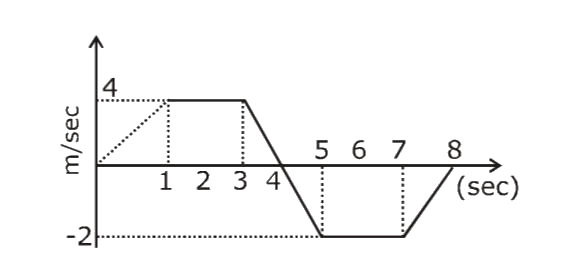
A
B
C
D
Text Solution
Verified by Experts
The correct Answer is:



Topper's Solved these Questions
KINEMATICS
MOTION|Exercise EXERCISE 2 OBJECTIVE PROBLEMS|75 VideosKINEMATICS
MOTION|Exercise EXERCISE 2 OBJECTIVE PROBLEMS (Level-2)|26 VideosKINEMATICS
MOTION|Exercise EXERCISE 4 PREVIOUS YEAR (LEVEL 2)|6 VideosHYDROSTATIC, FLUID MECHANICS & VISCOSITY
MOTION|Exercise EXERCISE -3 (SECTION-B) PREVIOUS YEAR PROBLEM|7 VideosKINETIC THEORY OF GASES
MOTION|Exercise EXERCISE-3 SECTION-B|16 Videos
Similar Questions
Explore conceptually related problems
MOTION-KINEMATICS-EXERCISE 1 OBJECTIVE PROBLEMS
- The variation of velocity of a particle moving along straight line is ...
Text Solution
|
- The displacement-time graph for two particles A and B are straight lin...
Text Solution
|
- The v-t graph of a linear motion is shown in adjoining figure. The dis...
Text Solution
|
- The adjoining curve represents the velocity-time graph of a particle, ...
Text Solution
|
- In the following velocity-time graph of a body, the distance and displ...
Text Solution
|
- If position time graph of particle is sincurve as shown, what will be...
Text Solution
|
- The diagram shows variation of (1)/(v) with respect to time (where v i...
Text Solution
|
- The particle moves with rectilinear motion given the acceleration-disp...
Text Solution
|
- Figure shows the graph of the x-co-ordinate of a particle going along ...
Text Solution
|
- Figure shows the graph of velocity versus time for a particle going al...
Text Solution
|
- Displacement-time graph of a particle moving in a straight line is as ...
Text Solution
|
- Displacement-time graph of a particle moving in a straight line is as ...
Text Solution
|
- Velocity-time graph of a particle moving in a straight line is shown i...
Text Solution
|
- Velocity-time graph of a particle moving in a straight line is shown i...
Text Solution
|
- A Body intially at rest, starts moving along x-axis in such a way so t...
Text Solution
|
- At an instasnt t the coordinates of a particles are x=at^(2), y=bt^(2)...
Text Solution
|
- The displacement of a body is given by 2 s= g t^(2) where g is a cons...
Text Solution
|
- A particle moves along a staight line such that its displacement at an...
Text Solution
|
- A particla starting from rest undergoes acceleration given by a=|t-2|"...
Text Solution
|
- The acceleration a in ms^-2 of a particle is given by a=3t^2+2t+2, whe...
Text Solution
|