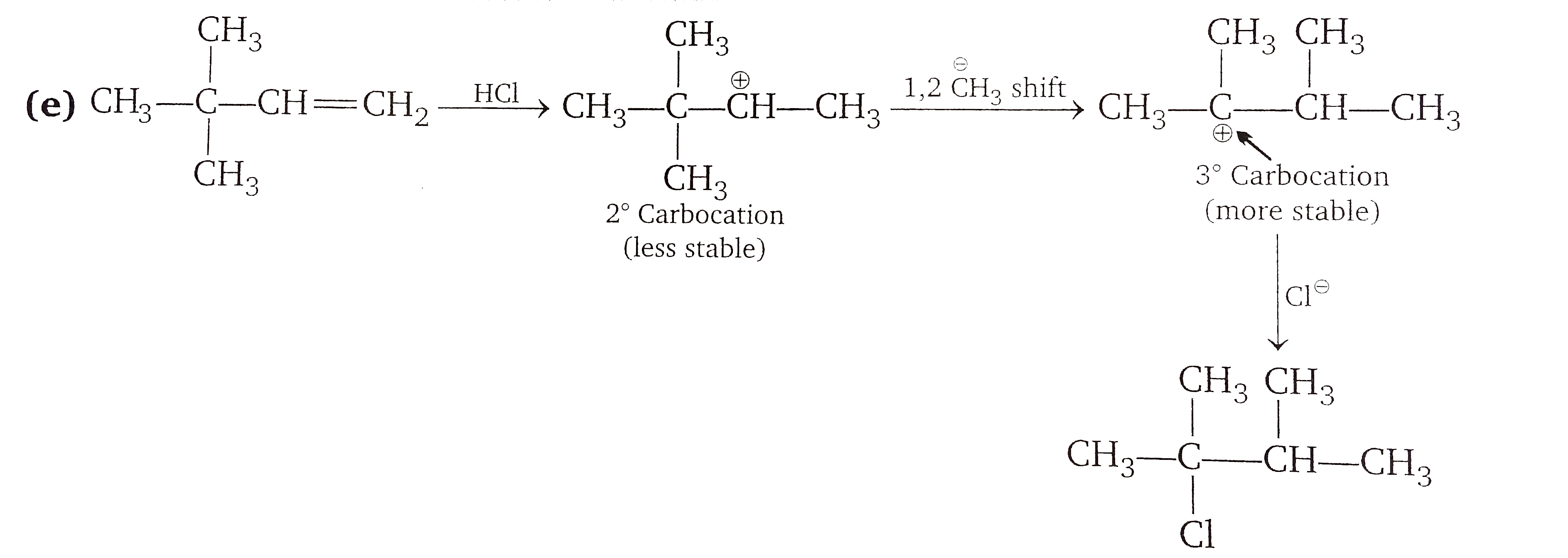
Addition of HCl to 3, 3-dimethyl-1-butene yields two products, one of which has a rearranged carbon skeleton. Among the following carbocations, selectr the possible intermediates in that reaction?
A
`1, 2`
B
`1, 3`
C
`1, 4`
D
`2, 3`
Text Solution
Verified by Experts
The correct Answer is:
a
Topper's Solved these Questions
HYDROCARBONS (ALKENES)
MS CHOUHAN|Exercise Level 1 (Q.1 To Q.30)|1 Videos
HYDROCARBONS (ALKENES)
MS CHOUHAN|Exercise Level 1 (Q.61 To Q.90)|2 Videos
HYDROCARBONS (ALKANES)
MS CHOUHAN|Exercise Level 1 (Q.31 To Q.50)|1 Videos
HYDROCARBONS (ALKYNES)
MS CHOUHAN|Exercise Level 1 (Q.1 To Q.30)|2 Videos
Similar Questions
Explore conceptually related problems
Additionof HCI to 3,3 dimethyl but-1-ene yields two products, one of which has a rearranged carbon skeleton. Which of the following cations are intermediates in that reaction ? (CH_(3))_(3) overset(o+) underset(I) C CHCH_(2)Cl " " (CH_(3))_(3) underset(II)(C)overset(o+)CHCH_(3) (CH_(3))_(2) overset(o+) underset(III)underset(Cl) underset(|) C (CH_(3))_(2) " " (CH_(3))_(2) underset(IV)overset(o+) C CH(CH_(3))_(2)
Which one among the following carbocations has longest half-life ?
Among the following which one does not act as an intermediate in hofmann rearrangement
Among the following which one does not act as an intermediate in hofmann rearrangement
Ozonolysis of 2,3-dimethyl-1-butene followed by reduction with zinc and water gives
Addition of HCl to 3,3-dimethyl-1-butene and reaction of HCl with 3,3-dimethyl-2-butanol give the same product. Explain,
3, 3-Dimethyl-2-butanol no reaction with HCl yield mainly