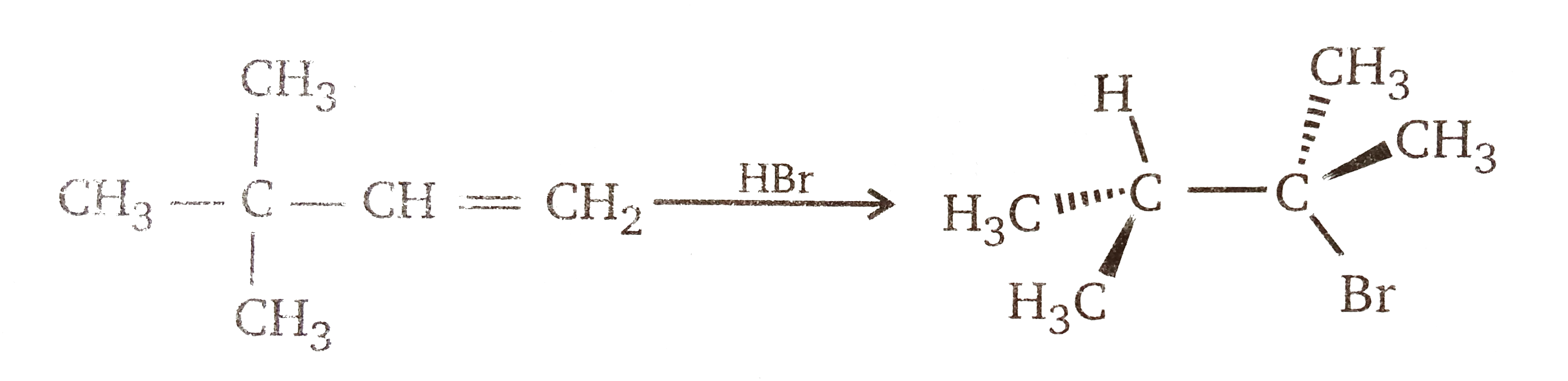
Consider the addition of HBr to 3,3-Dimethyl-1-butene shown below. What is the best mechanistic explanation for the formation of the observed product?
A
Protonation of the alkene followed by a hydride shift and addition of bromide to the carbocation
B
Double bond shift in the alkene following by the protonation and addition of bromide to the carbocation.
C
Addition of bromide to the alkene followed by a double bond shift and protonation
D
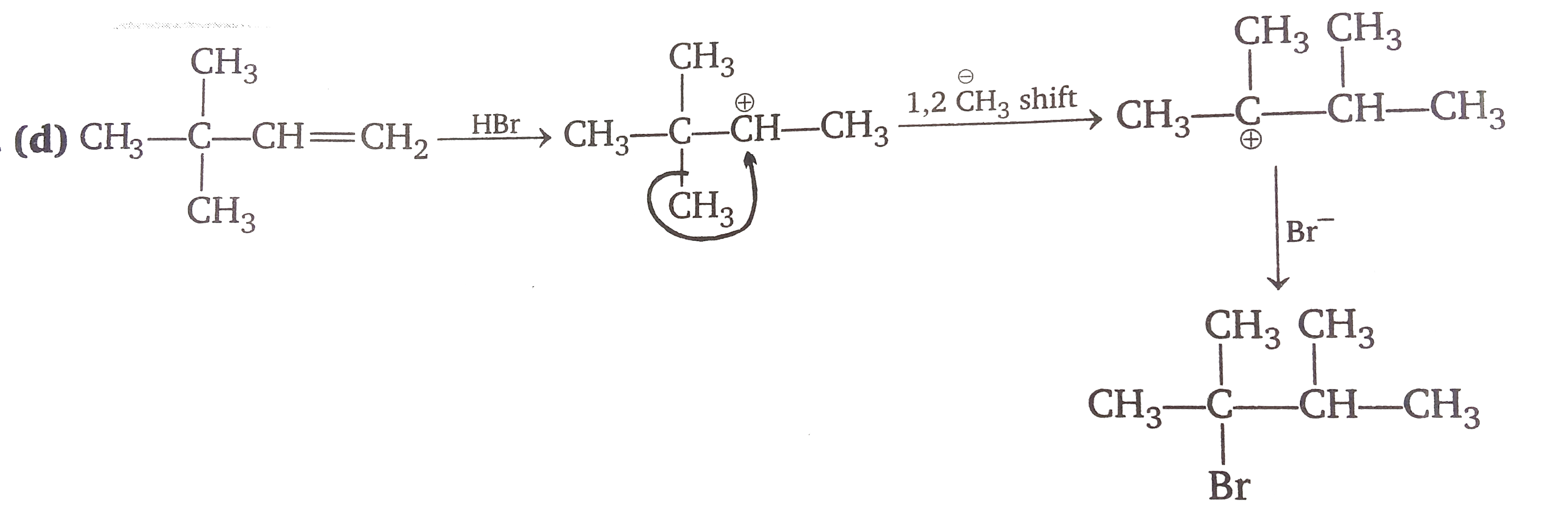
Protonation of the alkene followed by a methyl shift and addition of bromide to the carbocation
Text Solution
Verified by Experts
The correct Answer is:
D
Topper's Solved these Questions
HYDROCARBONS (ALKENES)
MS CHOUHAN|Exercise Level 1 (Q.1 To Q.30)|1 Videos
HYDROCARBONS (ALKENES)
MS CHOUHAN|Exercise Level 1 (Q.61 To Q.90)|2 Videos
HYDROCARBONS (ALKANES)
MS CHOUHAN|Exercise Level 1 (Q.31 To Q.50)|1 Videos
HYDROCARBONS (ALKYNES)
MS CHOUHAN|Exercise Level 1 (Q.1 To Q.30)|2 Videos
Similar Questions
Explore conceptually related problems
What is the product of 1, 4-addition in the reaction shown below?
Addition of HCl to 3,3-dimethyl-1-butene and reaction of HCl with 3,3-dimethyl-2-butanol give the same product. Explain,
Addition of HCl to 3, 3-dimethyl-1-butene yields two products, one of which has a rearranged carbon skeleton. Among the following carbocations, selectr the possible intermediates in that reaction?
A) Addition of HBr to 1-butene in presence of peroxide produces 1-bromobutane. R) It involves the formation of primary radical.
Ozonolysis of 2,3-dimethyl-1-butene followed by reduction with zinc and water gives