Home
Class 11
CHEMISTRY
Vladimir Markovnikov rule: Alkenes und...

Vladimir Markovnikov rule:
Alkenes undergo electrophilic addition reactions. It is triggered by the acid acting as a electrophile toward `pi`-electrons of the double bond.
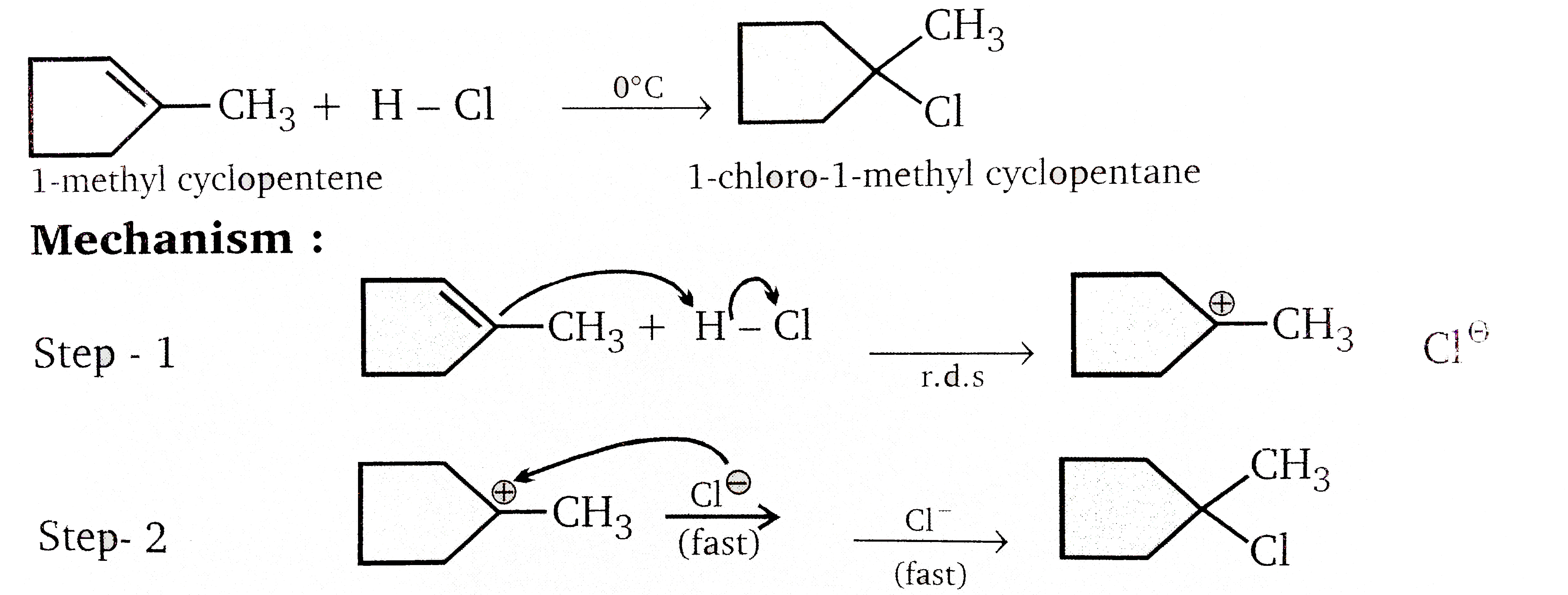
Markovnikov's rule states that when an unsymmetrically substituted alkene reacts with a hydrogen halide, the hydrogen atom adds to the carbon that has the greater number of hydrogen, e.g.,
In which of following reactions, carbocation rearrangement is possible?
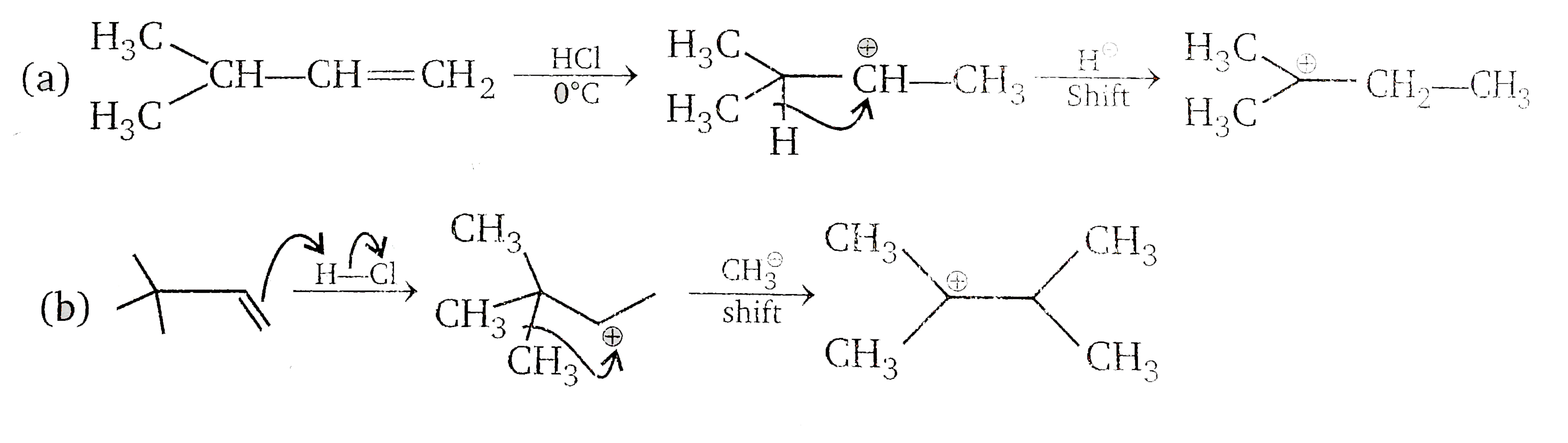

A

`(CH_(3))_(4)CH-CH=CH_(2)overset(HCl)underset(0^(@)C)(to)`

B

`(CH_(3))_(3)C-CH=CH_(2)overset(HBr)underset(0^(@)C//Cl_(4))(to)`

C

`Ph-CH_(2)-CH=CH_(2)overset(HBr)underset(C Cl_(4))(to)`

D

All of these

Text Solution

Verified by Experts

The correct Answer is:
D

d

Promotional Banner

Topper's Solved these Questions

  • HYDROCARBONS (ALKENES)

    MS CHOUHAN|Exercise Level 1 (Q.1 To Q.30)|1 Videos
  • HYDROCARBONS (ALKENES)

    MS CHOUHAN|Exercise Level 1 (Q.61 To Q.90)|2 Videos
  • HYDROCARBONS (ALKANES)

    MS CHOUHAN|Exercise Level 1 (Q.31 To Q.50)|1 Videos
  • HYDROCARBONS (ALKYNES)

    MS CHOUHAN|Exercise Level 1 (Q.1 To Q.30)|2 Videos

Similar Questions

Explore conceptually related problems

Vladimir Markovnikov rule: Alkenes undergo electrophilic addition reactions. It is triggered by the acid acting as a electrophile toward pi -electrons of the double bond. Markovnikov's rule states that when an unsymmetrically substituted alkene reacts with a hydrogen halide, the hydrogen atom adds to the carbon that has the greater number of hydrogen, e.g., What is the energy profile for the given reaction?

Vladimir Markovnikov rule: Alkenes undergo electrophilic addition reactions. It is triggered by the acid acting as a electrophile toward pi -electrons of the double bond. Markovnikov's rule states that when an unsymmetrically substituted alkene reacts with a hydrogen halide, the hydrogen atom adds to the carbon that has the greater number of hydrogen, e.g., Which of the following is most reactive toward Markovnikov addition?

Alkene and alkyne both undergo electrophilic additon beacuise of pi electron density, they behave as elctron rich species, alknens are more reactive toward this reaction because the intermiediate formed when an E^(oplus) adds to an alkyne is a vinylic cation wheras sthe intermediate formed when an E^(oplus) adds to akene is alkyl cation, which is mopre stable. In the reaction:

Alkenes undergo electrophilic addition reactions. Electrophilic addition to unsymmetrical alkenes involve the formation of a more stable carbocation intermediate in the first step which is rate determining and carbocation is then attacked by a nuclephile to form product Which one of the following alkene reacts most readily with HCI ?

Alkene and alkyne both undergo electrophilic additon beacuise of pi electron density, they behave as elctron rich species, alknens are more reactive toward this reaction because the intermiediate formed when an E^(oplus) adds to an alkyne is a vinylic cation wheras sthe intermediate formed when an E^(oplus) adds to akene is alkyl cation, which is mopre stable.

Alkene and alkyne both undergo electrophilic additon beacuise of pi electron density, they behave as elctron rich species, alknens are more reactive toward this reaction because the intermiediate formed when an E^(oplus) adds to an alkyne is a vinylic cation wheras sthe intermediate formed when an E^(oplus) adds to akene is alkyl cation, which is mopre stable.

