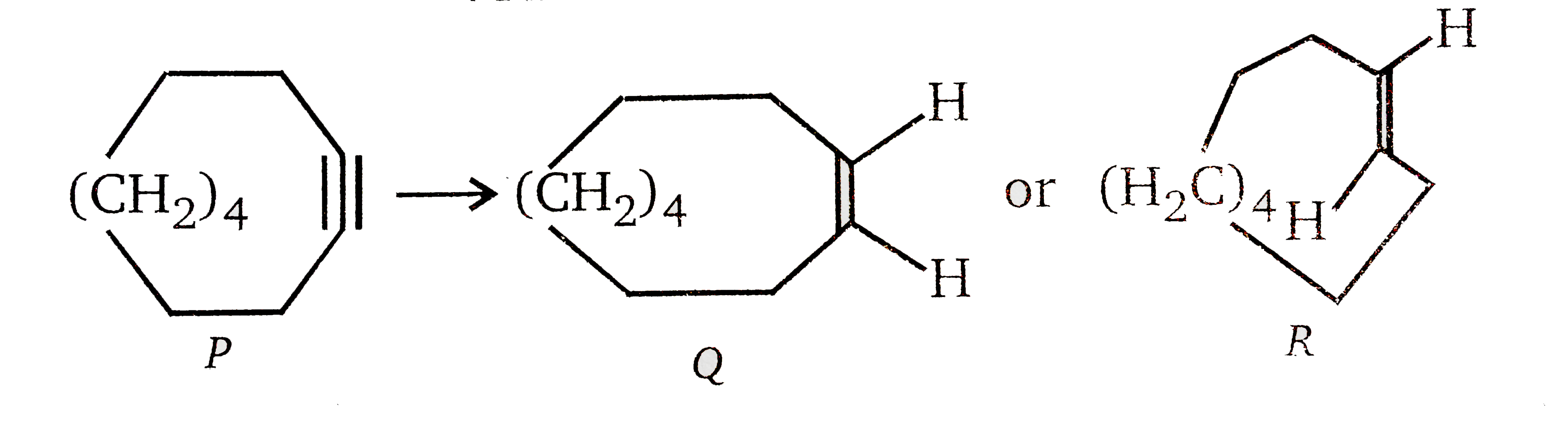
Reactant P gives products Q or R. The possible reagents are: (I) `2Na//liq. NH_(3)` (II) `H_(2)//Pd//CaCO_(3)("quinoline")` (III) `2H_(2)//Pd//C` The correct with respect to the above conversion is/are:
A
Q is obtained on treatment with reagent (I)
B
R and Q are obtained on treatment with reagent (II)
C
R is obtained on treatment with reagent (I)
D
R is obtained on treatment with reagent (II)
Text Solution
Verified by Experts
The correct Answer is:
C
Reagent (1) give trans prduct. Reagent (II) and (III) give cis-product
Topper's Solved these Questions
HYDROCARBONS (ALKYNES)
MS CHOUHAN|Exercise Level 1 (Q.1 To Q.30)|2 Videos
HYDROCARBONS (ALKENES)
MS CHOUHAN|Exercise LEVEL - 2|1 Videos
IONIC REACTIONS (NUCLEOPHILIC SUBSTITUTION AND ELIMINATON REATIONS OF ALKYL HALIDES)
MS CHOUHAN|Exercise ADDITIONAL OBJECTIVE QUESTIONS (Matrix Match Type )|2 Videos
Similar Questions
Explore conceptually related problems
The reduction 4- octyne with H_(2) in the presence of Pd//CaCO_(3)- quioline gives-
The most appropriate reagent for conversion of C_(2) H_(5) CN into CH_(3) CH_(2) CH_(2) NH_(2) is :
The reduction of 4 - octyne with H_(2) in the presence of Pd //CaCo_3 quinoline gives
Give the conjugate bases of (i) H_(2)O (ii) NHO_(3) (iii) NH_(4)^(+) (Iv) HCO_(3)^(2-).
Among (i) C_(6)H_(5) NH_(2) (ii) CH_3NHCH_(3) (iii) (CH_3)_2NCH_(3) and (iv) NH_3 , the correct order of basic strength follows the order
MS CHOUHAN-HYDROCARBONS (ALKYNES)-Level 1 (Q.1 To Q.30)