

Home
Class 11
CHEMISTRY
1.23 g of Nitro Benzene on reduction wit...

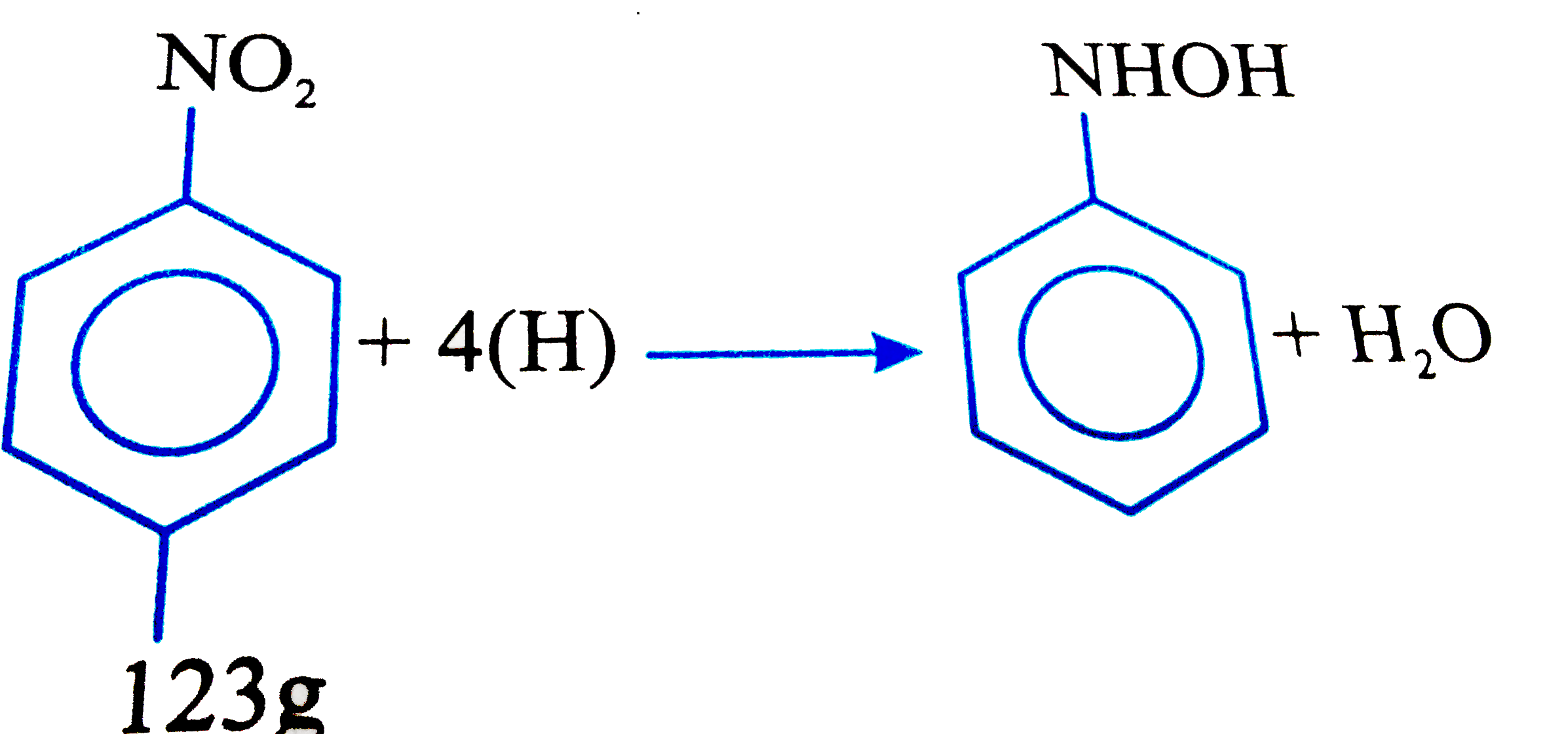
1.23 g of Nitro Benzene on reduction with `Zn + NH_(4)Cl` then its gives N-Phenyl hydroxyl amine that isomerised to 4-amino phenol. Then no. of electron involved and the element reduced is

A

`24 xx 10^(21),N`

B

`24 xx 10^(24),N`

C

`12 xx 10^(23),N`

D

`6 xx 10^(23),N`

Text Solution

Verified by Experts

The correct Answer is:
A


123g of Nitro Benzene 4N electrons
Promotional Banner

Topper's Solved these Questions

  • SOLID STATE

    NARAYNA|Exercise LEVEL-V|122 Videos
  • SOME BASIC CONCEPTS OF CHEMISTRY

    NARAYNA|Exercise EXERCISE - IV|43 Videos

Similar Questions

Explore conceptually related problems

An organic compound [A] with molecular formula C_(5)H_(8)O_(2) is reduced to n-pentane on treatment with Zn-Hg//HCl . The compound [A] forms a dioxine with hydroxyl amine and give a positive iodoform test and Tollen's test. Identify the compound [A] and deduce its structure?

Reduction of nitrobenzene in the presence of Zn//NH_(4)Cl gives

Oxidation and reduction process involves the transaction of electrons. Loss of electrons is oxidation and the gain of electrons is reduction. It is thus obvious that in a redox reaction, the oxidant is reduced by accepting the electrons and the reductant is oxidised by losing electrons. The reactions in which a species disproportionates into two oxidation states (lower and higher) are called disproportionation reactions. In electrochemical cells, redox reaction is involved, i.e., oxidation takes place at anode and reduction at cathode. In the reaction: I_(2)+2S_(2)O_(3)^(2-) to 2I^(-)+S_(4)O_(6)^(2-)

What is the difference in oxidation state of nitrogen in between hydroxyl amine (NH_(2)OH) and hydrazine (N_(2)H_(4)) ?

NARAYNA-SOME BASIC CONCEPTS IN CHEMISTRY STOICHIOMETRY (PART-I)-All Questions
  1. Versene, a chelating agent having chemical formula C(2)H(4)N(2)(C(2)H...

    Text Solution

    |

  2. One mole of a mixture of CO and CO(2) requires exactly 20g of NaOH in ...

    Text Solution

    |

  3. 1.23 g of Nitro Benzene on reduction with Zn + NH(4)Cl then its gives ...

    Text Solution

    |

  4. A mixture of HCOOH and H(2)C(2)O(4) is heated with conc. H(2)SO(4). Th...

    Text Solution

    |

  5. When burnt in air, a 12.0 g mixture of carbon and sulphur yields a mix...

    Text Solution

    |

  6. The oxide of a metal contains 40% of oxygen. The valency of metal is 2...

    Text Solution

    |

  7. Cuprous sulphide and silver sulphide are isomorphous. The atomic mass ...

    Text Solution

    |

  8. A sample of 1.0g of solid Fe(2)O(3) of 80% purity is dissolved in a mo...

    Text Solution

    |

  9. A gaseous hydrocarbon gives upon combustion 0.72g of water and 3.08g o...

    Text Solution

    |

  10. 10 " mL of " a gaseous organic compound containing C, H and O only was...

    Text Solution

    |

  11. A hydrocarbon contains 10.5 g of carbon per gram of hydrogen. 1 L of v...

    Text Solution

    |

  12. When K(2)Cr(2)O(7) is heated with conc. H(2)SO(4) and soluble chloride...

    Text Solution

    |

  13. A 20 mL mixture of CO, CH4, and Helium (He) gases is exploded by an el...

    Text Solution

    |

  14. 7.36g of a mixture of KCI and KI was dissolved in H(2)O to prepare 1 l...

    Text Solution

    |

  15. Equal weights of Zn metal and iodine are mixed together and I(1) is co...

    Text Solution

    |

  16. A hydrocarbon 'X' have 81% of carbon. Volume of CO(2) liberated at 298...

    Text Solution

    |

  17. Gastric juice contains 3g HCl per liter. If a person produces 2.5 L of...

    Text Solution

    |

  18. 50.0 kg of N(2)(g) and 10.0 kg of H(2)(g) are mixed to produce NH(3)(g...

    Text Solution

    |

  19. Calcium carbonate reacts with aqueous HCl to give CaCl(2) and CO(2) ac...

    Text Solution

    |

  20. 3.92g of ferrous ammonium sulphate (FAS) react completely with 50 mlN/...

    Text Solution

    |