Home
Class 12
PHYSICS
The ratio of potential differences betwe...

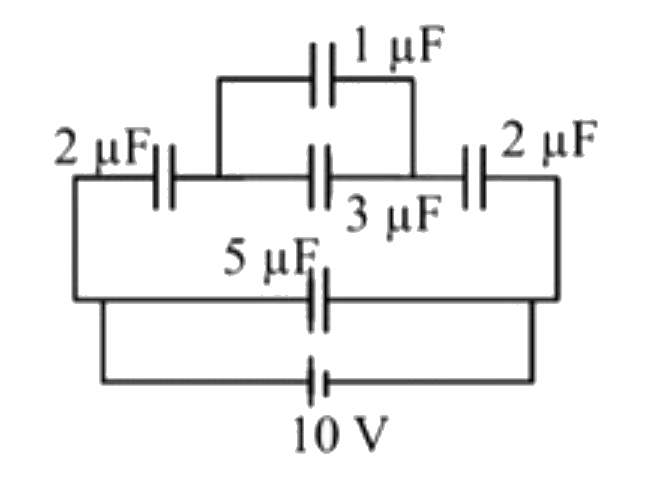
The ratio of potential differences between `1muF and 5muF` capacitors is

A

`1:2`

B

`3:1`

C

`1:5`

D

`10:1`

Text Solution

Verified by Experts

The correct Answer is:

C
Promotional Banner

Topper's Solved these Questions

  • NEET MOCK TEST 2

    NTA MOCK TESTS|Exercise PHYSICS|44 Videos
  • NEET MOCK TEST 21

    NTA MOCK TESTS|Exercise PHYSICS|45 Videos

Similar Questions

Explore conceptually related problems

Three capacitors of 2 muF, 3 muF and 6 muF are joined in series and the combination is charged by means of a 24 volt battery. The potential difference between the plates of the 6 muF capacitor is

A 10 muF capacitor is charged to 15 V . It is next connected in seties with an uncharged 5 muf capacitor. The series cambination is finally connected across a 30 V battery, as shown in. Find the new potential differnce across the 5 muF and 10 muF capacitors.

Three capacitors of capacitance 1 muF, 2muF and 3 muF are connected in series and a potential difference of 11 V is applied across the combination. Then, the potential difference across the plates of 1 muF capacitor is

In the circuit shown in the figure, the potential difference across the 4.5 muF capacitor is

In the circuit shown, the potential difference across the 3muF capacitor is V and the equivalent capacitance between A and B is C Then:

In a parallel plate capacitor of capacitor 1muF two plates are given charges 2muC and 4muC the potential difference between the plates of the capacitor is

A capacitor of 20muF is given a potential difference of 500 V and a 10muF capacitor is charged through a potential difference of 200 V. What is the potential across each when they are connected in parallel ?

Find the charges on 6muF and 4muF capacitors

A series combination of three capacitors of capacities 1 muF, 2muF and 8 muF is connected to a battery of e.m.f. 13 volt . The potential difference across the plates of 2 muF capacitor will be

NTA MOCK TESTS-NEET MOCK TEST 20-PHYSICS
  1. An electric dipole of length 2 cm is placed with its axis making an an...

    Text Solution

    |

  2. A proton and an electron are released from an infinite distance apart ...

    Text Solution

    |

  3. The ratio of potential differences between 1muF and 5muF capacitors is

    Text Solution

    |

  4. In a meter bridge circuit as shown in the figure, the bridge is balanc...

    Text Solution

    |

  5. The ratio of the resistances of a conductor at a temperature of 15^(@)...

    Text Solution

    |

  6. When a material is inserted inside the inductor the current in the cir...

    Text Solution

    |

  7. A flux of 10^(-3)Wb passes through a strip having an area A = 0.02m^(2...

    Text Solution

    |

  8. Consider the situation shown in the figure. If the current I in the l...

    Text Solution

    |

  9. Magnetic susceptibility of a diamagnetic substances

    Text Solution

    |

  10. De Broglie wavelength of 0.05 eV thermal neutron is

    Text Solution

    |

  11. The maximum velocity of electrons emitted from a metal surface is v wh...

    Text Solution

    |

  12. Choose the WROMG statement.

    Text Solution

    |

  13. Number of nuclei of a radioactive substance are 1000 and 900 at times ...

    Text Solution

    |

  14. Which of the following has maximum specific heat?

    Text Solution

    |

  15. When p calories of heat is given to a body, it absorbs q calories, t...

    Text Solution

    |

  16. One likes to sit under sunshine in winter seasons, because

    Text Solution

    |

  17. A piece of glass is heated to a high temperature and then allowed to c...

    Text Solution

    |

  18. The velocity of kerosene oil in a horizontal pipe is 5 m//s. If g = 10...

    Text Solution

    |

  19. A force of 100 dynes acts on mass of 5 gm for 10 sec . The velocity pr...

    Text Solution

    |

  20. if temperature of an object is 140^(@)F, then its temperature in centi...

    Text Solution

    |
