Home
Class 11
CHEMISTRY
An aqueous solution of a mixture of two ...

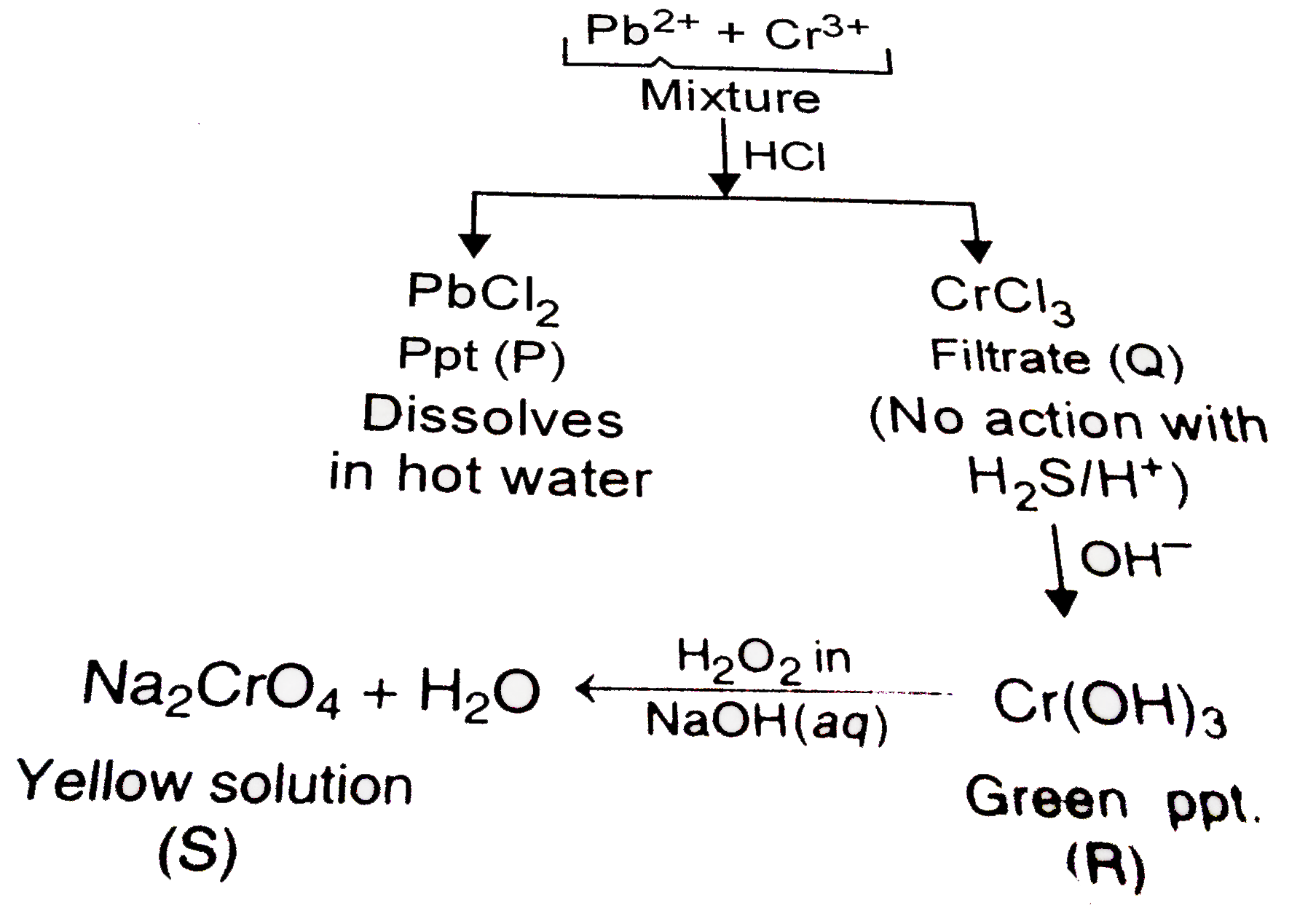
An aqueous solution of a mixture of two inorganic salts when treated with dilute HCl, gave a precipitate (P) and a filtrate (Q). The precipitate (P) was found to dissolve in hot water. The filtrate (Q) remained unchanged, when treated with `H_(2)S` in a dilute mineral acid medium. However, it gave a green precipitate (R) in an ammoniacal medical. The precipitate (R) gave a coloured solution (S), when treated with `H_(2)O_(2)` in an aqueous NaOH medium. Answer Question 62 and 63
The coloured solution (S) contains

A

`Fe(SO_(4))_(3)`

B

`CuSO_(4)`

C

`ZnSO_(4)`

D

`Na_(2)CrO_(4)`

Text Solution

Verified by Experts

The correct Answer is:
D

The coloured solution (S) is `Na_(2)CrO_(4)`
The available data suggests that the mixture contains `Pb^(2+)` and `Cr^(3+)` ions. The series of reactions involved are :
Promotional Banner

Topper's Solved these Questions

  • ALCOHOLS AND PHENOLS

    DINESH PUBLICATION|Exercise Ultimate Preparatory Package|20 Videos
  • APPENDIX

    DINESH PUBLICATION|Exercise Completion Reactions|15 Videos

Similar Questions

Explore conceptually related problems

An aqueous solution of a mixture of two inorganic salts, when treated with dilute HCl , gave a precipiate (P) and filtrate (Q). The precipitate (P) was found to dissolve in hot water. The filtrate (Q) remained unchanged, when treated with H_(2)S in a dilute mineral acid medium. However, it gave a precipitate (R) With H_(2)S in an ammoniacal medium. The precipitate R gave a coloured solution (S), when treated with H_(2)O_(2) in an aqueous NaOH medium. The precipitate P contains

An aqueous solution of a mixture of two inorganic salts, when treated with dilute HCl , gave a precipiate (P) and filtrate (Q). The precipitate (P) was found to dissolve in hot water. The filtrate (Q) remained unchanged, when treated with H_(2)S in a dilute mineral acid medium. However, it gave a precipitate (R) With H_(2)S in an ammoniacal medium. The precipitate R gave a coloured solution (S), when treated with H_(2)O_(2) in an aqueous NaOH medium. The coloured solution S contains

An aqueous solution of a mixture of two inorganic salts, when treated with dilute HCI, gave a precipitate (P) and a filtrate (Q). The precipitate (P) was found to dissolved in hot water. The filtrate (Q) remained unchanged, when treated with H_(2)S in a dilute mineral acid medium. However, it gave a precipitatew (R) with H_(2)S in an ammoniacal medium. The precipitate (R) gave a coloured solution (S), when treated with H_(2)O_(2) in an aqueous NaOH medium. The precipitate (P) contains ------ while the colored solution (S) contains

DINESH PUBLICATION-APPENDICES-Multiple choice
  1. CB(2) layer gives a test for

    Text Solution

    |

  2. Upon treatment with ammoniacal H(2)S solution, the metal ion precipita...

    Text Solution

    |

  3. Match the list I with list II and select the correct answer using the ...

    Text Solution

    |

  4. A yellow turbidity, sometimes appears on passing H(2)S gas ever in the...

    Text Solution

    |

  5. X' is a colourless salt giving following reactions : 'X' can be

    Text Solution

    |

  6. An aqueous solution of a mixture of two inorganic salts when treated w...

    Text Solution

    |

  7. An aqueous solution of a mixture of two inorganic salts when treated w...

    Text Solution

    |

  8. Among PbS, CuS, HgS, MnS, Ag(2)S, NiS, CoS, Bi(2)S(3) and SnS(2), tota...

    Text Solution

    |

  9. The incorrect statement in respect of chromyl chloride test is

    Text Solution

    |

  10. When I(2) is passed through KCl, KF and KBr solution

    Text Solution

    |

  11. Among the following observation, the correct one that differentiates b...

    Text Solution

    |

  12. The pair (s) where both the ions are precipitated upon passing H(2)S g...

    Text Solution

    |

  13. In the presence of dilute HCl, H(2)S results in the precipitation of g...

    Text Solution

    |

  14. Consider the following salts : NaCl, HgCl(2), CuCl(2), CuCl and AgCl...

    Text Solution

    |

  15. The hottest region of Bunsen flame shown in the figure below is :

    Text Solution

    |

  16. compound X is tested and the results are shown in the following table....

    Text Solution

    |

  17. The reagent (s) that can selectively precipitate S^(2-) from a mixture...

    Text Solution

    |

  18. HgCl(2) and I(2) both when dissolved in water containing I^(-)ions, th...

    Text Solution

    |

  19. When BaCl(2) is added to an aqueous salt solution, a while precipitate...

    Text Solution

    |

  20. The correct options (s) to distinguish nitrate salts of Mn^(2+) and Cu...

    Text Solution

    |

