Home
Class 12
CHEMISTRY
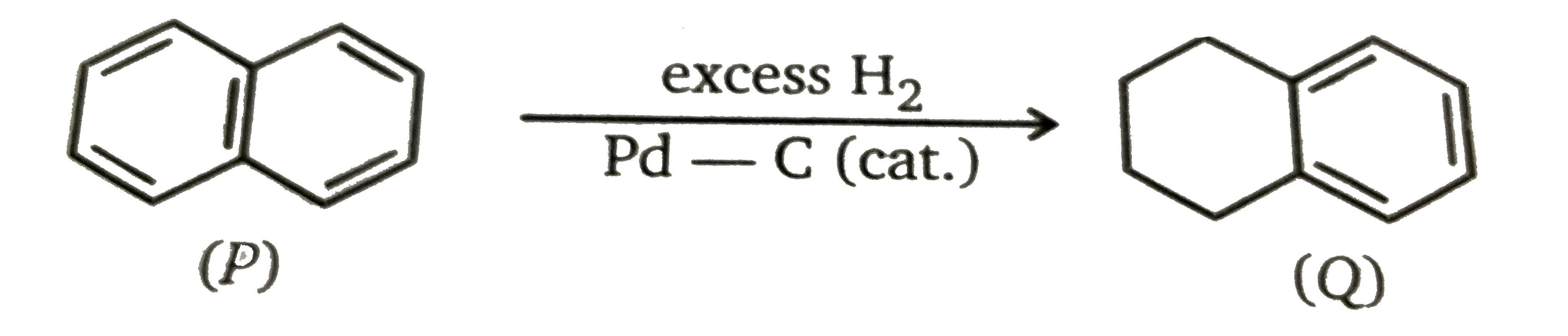
Hydrogenation of naphthalene (P) with ex...

Hydrogenation of naphthalene (P) with excess hydrogen gas stops cleanly at 1, 2, 3, 4-tetrahydronaphalene (Q). What conclusion can be drawn from this experiment ?

A

the hydrogenation of P is exothermic

B

one aromatic ring of P is more reactive than the aromatic ring of Q

C

one aromatic ring of P is less reactive than the other ring of Q

D

reduction of the first `C = C` of P is faster than reduction of the second or third `C = C`

Text Solution

Verified by Experts

The correct Answer is:

B

Annelation effect.
Promotional Banner

Topper's Solved these Questions

  • AROMATIC COMPOUNDS

    MS CHOUHAN|Exercise Level 1 (Q.31 To Q.60)|1 Videos
  • AROMATIC COMPOUNDS

    MS CHOUHAN|Exercise Level 1 (Q.121 To Q.150)|3 Videos
  • AN INTRODUCTION TO ORGANIC REACTIONS AND THEIR MECHANISMS ACIDS AND BASES

    MS CHOUHAN|Exercise ADDITIONAL QUESTION (SINGLE CORRECT CHOICE TYPE )|32 Videos
  • BIOMOLECULES

    MS CHOUHAN|Exercise Level 2|1 Videos

Similar Questions

Explore conceptually related problems

For a mirror linear magnification m comes out to +2 . What conclusions can be drawn from this ?

What conclusion can be drawn from each part of Fig. 2.14, if BD bisects angleABC ?

What conclusion can be drawn from each part of Fig. 2.14, if DB is the bisector of angleADC ?

At 27^(@)C it was observed during a reaction of hydrogenation that the pressure of hydrogen gas decreases from 2 atmosphere to 1.1 atmosphere in 75 minutes. Calculate the rate of reaction (in M "sec"^(–1) ) .

'P#Q' means 'P is the daughter of Q'. 'P©Q' mean 'Q is the brother of P'. 'P=Q' means 'Q is the sister of P'. 'P&Q' means 'P is the son of Q ' . 'P*Q' mean 'P is the father of Q' 'P@Q' means 'P is the mother of Q'. Which of the following can be the correct conclusion drawn from the expression 'L=M#N©P*Q' ?

Observe the rates of evolution of hydrogen gas with five metals P,Q,R,S and T at room temperature. What could be the metals P,Q,R,S and T ?

H_(2) gas is often used as a reducing gas. In a particular set up 17.4 gm of MnO_(2) on reacting with excess of hydrogen gas gives water and new oxide Mn_(x)O_(y) such that mass of the oxide obtained is 12.6 g. What will be value of y if x is 2. [Mn=55]

Can we use conc. H_(2)SO_(4) for preparing hydrogen gas from zinc metal?

Conc. H_2SO_4 liberates hydrogen chloride gas from chlorides because
