Home
Class 12
CHEMISTRY
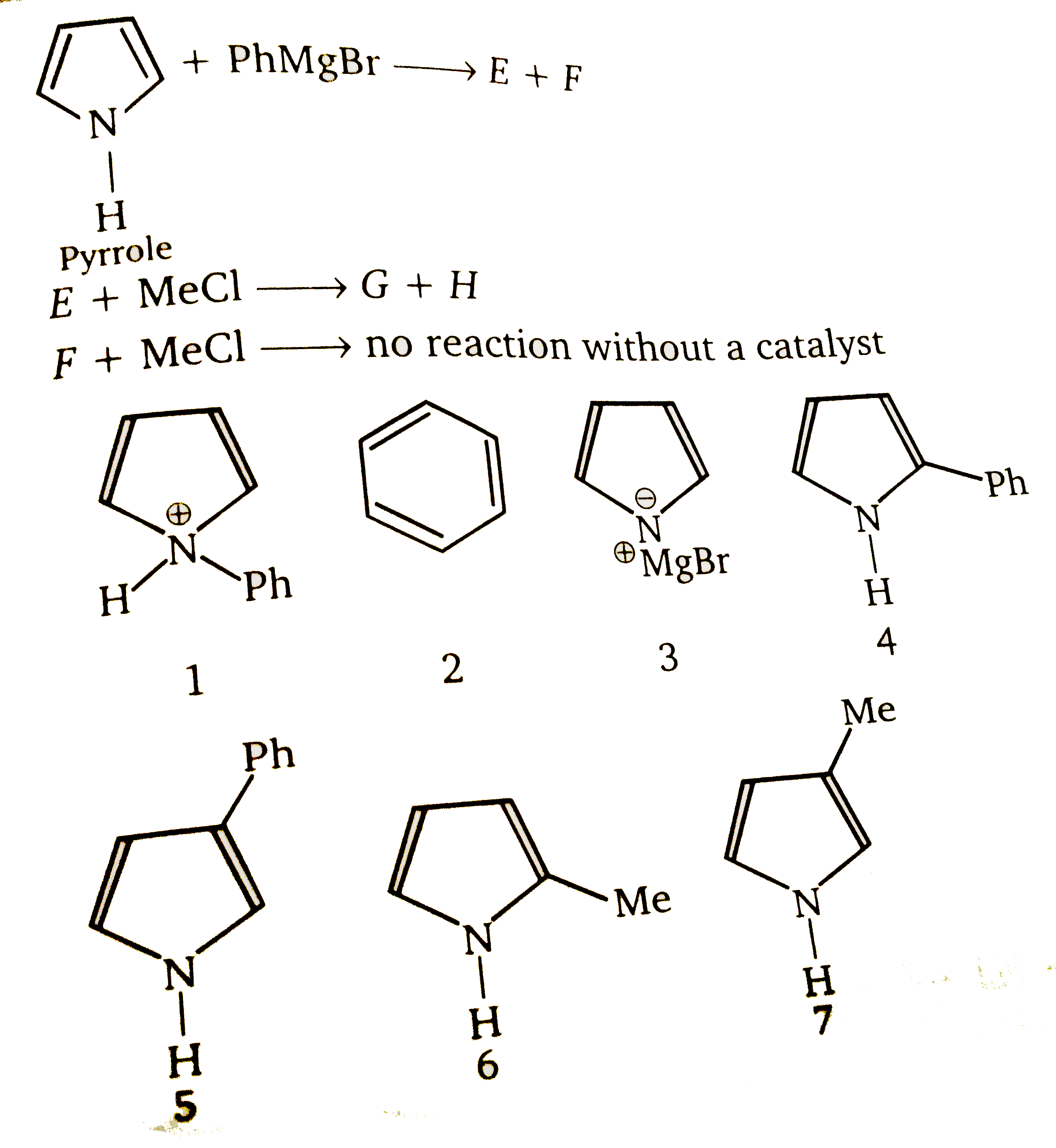
E + MeCl rarr G + H F + MeCl rarr no r...


`E + MeCl rarr G + H`
`F + MeCl rarr` no reaction without a catalyst

The structure of products `E - H`, respectively are

A

3, 2, 6, 7

B

4, 5, 6,1

C

3,4,5,2

D

3,2,4,5

Text Solution

Verified by Experts

The correct Answer is:
A

Promotional Banner

Topper's Solved these Questions

  • AROMATIC COMPOUNDS

    MS CHOUHAN|Exercise Level 1 (Q.31 To Q.60)|1 Videos
  • AROMATIC COMPOUNDS

    MS CHOUHAN|Exercise Level 1 (Q.121 To Q.150)|3 Videos
  • AN INTRODUCTION TO ORGANIC REACTIONS AND THEIR MECHANISMS ACIDS AND BASES

    MS CHOUHAN|Exercise ADDITIONAL QUESTION (SINGLE CORRECT CHOICE TYPE )|32 Videos
  • BIOMOLECULES

    MS CHOUHAN|Exercise Level 2|1 Videos

Similar Questions

Explore conceptually related problems

For the reaction 2H(g)rarr H_(2)(g) , the sign of DeltaH and DeltaS respectively are :

Colemanite + G (compound) rarr A + B + C Coverset(Delta)rarrD+E("gas")overset("Baryta water")rarr "milky"overset(E+H_(2)O)rarr"milkyness disappears" B + E ("gas") rarr A + G , A overset(Delta)rarr F + B F + CuO rarr "Blue bead" F with 3 moles of water gives 2 moles of compound 'H'. 'H' on heating to 100^(@)C gives 'I'.'I' is :

O(g) +2e^(-1) rarr O^(-2) (g) -E = +744.7 The reaction for the positive value of e is

MeC-=C-COCl overset(H_(2)+ "Lindlar's Catalyst")(rarr)(A) The Product (A) is:

Colemanite + G (compound) rarr A + B + C Coverset(Delta)rarrD+E("gas")overset("Baryta water")rarr "milky"overset(E+H_(2)O)rarr"milkyness disappears" B + E ("gas") rarr A + G , A overset(Delta)rarr F + B F + CuO rarr "Blue bead" When 1 mole of 'C' and 2 moles of 'G' are heated the number of moles of 'E' formed is/are 'x' . The number of hybrid or orbitals in 'E' is/are 'y' . then x + y =

Give the structure of the products in the following reaction Sucrose overset(H^(+))(rarr) A + B

Two reactions A rarr products and B rarr products have rate constants k_(a) and k_(b) respectively at temperature T and activation energies are E_(a) and E_(b) respectively. If k_(a) gt k_(b) and E_(a) lt E_(b) and assuming the freuency factor A in both the reactions are same then

