Home
Class 11
BIOLOGY
Describe the theory of K^(+) transport t...

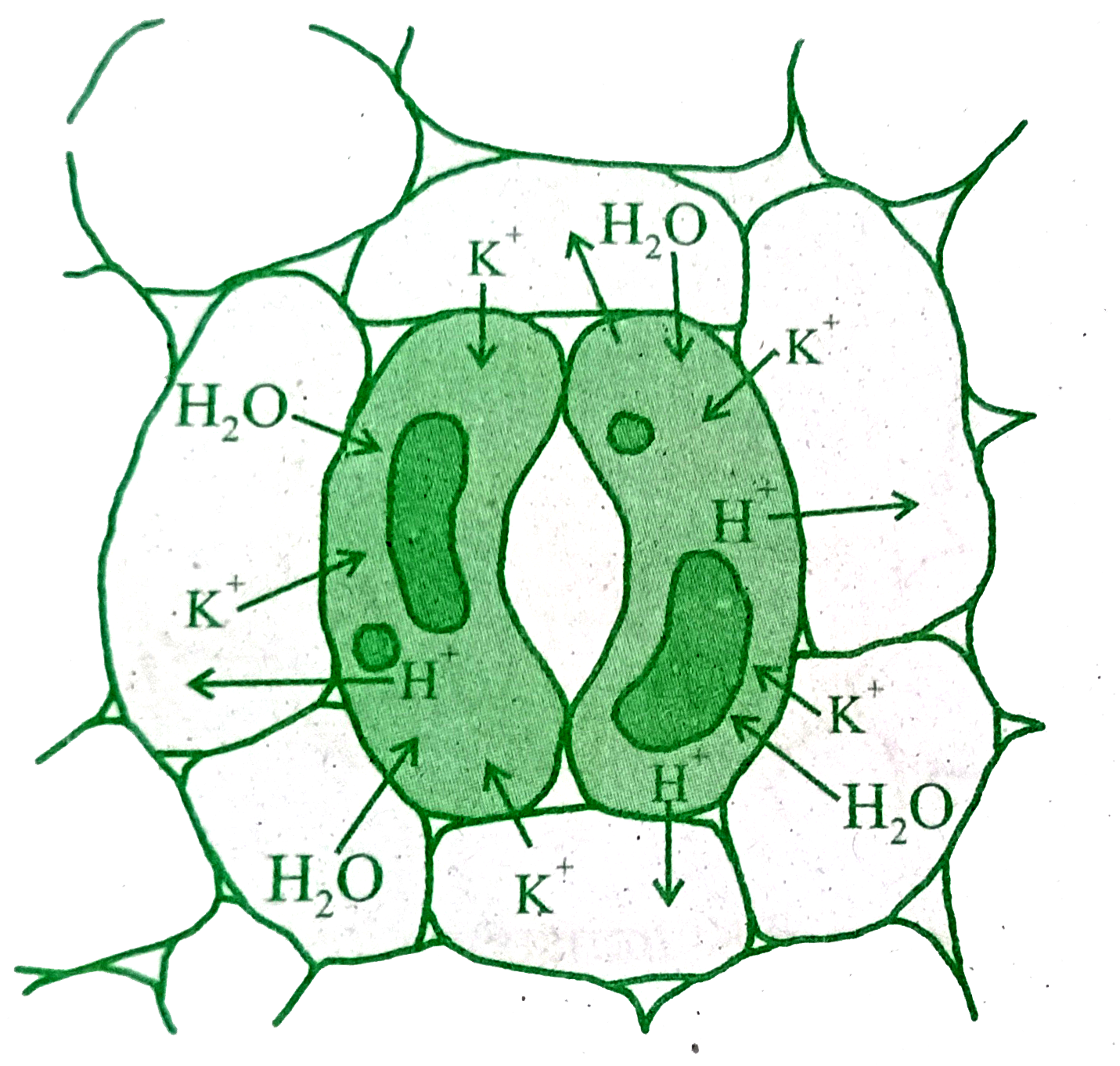
Describe the theory of `K^(+)` transport theory of stomatal opening.

Text Solution

Verified by Experts

This theory was proposed by Levit (1974) and elaborated by Raschke (1975) . According to this theory the following steps are involved in the stomatal opening:
In light :
1. In guard cell starch is converted into organic acid (malic acid ).
2. Malic acid in guard cell dissociates to malate anion and proton `(H^(+)`).
3. The protons are transported through the membrane into the nearby subsidiary cells with the exchange of `K^(+)` (Potassium ions ) from subsidiary cells to guard cells. This process involves an electrical gradient and is called ion exchange.
4. This ion exchange is an active process and consumes ATP for energy.
5. Increased `K^(+)` ions in the guard cell are balanced by `CI^(-)` ions. Increase in solute concentration decreases the water potential in the guard cell.
6. Guard cell becomes hypertonic and favour the entry of water from surrounding cells.
7. Increased turgor pressure due to the entry of water opens the stomatal pore.

In Dark :
1. In dark photosynthesis stops and respiration continues with accumulation of `CO_(2)` in the sub stomatal cavity .
2. Accumulation of `CO_(2)` in cell lowers the pH level.
3. Low pH and a shortage of water in the guard cell activate the stress hormone Abscisic acid (ABA).
4. ABA stops further entry of `K^(+)` ions and also induce `K^(+)` ions to leak out to subsidiary cells froms guard cell.
5. Loss of water from guard cell reduces turgor pressure and causes closure of stomata.
Promotional Banner

Similar Questions

Explore conceptually related problems

Describe the K^(+) Transport theory on transpiration .

The theory of K^(+) transport to explain stomatal opening was proposed by __________ .

Kinetic theory

Show the K^(+) transport theory of opening of stomata with diagram.

Theory of K^+ transport was proposed by

Describe the histogen theory.

Histogen theory of Stem. Explain.

