

Home
Class 10
MATHS
In a circular table cover of radius 32 c...

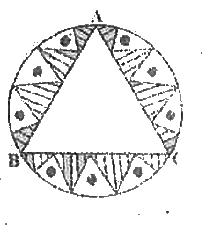
In a circular table cover of radius 32 cm, a design is fromed leaving an equilateral triangle ABC in the middle as shown in Fig. 5.24. Find the area of the design.

Promotional Banner

Topper's Solved these Questions

  • AREAS RELATED TO CIRCLES

    SUBHASH PUBLICATION|Exercise EXERCISE 5.2|19 Videos
  • ANNUAL EXAMINATION QUESTION PAPER JUNE-2019 (WITH ANSWERS)

    SUBHASH PUBLICATION|Exercise EXERCISE|35 Videos
  • ARITHMETIC PROGRESSION

    SUBHASH PUBLICATION|Exercise Exericise 1.3|31 Videos

Similar Questions

Explore conceptually related problems

In a circular table cover of radius 32cm, a design is formed leaving an equilateral triangle ABC in the middle as shown in the figure. Find the area of the design.

From each corner of a square of side 4 cm a quadrant of a circle of radius 1 cm is cut and also a circle of diameter 2 cm is cut as shown in Fig. 5.23. Find the area of the remaining portion of the square.

From a circular card sheet of radius 14cm, two circles of radius 3.5cm and a rectangle of length 3cm and breadth 1cm are removed (as shown in the adjoining figure. Find the area of the remaining sheet. (Take pi=22/7 )

The area of an equilateral triangle ABC is 17320.5 cm^2 . With each vertex of the trianlge as centre, a circle is drawn with radius equal to half the length of the side of the triangle. Find the area of the shaded region .

In the given figure, Delta POR is an equilateral triangle of side 8 cm and D, E, F are centres of circular arcs, each of radius 4 cm. Find the area r shaded region. (Use pi = 3.14 and sqrt(3) = 1.732)

A round table cover has six designs of equal area as shown is the figure. If the radius of the cover is 28cm, find the cost of making the designs at the rate Rs. 0.35 per cm^2

Find the area of the shaded region in Fig. 5.22, where a circular arc of radius 6 cm has been drawn with vertex O of an equilateral triangle OAB of side 12 cm as centre.

A circular disc of radius 3 cm is being heated. Due to expansion, its radius increased at the rate of 0.05 cm//s . Find the rate at which its area is increasing when radius is 3.2 cm.

SUBHASH PUBLICATION-AREAS RELATED TO CIRCLES-EXERCISE 5.3
  1. Unless stated otherwise, use pi=(22)/(7). Find the area of the shade...

    Text Solution

    |

  2. Find the area of the shaded region in Fig., if radii of the two conecn...

    Text Solution

    |

  3. Find the area of the shaded region in Fig, if ABCD is a square of side...

    Text Solution

    |

  4. Find the area of the shaded region in Fig. 5.22, where a circular arc ...

    Text Solution

    |

  5. From each corner of a square of side 4 cm a quadrant of a circle of ra...

    Text Solution

    |

  6. In a circular table cover of radius 32 cm, a design is fromed leaving ...

    Text Solution

    |

  7. In the figure , ABCD is a square of side 14 cm. A, B, C and D are the ...

    Text Solution

    |

  8. Fig. 5.26 depicts a racing whose left and right ends are semicircular....

    Text Solution

    |

  9. Fig. 5.26 depicts a racing whose left and right ends are semicircular....

    Text Solution

    |

  10. AB and CD are two diameters of a circle perpendicular to each other an...

    Text Solution

    |

  11. The area of an equilateral triangle ABC is 17320.5 cm^2. With each ver...

    Text Solution

    |

  12. On a square handkerchief, nine circular desins each of radius 7 cm are...

    Text Solution

    |

  13. In Fig, OACB is a quadrant of a circle with centre O and radius 3.5 cm...

    Text Solution

    |

  14. In Fig, OACB is a quadrant of a circle with centre O and radius 3.5 cm...

    Text Solution

    |

  15. In Fig, a square OABC is incribed in a quadrant OPBQ. If OA = 20 cm, f...

    Text Solution

    |

  16. AB and CD are respectively arcs of two concentric circle of 21 cm and ...

    Text Solution

    |

  17. In the fig.ABC is a quadrant of a circle of radius 14cm and a semicirc...

    Text Solution

    |

  18. Calculate the area of the designed region in Fig. 5.34 common between ...

    Text Solution

    |