Home
Class 12
CHEMISTRY
Consider the reversible isothermal expan...

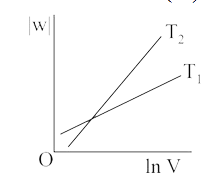
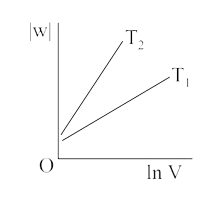
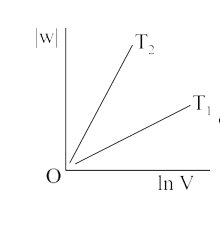
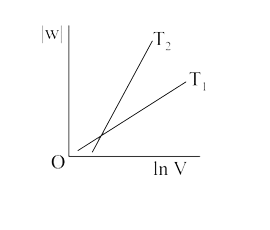
Consider the reversible isothermal expansion of an ideal gas in a closed system at two different temperatures `T_(1)` and `T_(2)(T_(1)ltT_(2))`. The correct graphical depiction of the dependence of work done (w) on the final volume (V) is:

A

B

C

D

Text Solution

AI Generated Solution

The correct Answer is:

To solve the problem of the reversible isothermal expansion of an ideal gas at two different temperatures \( T_1 \) and \( T_2 \) (where \( T_1 < T_2 \)), we need to analyze the relationship between the work done (w) and the final volume (V) of the gas. ### Step-by-Step Solution: 1. **Understand the Work Done in Isothermal Expansion**: The work done \( W \) during the isothermal expansion of an ideal gas can be expressed using the formula: \[ W = -nRT \ln \left(\frac{V_f}{V_i}\right) \] where: - \( n \) = number of moles of gas - \( R \) = universal gas constant - \( T \) = absolute temperature (in Kelvin) - \( V_f \) = final volume - \( V_i \) = initial volume 2. **Magnitude of Work Done**: Since we are interested in the magnitude of work done, we can ignore the negative sign: \[ |W| = nRT \ln \left(\frac{V_f}{V_i}\right) \] 3. **Graphical Representation**: - The work done \( |W| \) is dependent on the natural logarithm of the ratio of final volume to initial volume. - As \( V_f \) increases, \( |W| \) also increases, indicating a positive correlation between work done and final volume. 4. **Comparing Two Temperatures**: - For two different temperatures \( T_1 \) and \( T_2 \): - At a higher temperature \( T_2 \), the work done will be greater for the same change in volume compared to \( T_1 \) because \( |W| \) is directly proportional to \( T \). - Therefore, the graph of work done versus final volume will show that at \( T_2 \), the curve will be above that of \( T_1 \). 5. **Identifying the Correct Graph**: - The graph will show two curves, one for \( T_1 \) and one for \( T_2 \). Both curves will be increasing, with the curve for \( T_2 \) lying above the curve for \( T_1 \). - The intercepts on the work axis will be negative because as \( V_f \) approaches \( V_i \), the work done approaches zero, but remains negative due to the nature of expansion. ### Conclusion: The correct graphical depiction of the dependence of work done (w) on the final volume (V) will show two curves: one for \( T_1 \) and one for \( T_2 \), with the curve for \( T_2 \) lying above that of \( T_1 \) and both having negative intercepts.

To solve the problem of the reversible isothermal expansion of an ideal gas at two different temperatures \( T_1 \) and \( T_2 \) (where \( T_1 < T_2 \)), we need to analyze the relationship between the work done (w) and the final volume (V) of the gas. ### Step-by-Step Solution: 1. **Understand the Work Done in Isothermal Expansion**: The work done \( W \) during the isothermal expansion of an ideal gas can be expressed using the formula: \[ W = -nRT \ln \left(\frac{V_f}{V_i}\right) ...
Promotional Banner

Similar Questions

Explore conceptually related problems

The correct representation of wavelength intensity relationship of an ideal blackbody radiation at two different temperatures T_(1) and T_(2) is

The amount of work done in an adiabatic expansion from temperature T to T_(1) is

The isothermal diagram of a gas at three different temperatures T_(1),T_(2) and ^_(3) , is show in the given figure .Then

Two curves are given at temperatures T_(1) and T_(2) in an isothermal process, then-

Entrolpy change in isothermal expansion work of one mole of an ideal gas from volume V_(1) and V_(2) is given by

Figure shows graphs of pressure versus density for an ideal gas at two temperatures T_(1) and T_(2) Which is correct ? .

Correct relation for isothermal reversible expansion of an ideal gas is DeltaS = 0 DeltaG = - T DeltaS DeltaH != 0 DeltaU != 0
