Home
Class 12
PHYSICS
A solid metal cube of edge length 2 cm i...

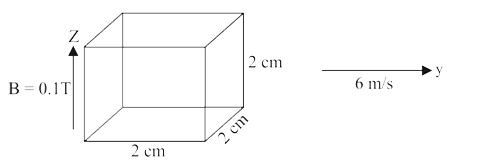
A solid metal cube of edge length 2 cm is moving in a positive y-direction at a constant speed of 6 m/s. There is a uniform magnetic field of 0.1 T in the positive z-direction. The potential difference between the two faces of the cube perpendicular to the x-axis, is :

A

1 mV

B

6 mV

C

2 mV

D

12 mV

Text Solution

Verified by Experts

The correct Answer is:
D


`epsilon=VBL=6xx0.1xx0.02=12mV`
Promotional Banner

Similar Questions

Explore conceptually related problems

A solid metal cube of edge length 2 cm is moving in a positive y-direction at a constant speed of 8m/s There is a uniform magnetic field of 0.1 T in the positive z-direction. The potential difference between the two faces of the cube perpendicular to the x-axis, is

A conductor rod AB moves parallel to X-axis in a uniform magnetic field, pointing in the positive Z-direction. The end A of the rod gets-

A metal rod of length 2 m is rotating with an angular velocity of 100 rad//sec in a plane perpendicular to a uniform magnetic field of 0.3 T . The potential difference between the ends of the rod is

Consider the following figure, a uniform magnetic field of 0.2 T is directed along the positive X-axis. The magnetic flux through top surface of the figure.

A metal rod of length 2 m is rotating with an angualr velocity of 100 "rads"^(-1) in plane perpendicular to a uniform magnetic field of 0.3 T. The potential difference between the ends of the rod is

A conducting rod AB moves parallel to the x-axis (see Fig.) in a uniform magnetic field pointing in the positive z-direction. The end A of the rod gets positively charged. .

Given figure shows a coil bent with all edges of length 1 m and carrying a current of 1 A . There exists in space a uniform magnetic field of 2 T in positive y-direction. Find the torque on the loop.

Two rings of radii 5m and 10m move in opposite directions with velocity 20 m/s and 10 m/s respectively, on a conducting curface S. There is a uniform magnetic field of magnitude 0.1T perpendicular to the plane of the rings. Find the potential difference between the highest points of the two rings.

