Home
Class 12
PHYSICS
Two identical beakers A and B contain eq...

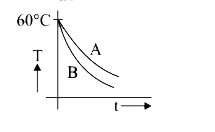
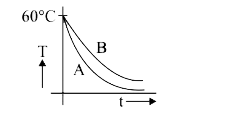
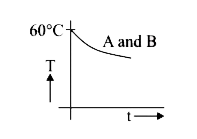
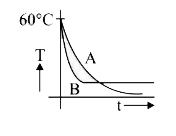
Two identical beakers A and B contain equal volumes of two different liquids at `60^@C` each and left to cool down. Liquid in A has density of `8xx10^(2)kg//m^3` and specific heat of `2000 J kg ^(-1)K^(-1)` while liquid in B has density of `10^(3)kgm^(-3)` and specific heat of `4000J kg ^(-1)K^-1` . Which of the following best describes their temperature versus time graph schematically ? (assume the emissivity of both the beakers to be the same)

A

B

C

D

Text Solution

AI Generated Solution

The correct Answer is:

To solve the problem, we need to analyze the cooling rates of the two liquids in beakers A and B based on their specific heat capacities and masses. Here’s a step-by-step breakdown of the solution: ### Step 1: Calculate the Mass of the Liquids The mass of the liquid in each beaker can be calculated using the formula: \[ \text{Mass} (m) = \text{Density} (\rho) \times \text{Volume} (V) \] - For beaker A: \[ m_A = \rho_A \times V = (800 \, \text{kg/m}^3) \times V \] - For beaker B: \[ m_B = \rho_B \times V = (1000 \, \text{kg/m}^3) \times V \] ### Step 2: Identify the Specific Heat Capacities The specific heat capacities of the liquids are given as: - For liquid A: \( c_A = 2000 \, \text{J/kg/K} \) - For liquid B: \( c_B = 4000 \, \text{J/kg/K} \) ### Step 3: Calculate the Heat Capacity (C) of Each Liquid The heat capacity \( C \) is calculated as: \[ C = m \times c \] - For beaker A: \[ C_A = m_A \times c_A = (800V) \times (2000) = 1600000V \, \text{J/K} \] - For beaker B: \[ C_B = m_B \times c_B = (1000V) \times (4000) = 4000000V \, \text{J/K} \] ### Step 4: Compare the Heat Capacities From the calculations: - \( C_A = 1600000V \) - \( C_B = 4000000V \) Since \( C_B > C_A \), it indicates that beaker B has a higher heat capacity than beaker A. ### Step 5: Apply Newton's Law of Cooling According to Newton's law of cooling, the rate of change of temperature is given by: \[ \frac{d\theta}{dt} = -k \frac{(T - T_0)}{C} \] Where: - \( T \) is the temperature of the liquid, - \( T_0 \) is the surrounding temperature, - \( k \) is a constant. Since \( C_B > C_A \), the rate of temperature change \( \frac{d\theta}{dt} \) will be smaller for beaker B compared to beaker A. ### Step 6: Analyze the Temperature vs. Time Graph Since the cooling rate of beaker B is slower than that of beaker A, the temperature of liquid A will decrease faster than that of liquid B. Therefore, the temperature vs. time graph will show: - Beaker A will have a steeper slope (cooling faster), - Beaker B will have a gentler slope (cooling slower). ### Conclusion The best schematic representation of the temperature versus time graph will show the temperature of liquid A decreasing faster than that of liquid B.

To solve the problem, we need to analyze the cooling rates of the two liquids in beakers A and B based on their specific heat capacities and masses. Here’s a step-by-step breakdown of the solution: ### Step 1: Calculate the Mass of the Liquids The mass of the liquid in each beaker can be calculated using the formula: \[ \text{Mass} (m) = \text{Density} (\rho) \times \text{Volume} (V) \] ...
Promotional Banner

Similar Questions

Explore conceptually related problems

Specific heat capacity of water is ____ J kg^(-1) K^(-1) .

An electric kettle of 2000 Wis used to boil 20 litres of water. Find the time required to boil to the water from its initial temperature of 20^(@)C . (Take specific heat of water as 4200 J kg^(-1) K^(-1) . Density of water = 1000kg m^(-3) )

The difference between two specific heats of a gas is 5000 J kg^-1 K^-1 and the ratio of specific heats is 1.6. Find the two specific heats.

A calorimeter has mass 100 g and specific heat 0.1 kcal/ kg.^(@)C . It contains 250 g of liquid at 30^(@) C having specific heat of 0.4 kcal/ kg.^(@) C . If we drop a piece of ice of mass 10 g at 0^(@) c into it , what will be the temperature of the mixture ?

500 kg of water is heated from 20^(@) to 100^(@) C . Calculate the increase in the mass of water.Given specific heat of water =4.2 xx 10^(3) J kg ^(-1) .^(@)C^(-1) .

What will be the result of mixing 2kg of cooper at 100^(@)C with 0.75 kg of ice at 0^(@)C (Specific heat capacity of cooper =378J kg^(-1)K^(-1) specific heat capacity of water =4200 J kg^(-1)K^(-1) and specific latent heat of fusion of ice =336xx10^(3)Jkg^(-1) )

400 kg of water is heated from 30^(@) C to 100^(@)C . What will be the increase in mass of water ? Take specific heat of wateer = 4.2 xx10^(3) " J kg"^(-1).^(@)C^(-1) .
