Home
Class 12
PHYSICS
A solid conducting sphere, having a char...

A solid conducting sphere, having a charge Q, is surrounded by an uncharged conducting hollow spherical shell. Let the potential difference between the surface of the solid sphere and that of the outer surface of the hollow shell be V. If the shell is now given a charge of -4 Q, the new potential difference between the same two surfaces

A

4 V

B

2 V

C

`-2V`

D

V

Text Solution

Verified by Experts

The correct Answer is:
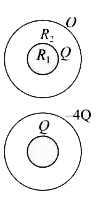
D

Initial `pd = (KO)/(R_1) - (KO)/(R_2) = V`
Final `pd = ((KQ)/(R_1) - (4KQ)/(R_2)) - ((KQ)/(R_2))`
`(KQ)/(R_1) - (KQ)/(R_2) = V`
Promotional Banner

Similar Questions

Explore conceptually related problems

A solid conducting sphere having a charge Q is surrounded by an uncharged concentric conducting hollow spherical shell. Let the potential difference between the surface of the solid sphere and that of the outer surface of the hollow shell be V. If the shell is now given a charge of -3Q , the new potential difference between the same two surfaces is :

A conducting shell S_1 having a charge Q is surrounded by an uncharged concentric conducting spherical shell S_2 . Let the potential difference between S_1 and that S_2 be V. If the shell S_2 is now given a charge -3Q , the new potential difference between the same two shells is

A conducting sphere is enclosed by a hollow conducting shell. Initially the inner sphere has a charge Q while the outer one is uncharged. The potential difference between the two spherical surface is found to be V. later on the outer shell is given a charge -4Q. The new potential difference between the two surfaces is : (A) V (B) -V (C) -2V (D) 2V

In the given figure there are two concentric shells find potential difference between spheres.

Two hollow concentric non-conducting spheres of radius the a and b (a gt b) contain charges Q_(a) and Q_(b) respectively. Prove that potential difference between the two spheres is independent of charge on outer sphere. If outer sphere is given an extra charge, is there any change in potential difference ?

A conducting sphere carrying charge Q is surrounded by a spherical conducting shell. a. What is the net charge on the inner surface of the shell? b. Another charge q is placed outside the shell. Now, what is the net charge on the inner surface of the shell? c. If q is moved to a position between the shell and the sphere, what is the net charge on the inner surface of the shell? d. Are your answer valid if the sphere and shell are not concentric?

A solid metallic sphere of radius a is surrounded by a conducting spherical shell of radius b(bgt a ). The solid sphere is given a charge Q. A student measures the potential at the surface of the solid sphere as V and the potential at the surface of spherical shell as V_b . After taking these readings, he decides . to put charge of -4Q on the shell. He then noted the readings of the potential of solid sphere and the shell and found that the potential difference is /_\V . He then connected the outer spherical shell to the earth by a conducting wire and found that the charge on the outer surface of the shell as He then decides to remove the earthing connection from the shell and earthed the inner solid sphere. Connecting the inner sphere with the earth he observes the charge on the solid sphere as q_2 . He then wanted to check what happens if the two are connected by the conducting wire. So he removed the earthing connection and connected a conducting wire between the solid sphere and the spherical shelll. After the connections were made he found the charge on the outer shell as q_3 . Potential difference (/_\CV) measured by the student between the inner solid shere and outer shell after putting a charge -4Q is

