Home
Class 12
CHEMISTRY
Points I, II and III in the following pl...

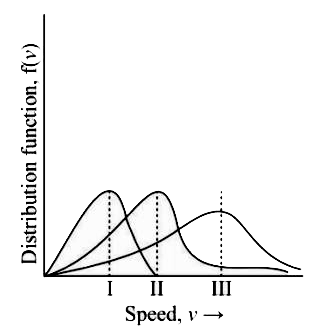
Points I, II and III in the following plot respectively correspond to (`V_(mp)`: most probable velocity)

A

`V_(mp) " of " N_(2) (300K), V_(mp) " of " H_(2) (300K), V_(mp) " of " O_(2) (400K)`

B

`V_(mp) " of " N_(2) (300K), V_(mp) " of " O_(2) (400K), V_(mp) " of " H_(2) (300K)`

C

`V_(mp) " of " H_(2) (300K), V_(mp) "of " N_(2) (300K), V_(mp) " of " O_(2) (400K)`

D

`V_(mp) " of " O_(2) (400K), V_(mp) " of " N_(2) (300K), V_(mp) " of " H_(2) (300K)`

Text Solution

Verified by Experts

The correct Answer is:

B

`V_(mp) = sqrt((2RT)/(M))` , where R `rArr` universal gas constant `rArr` Temperature `rArr` Molar mass
Greater the `(T)/(M)` ratio, greater will be the speed and higher the speed, the graph will shift towards right
Promotional Banner

Similar Questions

Explore conceptually related problems

The most probable velocity is expressed as

A gas consists of molecules of mass m and is at a temperature T . Making use of the Maxwell velocity distribution function, find the corresponding distribution of the molecules over the kinetic energies epsilon . Determine the most probable value of a gas the kinetic energy epsilon_p . Does epsilon_p correspond to the most probable velocity ?

Find the de Broglie wavelength of hydrogen molecules, which corresponds to their most probable velocity at room temperature.

Among the following , the plot that shows the correct marking of most probable velocity (V_(MP)) average velocity (vecV) and root mean square velocity (V_(RMS) ) is :

Identify the correct labels of A, B and C in the following graph from the options given below: Root mean square speed (V_("rms"), most probable speed (V_("mp") , Average speed (V_("av"))

The relation between rms velocity, v_(rms) and the most probable velocity, v_(mp) , of a gas is

Consider the plots for the types of reaction nAtoB+C These plots respectively correspond to the reaction orders :

Consider the plots for the types of reaction nAtoB+C These plots respectively correspond to the reaction orders :
