Home
Class 12
PHYSICS
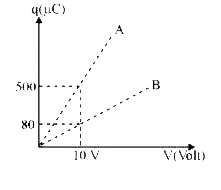
Figure shows charge (q) versus voltage (...

Figure shows charge (q) versus voltage (V) graph for series and parallel combination to two given capacitors. The capacitances are:

A

`20 mu F` and `30 mu F`

B

`40 muF` and `10 muF`

C

`60 muF` and `30 muF`

D

`50 muF` and `30 mu F`

Text Solution

Verified by Experts

The correct Answer is:

B

For series combination
`(C_(1)C_(2))/(C_(1)+C_(2)) =C_(eq) =80/10 =8`……..(1)
For parallel combination
`C_(1) + C_(2) =C_(eq) =500/10 =50`………..(2)
Solving (1) & (2)
`C_(1) = 40 muF`
`C_(2) = 10 muF`
Promotional Banner

Similar Questions

Explore conceptually related problems

Explain the series and parallel combinations of capacitors.

Combination of capacitors| series and parallel combination

combination OF capacitor ( series and parallel )

A capacitor of capacitance C_(1) is charged to a potential V_(1) while another capacitor of capacitance C_(2) is charged to a potential difference V_(2) . The capacitors are now disconnected from their respective charging batteries and connected in parallel to each other . (a) Find the total energy stored in the two capacitors before they are connected. (b) Find the total energy stored in the parallel combination of the two capacitors. (c ) Explain the reason for the difference of energy in parallel combination in comparison to the total energy before they are connected.

Energy stored in a capacitor |Series combination|Parallel combination

Two identical capacitors are connected in series with a source of constant voltage V . If Q is the charge on one of the capacitors, the capacitance of each capacitor is :

Plot A & B represent variation of charge with potential difference across the combination (series and parallel) of two capacitors. Then Find the values of capacitance of capacitors.

For capacitors in series combination, total capacitance C is given by

A battery is used to charge a parallel plate combination of two identical capacitors. If the potential difference across the battery is V and the total charge Q flows through the battery during the charging process then 1) The charge on each capacitor is Q/2 and the potential of each capacitor is V/2 2) The charge on each capacitor is Q and the potential of each capacitor is V 3) The charge on each capacitor is Q/2 and the potential of each capacitor is V 4) The charge on each capacitor is Q and the potential of each capacitor is V/2
