Home
Class 12
CHEMISTRY
A bacterial infection in an internal wou...

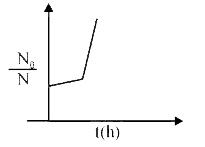
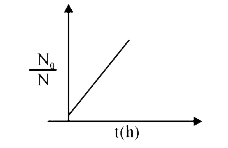
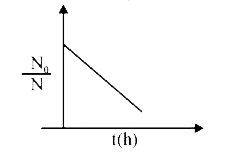
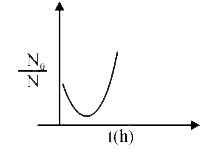
A bacterial infection in an internal wound grows as `N'(t) = N_(0) exp (t)`, where the time t is in hours.A dose of antibiotic, taken orally, needs 1 hour to reach the wound. Once it reaches there, the bacterial population goes down as `(dN)/(dt)= -5 N^(2)`. What will be the plot of `N_(0)/N` vs. t after 1 hour?

A

B

C

D

Text Solution

AI Generated Solution

The correct Answer is:

To solve the problem step by step, we need to analyze the growth of the bacterial infection and the effect of the antibiotic over time. ### Step 1: Understand the Growth of Bacteria The bacterial population grows according to the equation: \[ N'(t) = N_0 e^t \] where \( N_0 \) is the initial bacterial population and \( t \) is the time in hours. ### Step 2: Calculate Bacterial Population Before Antibiotic Effect For the first hour (from \( t = 0 \) to \( t = 1 \)): At \( t = 1 \): \[ N(1) = N_0 e^1 = N_0 e \] ### Step 3: Effect of Antibiotic After 1 Hour After 1 hour, the antibiotic reaches the wound, and the bacterial population starts to decrease according to the equation: \[ \frac{dN}{dt} = -5N^2 \] ### Step 4: Solve the Differential Equation We need to solve the differential equation: \[ \frac{dN}{dt} = -5N^2 \] Rearranging gives: \[ \frac{dN}{N^2} = -5 dt \] Now, we integrate both sides. The left side integrates to: \[ \int \frac{dN}{N^2} = -\frac{1}{N} \] The right side integrates to: \[ -5 \int dt = -5t + C \] ### Step 5: Apply Initial Conditions At \( t = 1 \), \( N = N_0 e \): \[ -\frac{1}{N_0 e} = -5(1) + C \] Thus, \[ C = -\frac{1}{N_0 e} + 5 \] ### Step 6: Substitute Back to Find N Substituting \( C \) back into the equation gives: \[ -\frac{1}{N} = -5t - \frac{1}{N_0 e} + 5 \] Rearranging gives: \[ \frac{1}{N} = 5t - 5 + \frac{1}{N_0 e} \] ### Step 7: Express \( \frac{N_0}{N} \) To find \( \frac{N_0}{N} \): \[ \frac{N_0}{N} = \frac{N_0}{\frac{1}{5t - 5 + \frac{1}{N_0 e}}} \] This simplifies to: \[ \frac{N_0}{N} = N_0 \left( 5t - 5 + \frac{1}{N_0 e} \right) \] ### Step 8: Analyze the Plot of \( \frac{N_0}{N} \) vs. \( t \) The equation for \( \frac{N_0}{N} \) is linear in \( t \): \[ \frac{N_0}{N} = 5N_0 t - 5N_0 + \frac{1}{e} \] This indicates that the plot of \( \frac{N_0}{N} \) vs. \( t \) will be a straight line with a slope of \( 5N_0 \) and a y-intercept of \( -5N_0 + \frac{1}{e} \). ### Conclusion The plot of \( \frac{N_0}{N} \) vs. \( t \) after 1 hour will be a straight line with a positive slope. ---

To solve the problem step by step, we need to analyze the growth of the bacterial infection and the effect of the antibiotic over time. ### Step 1: Understand the Growth of Bacteria The bacterial population grows according to the equation: \[ N'(t) = N_0 e^t \] where \( N_0 \) is the initial bacterial population and \( t \) is the time in hours. ### Step 2: Calculate Bacterial Population Before Antibiotic Effect ...
Promotional Banner

Similar Questions

Explore conceptually related problems

Growth of a bacteria is represented as N(t)=N_(0)e^(lamdat) After one hour a drug is given which decreases bacterial growth as (dN)/(dt)=-5N^(2) Which of the following graph is correct.

The half-life of a sample of a radioactive substance is 1 hour. If 8 xx 10^10 atoms are present at t = 0 , then the number of atoms decayed in the duration t = 2 hour to t = 4 hour will be

At time t = 0, a material is composed of two radioactive atoms A and B, where N_(A0) = 2N_(B0) . The decay constant of both kind of radioactive atoms is lamda . However, A disintegrates to B and B disintegrates to C. Which of the following figures represents the evolution of N_B(t)//N_B(0) with respect to time t? [ N_A(0)= No. of A atoms at t = 0] [ N_B(0)= No. of B atoms at t= 0 ]

A balloon starts from the state of rest from the ground with constant acceleration g/n. after time T, a stone is dropped from the balloon. If stone takes time T to reach the ground then calculate value of n.

8 grams of a radioactive substance is reduced to 0.5 g after 1 hour . The t_(1//2) of the radioactive substance is

A population p(t) of 1000 bacteria introduced into nutrient medium grows according to the relation p(t)=1000+(1000t)/(100+t^2) . The maximum size of this bacterial population is equal to N then sum of the digits in N is

If S=t^(n) , where n ne 0 , then velocity equal acceleration at time t=3 sec if : n=
