Home
Class 12
CHEMISTRY
Heating of 2-chloro-1-phenylbutane with ...

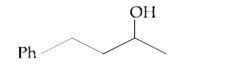
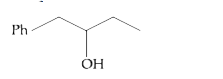
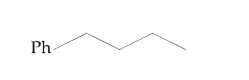
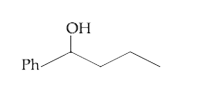
Heating of 2-chloro-1-phenylbutane with EtOK/EtOH gives X as the major product. Reaction of X with `Hg(PAc)_(2)//H_(2)O` followed by gives Y as the major product. Y is :

A

B

C

D

Text Solution

AI Generated Solution

The correct Answer is:

To solve the problem step by step, we will analyze the reactions involved in the transformation of 2-chloro-1-phenylbutane to the final product Y. ### Step 1: Identify the structure of 2-chloro-1-phenylbutane 2-chloro-1-phenylbutane has the following structure: - A butane chain (4 carbon atoms) with a phenyl group (C6H5) at the first carbon. - A chlorine atom (Cl) at the second carbon. ### Step 2: Reaction with EtOK/EtOH When 2-chloro-1-phenylbutane is treated with EtOK (ethoxide ion) in ethanol, an elimination reaction occurs. The ethoxide ion acts as a strong base and abstracts a proton from one of the beta carbons (the carbons adjacent to the carbon with the chlorine). #### Possible elimination pathways: 1. **Elimination at the beta carbon adjacent to the phenyl group**: - If the hydrogen from the beta carbon next to the phenyl group is abstracted, the double bond forms between the second and third carbons, resulting in a conjugated alkene. 2. **Elimination at the other beta carbon**: - If the hydrogen from the other beta carbon is abstracted, a double bond forms between the first and second carbons, leading to a non-conjugated alkene. #### Major Product (X): The major product X will be the more stable alkene, which is formed by the elimination that results in conjugation with the phenyl group. Therefore, the major product X is: - **1-phenyl-2-butene** (where the double bond is between the second and third carbons). ### Step 3: Reaction of X with Hg(OAc)₂/H₂O Next, we treat the alkene X (1-phenyl-2-butene) with mercuric acetate (Hg(OAc)₂) in the presence of water (H₂O). This reaction is known as oxymercuration-demercuration. #### Mechanism: 1. **Formation of a mercurinium ion**: - The double bond of the alkene attacks the mercury ion, forming a cyclic mercurinium ion. 2. **Nucleophilic attack by water**: - Water can attack either of the carbons involved in the double bond. However, due to the stability of the carbocation, the attack will occur at the more substituted carbon (the one that can stabilize the positive charge through resonance with the phenyl group). #### Major Product (Y): The product Y will be formed by the addition of an -OH group to the more substituted carbon (the one adjacent to the phenyl group) according to Markovnikov's rule. Therefore, the major product Y is: - **1-phenyl-2-butanol** (where the -OH group is added to the second carbon). ### Final Answer: Y is **1-phenyl-2-butanol**. ---

To solve the problem step by step, we will analyze the reactions involved in the transformation of 2-chloro-1-phenylbutane to the final product Y. ### Step 1: Identify the structure of 2-chloro-1-phenylbutane 2-chloro-1-phenylbutane has the following structure: - A butane chain (4 carbon atoms) with a phenyl group (C6H5) at the first carbon. - A chlorine atom (Cl) at the second carbon. ### Step 2: Reaction with EtOK/EtOH ...
Promotional Banner

Similar Questions

Explore conceptually related problems

The major product X of the reaction

The major product X of the reaction

Treatment of benzene with CO/HCl in the presence of anhydrous "AlCl"_(3)//"CuCl" followed by reaction with Ac_(2)"O"//"NaOAc" gives compound X as the major product. Compound X upon reaction with Br_(2)//Na_(2)CO_(3) , followed by heating at 473 K with moist KOH furnishes Y as the major product. Reaction of X with H_(2)//Pd-C , followed by H_(3)PO_(4) treatment gives Z as the major product. The compound Y is

Treatment of benzene with CO/HCl in the presence of anhydrous "AlCl"_(3)//"CuCl" followed by reaction with Ac_(2)"O"//"NaOAc" gives compound X as the major product. Compound X upon reaction with Br_(2)//Na_(2)CO_(3) , followed by heating at 473 K with moist KOH furnishes Y as the major product. Reaction of X with H_(2)//Pd-C , followed by H_(3)PO_(4) treatment gives Z as the major product. The compound Z is

2-Chloro-2-methylpropane on reaction with aqueous KOH gives X as the major product. X is
