Home
Class 12
PHYSICS
A charges Q is placed at each of the two...

A charges Q is placed at each of the two opposite corners of a square. A charge q is placed to each of the other two corners. If the resultant force on each charge q is zero, then

A

`Q=-2sqrt2q`

B

`Q=sqrt2q`

C

`Q=-sqrt2q`

D

Q=-2q

Text Solution

Verified by Experts

The correct Answer is:
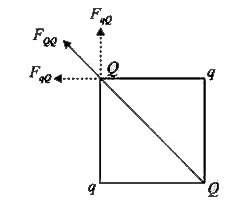
A

The force on charge is zero, therefore
`F_(qQ) cos 45^@+F_(qQ) cos 45^@ +F_(Q Q)=0`

`2F_(qQ)1/sqrt2+F_(Q Q)=0`
`1/(4piepsilon_0)[(qQ)/a^2 sqrt2 + (Q Q)/(2a^2)]=0`
`therefore Q=-2sqrt2q`
Promotional Banner

Similar Questions

Explore conceptually related problems

A charge Q is place at each of the opposite corners of a square. A charge q is placed at each of the other two corners. If the net electrical force on Q is zero, then Q//q equals:

A charge Q is placed at each of the two opposite corners of a square of side a.A charge is placed at each of the other two corners. (a) if the reultant electrical force system of charges? What is the signification of its negative potential energy?

Two equal point charges Q=+sqrt(2) mu C are placed at each of the two opposite corners of a square and equal point charges q at each of the other two corners. What must be the value of q so that the resultant force on Q is zero?

Four positive charges (2sqrt2-1)Q are arranged at the four corners of a square. Another charge q is placed at the center of the square. Resulting force acting on each corner charge is zero if q is

A charge +q is fixed to each of three corners of a square .On the empty corner a charge Q is placed such that there is no net electrostatic force acting on the diagonally opposite charge then

A point charge Q is placed at the corner of a square of side a. Find the flux through the square.

Two point charges +Q each are placed at adjacent corners of a square. Other two point charges -Q each are placed at the remaining two corners of the same square . The side of the square is l. Find electric field intensity at the centre of the square.

Four identical charges i.e. q is placed at the corners of a square of side a . The charge Q that must be placed at the centre of the square such that the whole system of charges in equilibrium is

