

Home
Class 11
PHYSICS
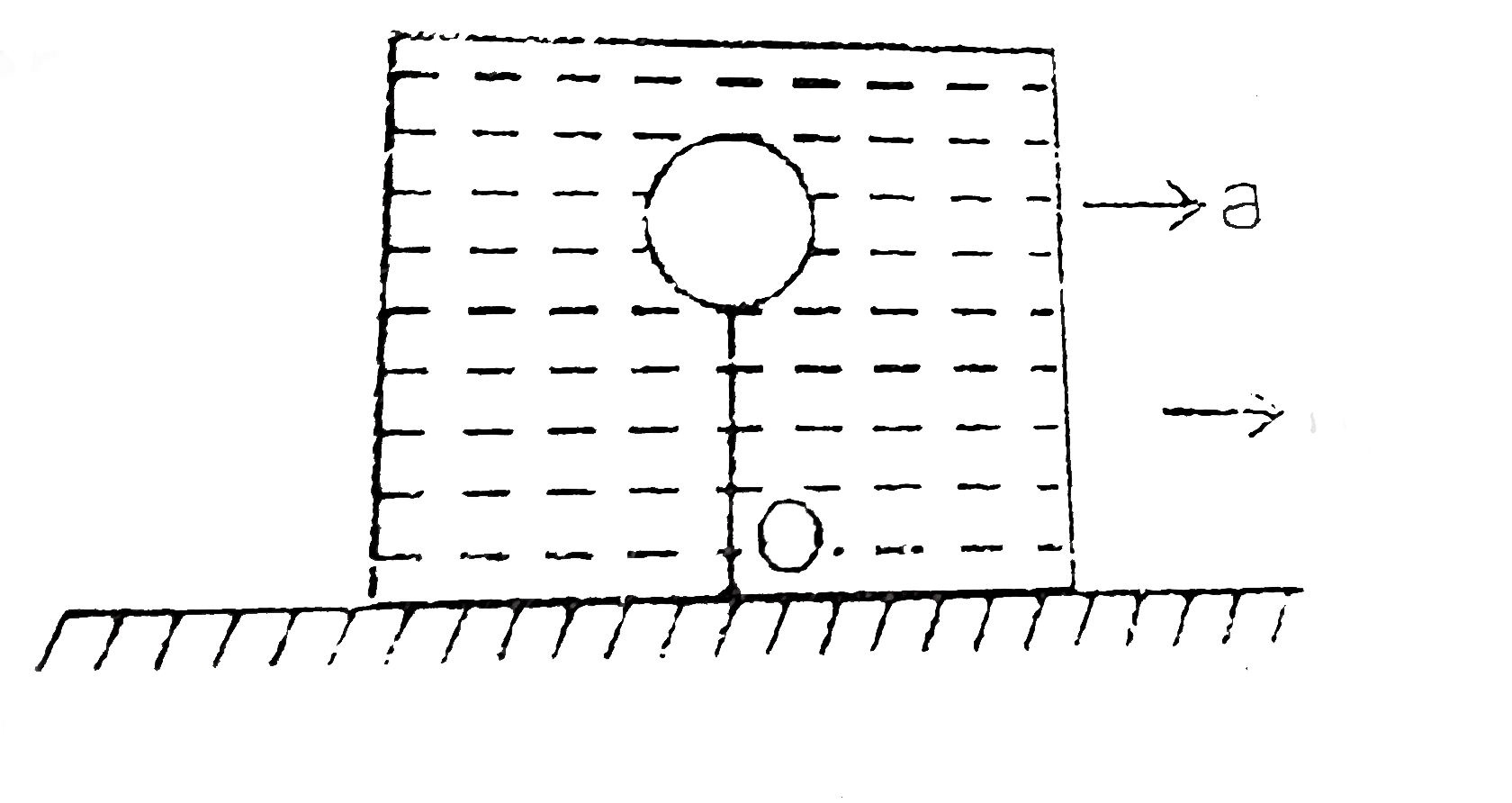
One end of light inelastic string is tie...

One end of light inelastic string is tied to a helium filled ballloon and its other end is tied bottom of a water filled container at point O. The container lies on a fixed horizontal acceleration of magnitude a. Assuming no relative motion of balloon and water with respect to container, the string will be inclined with vertical line passing through O by an angle (h is acceleration due to gravity)

Promotional Banner

Similar Questions

Explore conceptually related problems

The angle which the free surface of a liquid filled in a container will make with horizontal if the container is accelerated horizontally with acceleration (g)/(sqrt(3)) is

One end of ideal string tied up with fixed suppot & other end is tied with a bob. The string is released from horizontal position. When string makes an angle of theta with vertically downward direction then the acceleration vector of bob is horizontal then theta is

Two bodies of masses 4 kg and 6 kg are tied to the ends of a massless string. The string passes over a frictionless pulley. The acceleration of the system is :

A mass is attached to the end of a string of length l which is tied to a fixed point O. The mass is released from the initial horizontal position of the string. Below the point O at what minimum distance a peg P should be fixed so that the mass turns about P and can describe a complete circle in the vertical plane?

Inside a railway car a plumb bob is suspended from the roof and a helium filled balloon is tied by a string to the floor of the car. When the railway car accelerates to the right then.

A stone is tied to a string of length l and is whirled in a vertical circle with the other end of the string as the centre. At a certain instant of time, the stone is at its lowest position and has a speed u. The magnitude of the change in velocity as it reaches a position where the string is horizontal (g being acceleration due to gravity) is

Two bodies of mass 4 kg and tied to the ends of a massless string. the string passes over a pully which is frictionless (see figure). the acceleration of the system in terms of acceleration due to gravity (g) is:

One end of a string of length 1.5 m is tied to a stone of mass 0.4 kg and the other end to a small pivot on a smooth vertical board. What is the minimum speed of the stone required at its lower most point so that the string does not slack at any point in its motion along the vertical circle ?