Home
Class 11
PHYSICS
A horizontal bar of mass m(1) Prism of m...

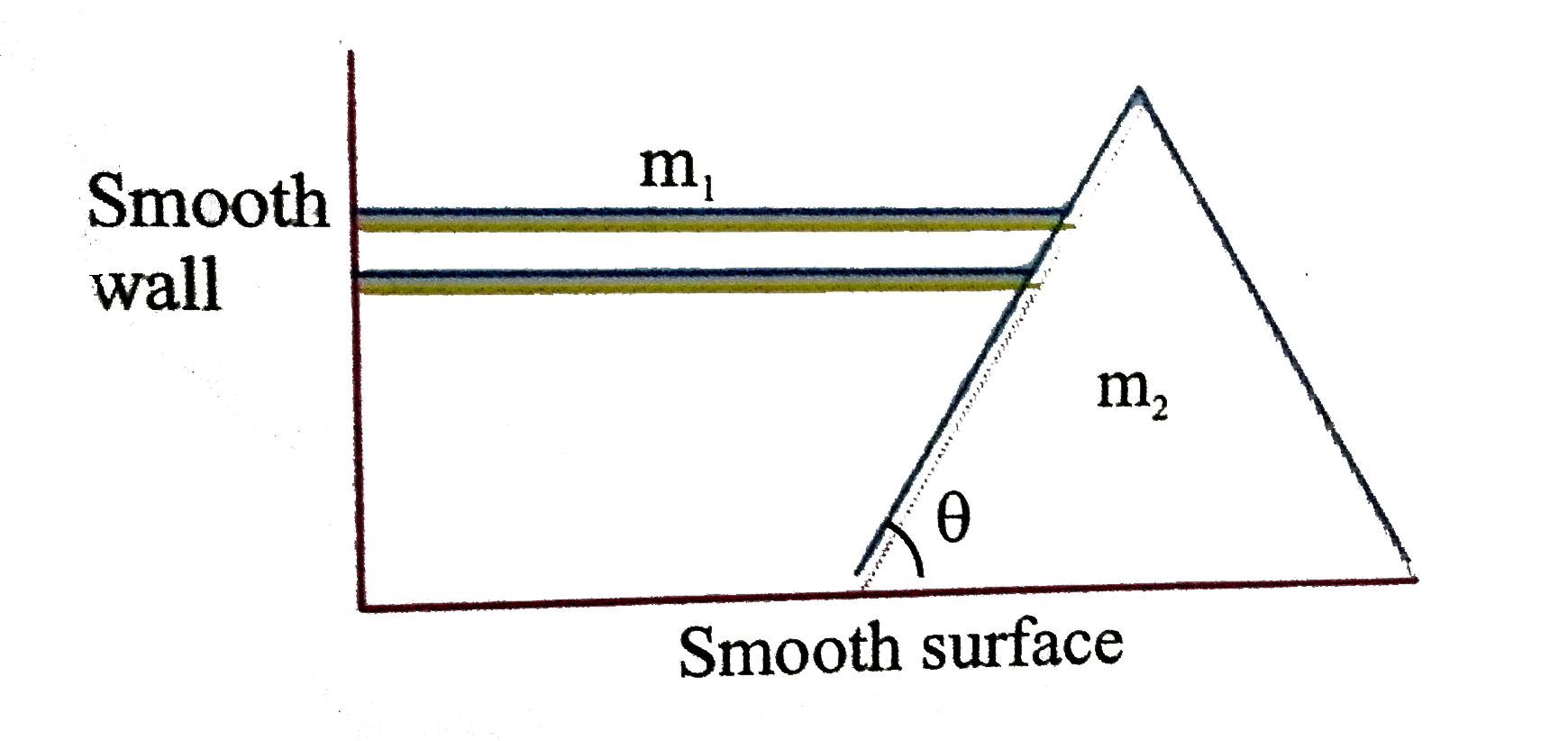
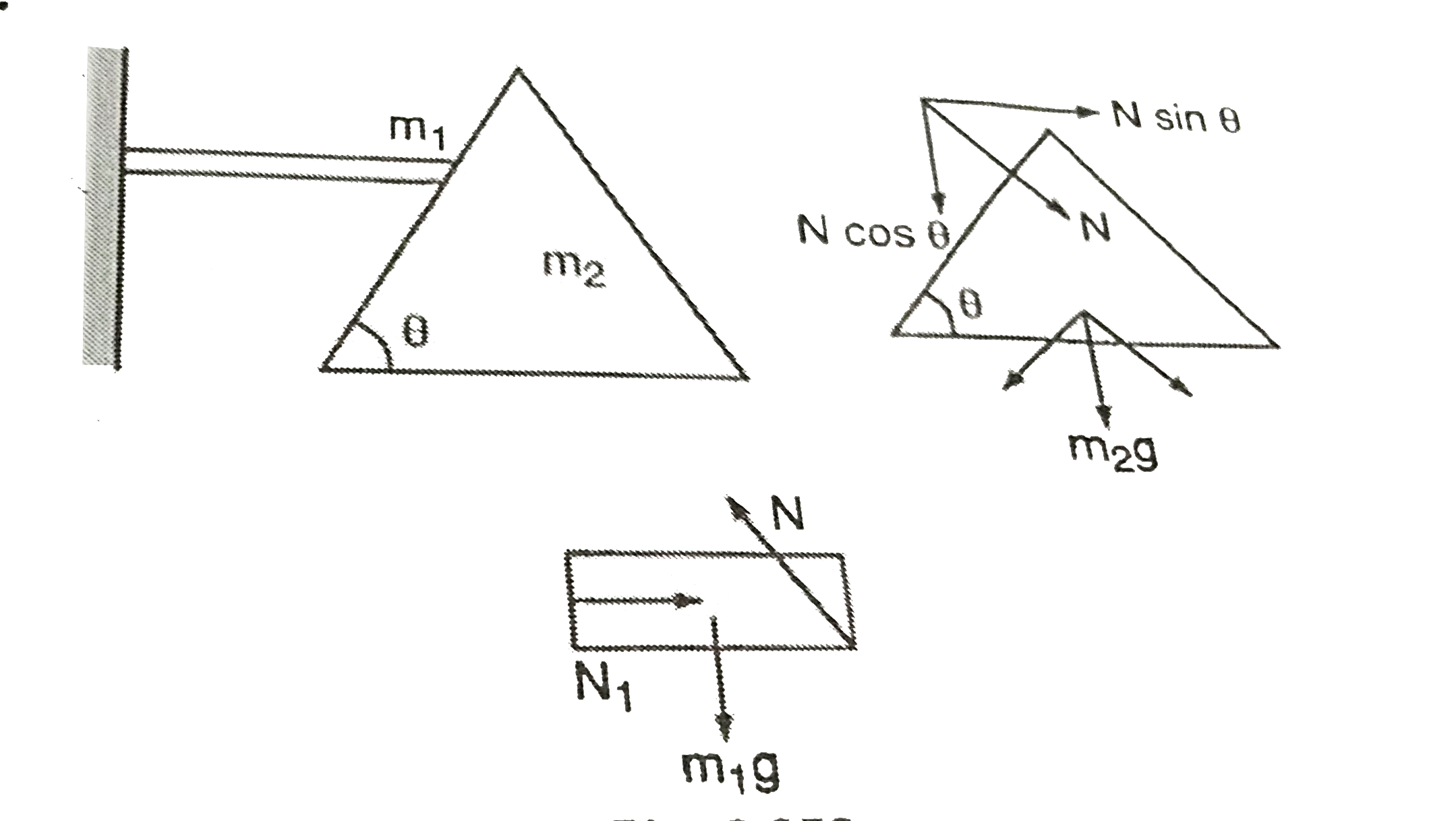
A horizontal bar of mass `m_(1)` Prism of mass `m_(2)` can move as shown. There is no friction at any contact point. During the motion the length of the rod is always horizontal Now, magnitude valuse of
.

A

acceleration of `m_(1)` is `g//(1+etacot^(2)theta),"where " eta=m_(2)//m_(1)`

B

acceleration of `m_(1)` is `(g tan theta)/(eta[1+tan^(2)theta]) " where "eta=m_(2)//m_(1)`

C

acceleration of `m_(2)` is `g//(tan theta+etacottheta), " where "eta=m_(2)//m_(1)`

D

acceleration of `m_(2)` is `(g tan^(2)theta)/(eta[1+tan^(2)theta]), " where "eta=m_(2)//m_(1)`

Text Solution

Verified by Experts

The correct Answer is:
A, C

Promotional Banner

Topper's Solved these Questions

  • FORCE AND NEWTONS LAWS OF MOTION

    GRB PUBLICATION|Exercise Assertion- Reason|4 Videos
  • FORCE AND NEWTONS LAWS OF MOTION

    GRB PUBLICATION|Exercise Matrix match|7 Videos
  • FORCE AND NEWTONS LAWS OF MOTION

    GRB PUBLICATION|Exercise Objective Questions|134 Videos
  • BASIC MATHEMATICS

    GRB PUBLICATION|Exercise Problems For Practice|35 Videos
  • FRICTION AND CIRCULAR MOTION

    GRB PUBLICATION|Exercise Comprehension type|11 Videos

Similar Questions

Explore conceptually related problems

A man pushes a cylinder of mass m_1 with the help of a plank of mass m_2 as shown in figure. There in no slipping at any contact. The horizontal component of the force applied by the man is F. (a) the acceleration fo the plank and the center of mass of the cylinder, and (b) the magnitudes and direction of frictional force at contact points.

A uniform rod of length L and mass M is lying on a frictionless horizontal plane and is pivoted at one of its ends as shown in Fig. There is no friction at the pivot. An inelastic ball of mass m is fixed with the rod at a distance L//3 from O . A horizontal impulse J is given to the rod at a distance 2L//3 from O in a direction perpendicular to the rod. Assume that the ball remains in contact with the rod after the collision and impulse J acts for a small time interval /_\t . Now answer the following questions: Find the magnitude of the impulse applied by the during the time interval /_\t

A cube of mass m is placed on top of a wedge of mass 2m, as shown in figure. There is no friction between the cube and the wedge. The minimum co - efficient of friction between the wedge and the horizontal surface, so that the wedge does not move is

The coefficient of friction between block A of mass m_(1)=5kg and block B of mass m_(2)=10 kg is mu_(2)=0.5 . There is no friction froce between block B and fixed horizontal surface. A force of 300N acts on block B in horizontal direction and a horizontal force of magnitude F acts on block A as shown , both towards right. Initially there is no relative motion between the blocks. The minimum value of F such that relative motion starts between A and B is :

Two block , with masses m_(1) and m_(2) are staked as shown in fig and placed on a frictionless horizontal surface . There is a friction between the two block .An external force of magnitude F is applied to the top block at an angle alpha below the horizontal . The coefficient of friction between m_(1) and m_(2) are mu_(s) b. If the two blocks move together, find their acceleration b . Calculate the maximum value of force so that blocks will move together

A heavy mass m slides down a triangular prism of mass M . The prism lies on a horizontal surface and can move along it without friction . What will be the direction of motion of m if the inclination of the hypotenuse of the prism is alpha with the horizontal ?

Two bars of masses m_(1) and m_(2) connected by a non - deformed light spring rest on a horizontal plane. The coefficient of friction between the bars and the surface is equal to mu . What minimum constant force has to be appled in the horizontal direction to the bar of mass m_(1) in order to shift the other bar?

In fig., the mass m_(2) starts with velocity v_(0) and moves with constant velocity on the surface. During motion, the normal reaction between the horizontal surface and fixed triangle block m_(1) is N . Then during motion.

In the figure-2.61 a bar of mass m is on the smooth inclined face of the wedge of mass M,the inclination to the horizontal being 0.The wedge is resting on a smooth horizontal plane.Assuming the pulley to be smooth and the string is light and inextensible. Find the acceleration of M,when M and m are always in contact.

