Home
Class 11
PHYSICS
Two blocks of masses m(1)=5 kg and m(2)=...

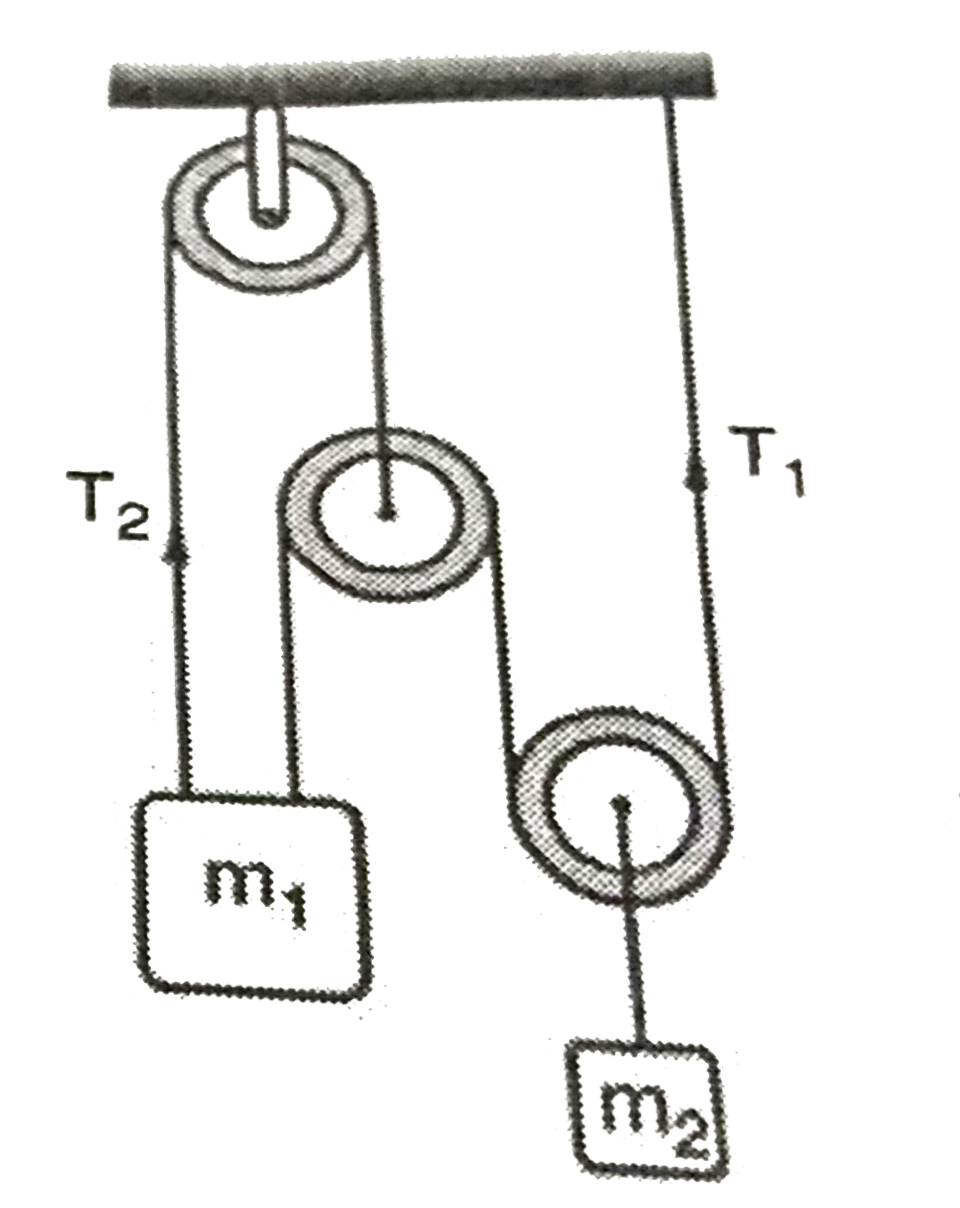
Two blocks of masses `m_(1)=5` kg and `m_(2)=2` kg are connected by threads which pass over the pulleys as shown in the figure. The threads are massless and the pulleys are massless and smooth. The blocks can move only along the vertical direction `T_(1) and T_(2)` are the tensions in the string as shown. Now match the following: `(Take g=10 m//s^(2))`

`{:(,"Column -I",,"Column -II"),("(a)",underset("acceleration of " m_(1) " with respect to ground")"Magnitude value of",,(p)500/19 "SI units"),("(b)",underset("acceleration of" m_(2) "with respect to ground")"Magnitude value of",,(q)250/19 "SI units"),("(c)","The value of tension" T_(1) ,,(r) 60/19 "SI units"),("(d)","The value of tension" T_(2),,(s) 40/19 "SI units"),(,,,"(t)None of the above"):}`

Text Solution

Verified by Experts

The correct Answer is:
`ararrs; brarr r; crarrq; d rarrp`


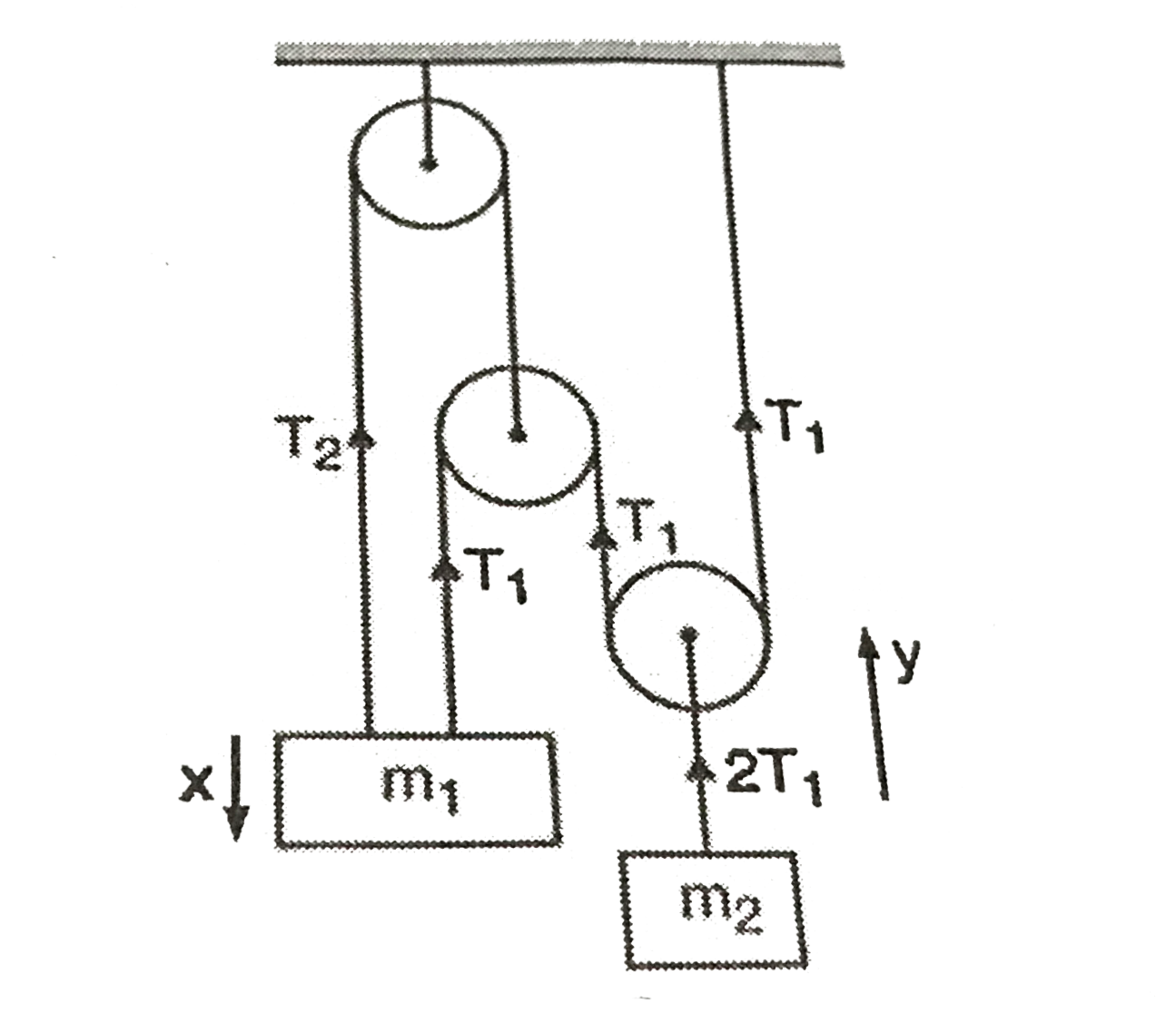
`T_(2)=2T_(1)`
Now, `m_(1)g-T_(1)-T_(2)=m_(1)a_(1)`
`2T_(1)-m_(2)g=m_(2)a_(2)` ...(ii)
as `y=((3x)/2)`
`2a_(2)=3a_(1)`….(iii)
By solving we will get the answer `a_(1)=(40/19)m//sec^(2)`
Promotional Banner

Topper's Solved these Questions

  • FORCE AND NEWTONS LAWS OF MOTION

    GRB PUBLICATION|Exercise Integer question|15 Videos
  • FORCE AND NEWTONS LAWS OF MOTION

    GRB PUBLICATION|Exercise Comprehension|12 Videos
  • FORCE AND NEWTONS LAWS OF MOTION

    GRB PUBLICATION|Exercise Assertion- Reason|4 Videos
  • BASIC MATHEMATICS

    GRB PUBLICATION|Exercise Problems For Practice|35 Videos
  • FRICTION AND CIRCULAR MOTION

    GRB PUBLICATION|Exercise Comprehension type|11 Videos

Similar Questions

Explore conceptually related problems

Blocks of mass M_(1) and M_(2) are connected by a cord which passes over the pulleys P_(1) and P_(2) as shown in the figure. If there is no friction, the acceleration of the block of mass M_(2) will be

Two blocks of masses m_1 = 4 kg and m_2 = 2 kg are connected to the ends of a string which passes over a massless, frictionless pulley. The total downwards thrust on the pulley is nearly

Two blocks of masses m_(i) = 2kg and m_(2) = 4kg hang, over a massless pulley as shown in the figure. A force F_(0)=100 N acting at the axis of the pulley accelerates the system upwards Then :

Two blocks of masses m_(1)=2kg and m_(2)=5kg hang over a massless pulley as shown in the figure. A force F_(0)=100N acting at the axis of the pulley accelerates the system upwards. Then : ( Take g=9.8m//s^(2))

Three blocks of masses m_(1)=4kg, m_(2)=2kg, m_(3)=4kg are connected with ideal strings passing over a smooth, massless pulley as shown in figure. The acceleration of blocks will be (g=10m//s^(2))

Two blocks m_(1) = 5 g and m_(2) = 10 g are hung vertically over a light frictionless pulley as shown in figure. What is the acceleration of the masses when left free ?

Two blocks of masses m_(1) and m_(2)(m_(1) gt m_(2)) connected by a massless string passing over a frictionless pulley Magnitude of acceleration of blocks would be

Two blocks of masses m_(1)=2 kg and m_(2)=5 kg hang over a massless pulley as shown in the fig A force F_(0)=100N acting at the axis of the pulley accelerates the system upwards Find (a) the acceleration of each mass (b) the tension in the string.

Two masses M_(1)=5kg,M_(2)=10 kg are connected at the ends of an inextensible string passing over a frictionless pulley as shown. When masses are released, then acceleration of masses will be

