Text Solution
Verified by Experts
The correct Answer is:



Topper's Solved these Questions
FORCE AND NEWTONS LAWS OF MOTION
GRB PUBLICATION|Exercise Comprehension|12 VideosFORCE AND NEWTONS LAWS OF MOTION
GRB PUBLICATION|Exercise Matrix match|7 VideosBASIC MATHEMATICS
GRB PUBLICATION|Exercise Problems For Practice|35 VideosFRICTION AND CIRCULAR MOTION
GRB PUBLICATION|Exercise Comprehension type|11 Videos
Similar Questions
Explore conceptually related problems
GRB PUBLICATION-FORCE AND NEWTONS LAWS OF MOTION-Integer question
- The pulleys and string are massless No friction on the inclined plane....
Text Solution
|
- Two blocks of masses m(1) and m(2) are connected by massless threads. ...
Text Solution
|
- fig shows a uniform rod of length of 3.0 kg The string shown in the fi...
Text Solution
|
- Two blocks of mass 2.9 kg and 1.9 kg are suspended from a rigid suppor...
Text Solution
|
- The elevator is going up with an acceleration of g//10 the pulley and ...
Text Solution
|
- In fig shown, both blocks are released from rest Length of 4 kg block ...
Text Solution
|
- Two smooth blocks of same mass are connected by an inextensible and ma...
Text Solution
|
- Fig shows a block of mass 0.1 kg placed on a smooth wedge of mass 1/(5...
Text Solution
|
- Two blocks of masses 10 kg and 20 kg are connected by a massless sprin...
Text Solution
|
- Two blocks A and B having masses m(1)=1 kg m(2)=4 kg are arranged as s...
Text Solution
|
- In the fig shown below, friction force between the bead and the light ...
Text Solution
|
- In the situation given, all surfaces are frictionless. Pulley is ideal...
Text Solution
|
- Block A of mass m is placed over a wedge of same mass m. Both the bloc...
Text Solution
|
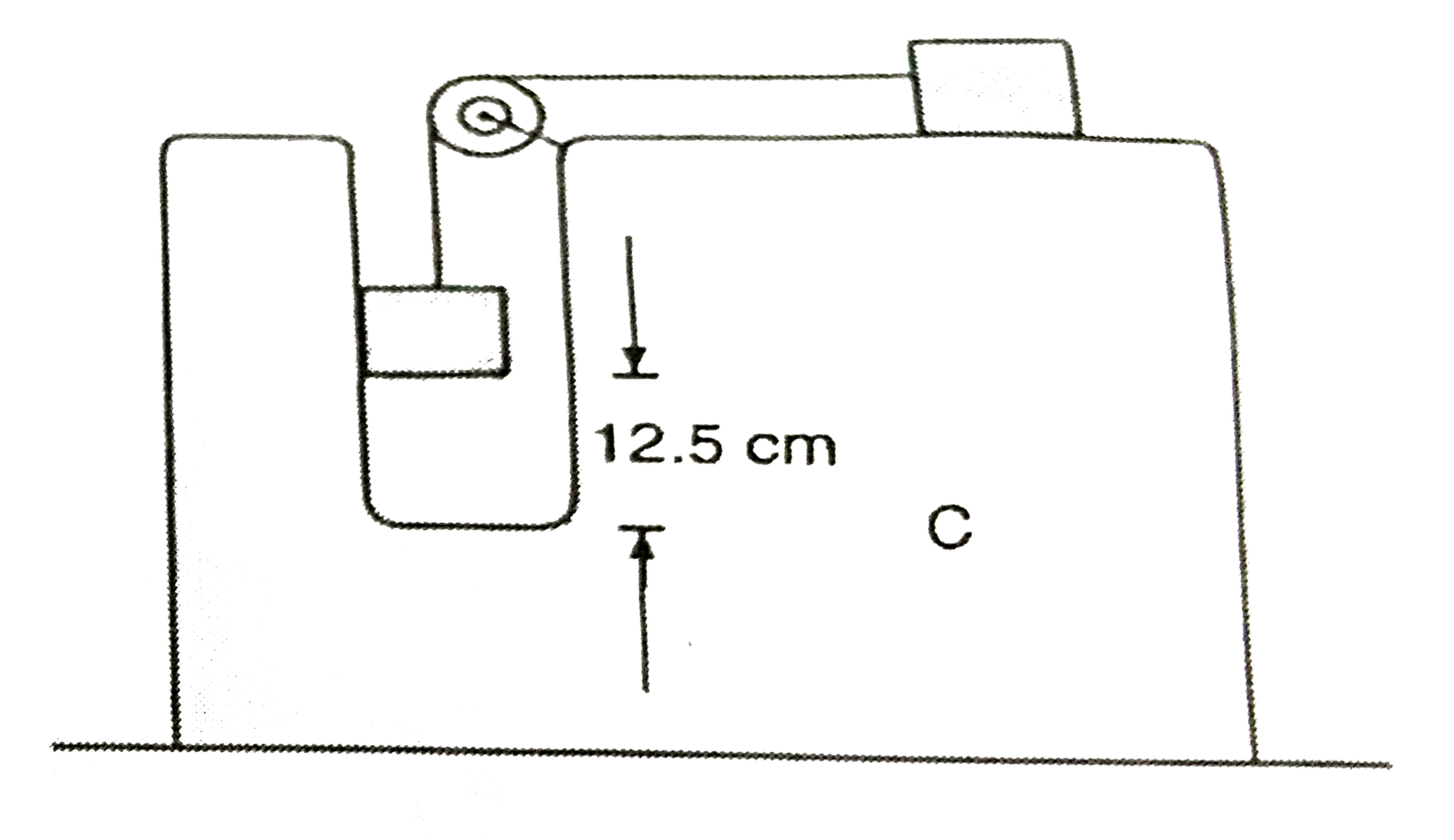
- A small, light pulley is attached with a block C of mass 4 kg as shown...
Text Solution
|
- If at t =0 right spring in (A) and right string in (B) breaks The rati...
Text Solution
|