Home
Class 11
PHYSICS
Two stones are thrown up simultaneously ...

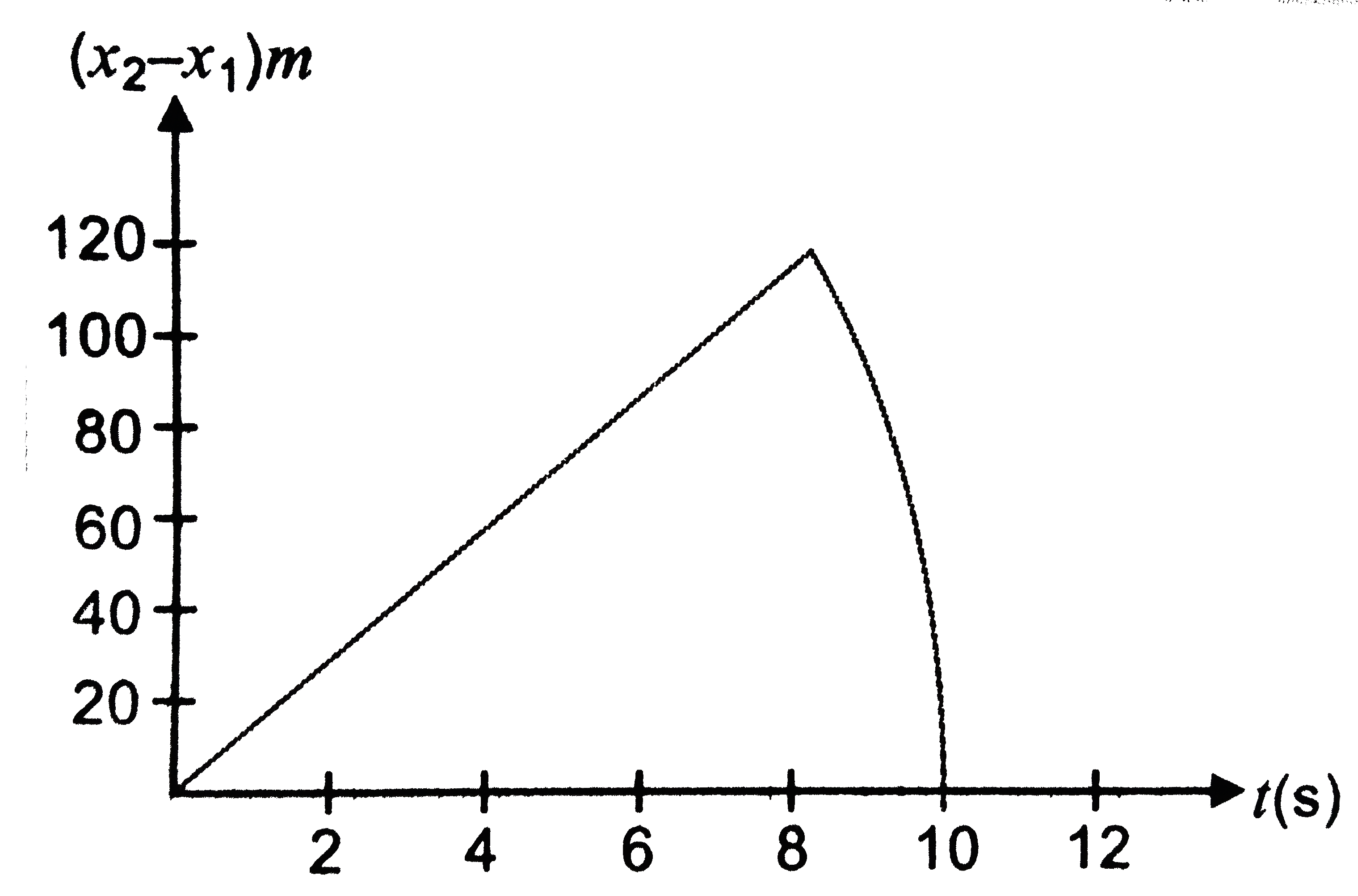
Two stones are thrown up simultaneously from the edge of a cliff ` 200 m` high with initial speeds of ` 15 ms^(-1)` and ` 30 ms^(-1)`. Verify that the graph shown in Fig. 2 ( NCT). 13 , correctly represents the time variation of the relative position of the second stone with respect to the first. Neglect the air resistance and assume that the stones do not rebound after hitting the ground. Take ` g= 10 ms^(-2)`.Give equations for the linear and curved parts of the plot.
.

Text Solution

Verified by Experts

For first stone :
initial velocity , `u_|=15` m/s
Aceleration , a=-g =`- 10m//s^2` ltbrrgt Using the realation,
`x_1=x_0+u_1t+1/2at^2`
Where height of the cliff, `x_0=200 m`
`x_1=200+15t-5t^2` ….(i)
When this stone hits the ground , `x_1=0`
`therefore -5t^2+15t+200=0`
`t^2-3t-40=0`
`t^2-8t+5t-40=0`
t(t-8)+5(t-8)=0
t=8 s or t = -5s
Since the stone was projected at time t = 0, the negative sign before time is meaningless.
`therefore t=8s`
For second stone :
Initial velocity ,`u_(||)=`30 m/s
Acceleration , a=-g=`-10 m//s^2`
Using the relation ,
`x_2=x_0+u_(||)t+1/2at^2`
`=200+30t-5t^2` ...(ii)
At the moment when this stone hits the ground, `x_2` = 0
`– 5t_2` + 30 t + 200 = 0
`t^2-6t-40=0`
`t^2 – 10t + 4t + 40 = 0`
t (t – 10) + 4 (t – 10) = 0
t (t – 10) (t + 4) = 0
t = 10 s or t = – 4 s
Here again, the negative sign is meaningless.
`therefore`t=10 s
Subtracting equations (i) and (ii), we get
`x_2-x_1=(200+30t-5t^2)-(200+15t-5t^2)`
`x_2-x_1=15t` ....(iii)
Equation (iii) represents the linear path of both stones. Due to this linear relation between `(x_2 – x_1)` and t, the path remains a straight line till 8 s.
Maximum separation between the two stones is at t = 8 s.
`(x_2 – x_1)`max = 15x 8 = 120 m
This is in accordance with the given graph.
After 8 s, only second stone is in motion whose variation with time is given by the quadratic equation:
`x_2 – x_1 = 200 + 30t – 5t^2`
Hence, the equation of linear and curved path is given by
`x_2 – x_1 = 15t` (Linear path)
`x_2 - x_1 = 200 + 30t – 5t^2` (Curved path)
Promotional Banner

Topper's Solved these Questions

Similar Questions

Explore conceptually related problems

Two stones are thrown up simultaneously from the edge of a cliff 200 m high with initial speeds of 15 ms?^(-1) and 30^(-1) . Verify that the graph shown in Fig. 2 ( NCT). 13 , correctly represents the time variation of the relativ e position of the second stone with respect to the first. Neglect the air resistance and assume that the stones do not rebound after hitting the ground. Taje g= 10 ms^(-2) .Give equations for the linear and curved parts of the plot. .

Two stones are thrown up simultaneously from the edge of a cliff 240 m high with initial speed of 10 m//s and 40 m//s respectively . Which of the following graph best represents the time variation of relative position of the speed stone with respect to the first ? ( Assume stones do not rebound after hitting the groumd and neglect air resistance , take g = 10 m//s^(2)) ( The figure are schematic and not drawn to scale )

Two stones are through up simultaneously from the edge of a cliff 240 m high with initial speed of 10 m/s and 40 m/s respectively. Which of the following graphs best represents the time variation of relative position of the second stone with respect to the first? Assume stones do not rebound after hitting the ground and neglect air resistance, take . g= 10 m//s^(2) (The figures are schematic and not drawn to scale)

Two stones are thrown up simultaneously with initial speeds of u_(1) and u_(2)(u_(2)gt_(1) u_(1)) . They hit the ground after 6 s and 10 s respectively. Which graph in fig. correctly represents the time variation of Deltax=(x_(2)-x_(1)) the relative position of the second stone with respect to the first upto t=10 s? Assume that the stones do not rebound after hitting the ground.

Two stones are thrown up simultaneously from the edge of a cliff with initial speed v and 2 v . The relative position of the second stone with respect to first varies with time till both the stones strike the ground as.

A stone is thrown upwards and it rises to a height 0f 200m. The relative velocity of the stone with respect to the earth will be maximum at :-

Two stones are thrown vertically upwards simultaneously from the same point on the ground with initial speed u_(1) = 30 m//sec and u_(2) = 50 m//sec . Which of the curve represent correct variation (for the time interval in which both reach the ground) of (x_(2) - x_(1)) = the relative position of second stone with respect to first with time (t) (v_(2) - v_(1)) = the relative velocity of second stone with respect to first with time (t). Assuming that stones do not rebound after hitting.

Two particles are thrown simultaneously from points A and B with velocities u_1 = 2ms^(-1) and u_2 - 14 ms^(-1) , respectively, as shown in figure. The relative velocity of B as seen from A in

NCERT-MOTION IN A STRAIGHT LINE-EXERCISE
  1. Two towns A and B are connected by a regular bus service with a bus le...

    Text Solution

    |

  2. A player throws a ball upwards with an initial speed of 29.4 ms^(-1)....

    Text Solution

    |

  3. Read each statement below carefully and state with reasons and example...

    Text Solution

    |

  4. A ball is dropped from a height of a height of 90 m on a floor. At eac...

    Text Solution

    |

  5. Explain clearly, with examples, the difference between : (a) magnitu...

    Text Solution

    |

  6. A man walks on a straight road from his home to a market 2.5 km away ...

    Text Solution

    |

  7. In above questions 13 and 14, we have carefully distinguished betwee...

    Text Solution

    |

  8. Look at the graphs (a) to (d) carefully and state, with reasons, with ...

    Text Solution

    |

  9. Fig. shows x-t plot of one dimensional motion a particle. Is it correc...

    Text Solution

    |

  10. A police van moving on a highway with a speed of 30 km h^(-1) Fires a ...

    Text Solution

    |

  11. Suggest a suitable physical situation for each of the following graph ...

    Text Solution

    |

  12. Fig gives the x-t plot of a particle executing one dimensional simple ...

    Text Solution

    |

  13. Fig. show the x-t plot of a particle in one dimensional motion. Three...

    Text Solution

    |

  14. Given a speed-time graph of a particle in motion along a constant dire...

    Text Solution

    |

  15. A three wheeler starts from rest, accelerates uniformly with 1 ms^(-2...

    Text Solution

    |

  16. A boy standing on a stationary lift (open from above) throws a ball up...

    Text Solution

    |

  17. On a long horizontally moving belt, a child runs to and fro with a sp...

    Text Solution

    |

  18. Two stones are thrown up simultaneously from the edge of a cliff 200 ...

    Text Solution

    |

  19. The speed-time graph of a particle moving along a fixed direction is s...

    Text Solution

    |

  20. The velocity-time graph of a particle in one-dimensional motion is sho...

    Text Solution

    |

