Home
Class 12
PHYSICS
Four charges are arranged at the corner...

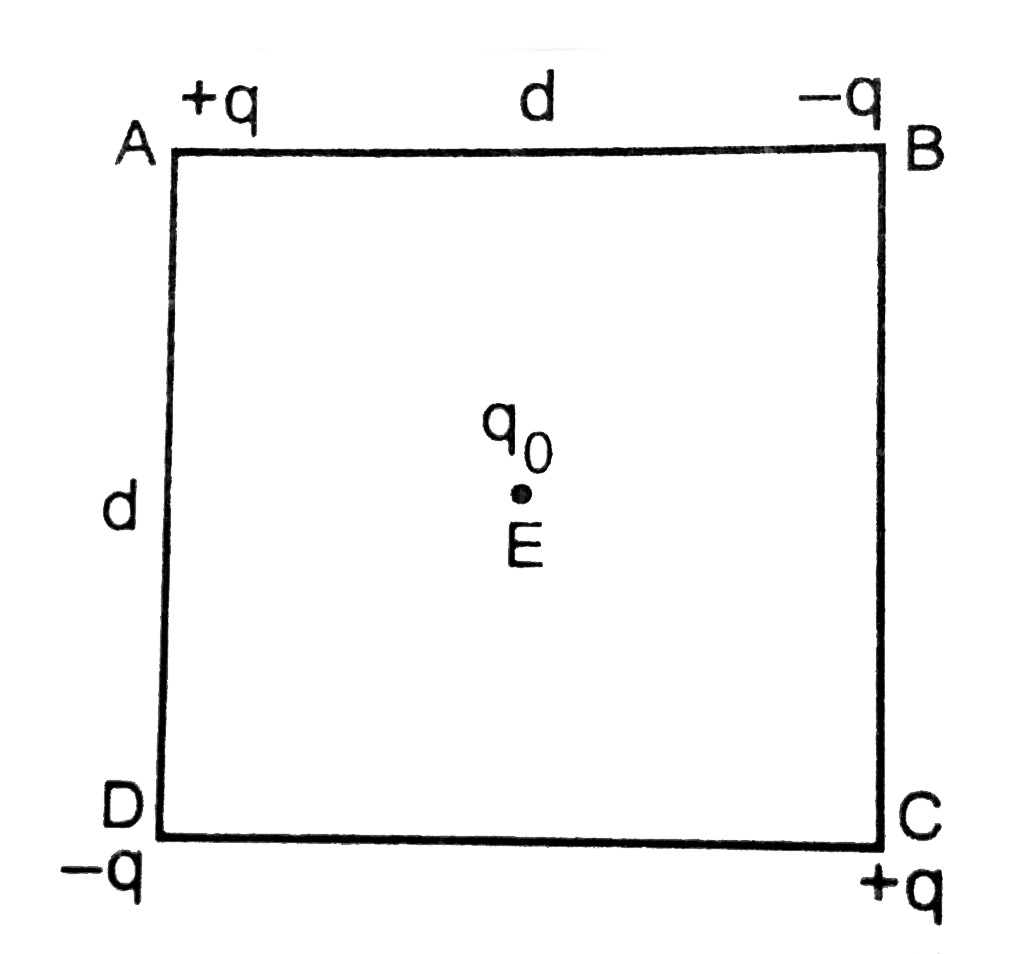
Four charges are arranged at the corners of a square ABCD of side d, as shown in Fig. Find the work required to put together this arrangement
(b) A charge `q_(0)` brought to the center E of the square, the four charges being held fixed at the corners . How much extra work in needed to do this ?

Text Solution

Verified by Experts

(a) Since the work done depends on the final arrangement of the charges, and not on how they are put together, we calculate work needed for one way of putting the charges at A, B, C and D. Suppose, first the charge + q is brought to A, and then the charges – q, + q, and – q are brought to B, C and D, respectively. The total work needed can be calculated in steps:
(i) Work needed to bring charge + q to A when no charge is present elsewhere: this is zero.
(ii) Work needed to bring – q to B when + q is at A. This is given by (charge at B) `xx` (electrostatic potential at B due to charge + q at A)
`= -q xx ((q)/(4pi epsilon_(0)d)) = -(q^(2))/(4pi epsilon_(0)d)`
(iii) Work needed to bring charge +q to C when +q is at A and –q is at B. This is given by (charge at C) `xx` (potential at C due to charges at A and B)
`= +q ((+q)/(4pi epsilon_(0)dsqrt(2))+(-q)/(4pi epsilon_(0)d))`
`= (-q^(2))/(4pi epsilon_(0)d)(1-(1)/(sqrt(2)))`
(iv) Work needed to bring –q to D when +q at A,–q at B, and +q at C. This is given by (charge at D) `xx` (potential at D due to charges at A, B and C)
` = -q((+q)/(4pi epsilon_(0)d)+(-q)/(4pi epsilon_(0)dsqrt(2))+(q)/(4pi epsilon_(0)d))`
`= (-q^(2))/(4pi epsilon_(0)d)(2-(1)/(sqrt(2)))`
Add the work done in steps (i), (ii), (iii) and (iv). The total work required is
`= (-q^(2))/(4pi epsilon_(0)d){(0) + (1)(1-(1)/(sqrt(2)))+(2-(1)/(sqrt(2)))}`
`= (-q^(2))/(4pi epsilon_(0)d)(4-sqrt(2))`
The work done depends only on the arrangement of the charges, and not how they are assembled. By definition, this is the total electrostatic energy of the charges. (Students may try calculating same work/energy by taking charges in any other order they desire and convince themselves that the energy will remain the same.)
(b) The extra work necessary to bring a charge `q_(0)` to the point E when the four charges are at A, B, C and D is `q_(0) xx` (electrostatic potential at E due to the charges at A, B, C and D). The electrostatic potential at E is clearly zero since potential due to A and C is cancelled by that due to B and D. Hence, no work is required to bring any charge to point E.
Promotional Banner

Topper's Solved these Questions

  • ELECTROSTATIC POTENTIAL AND CAPACITANCE

    NCERT|Exercise Exercise|37 Videos
  • ELECTROMAGNETIC WAVES

    NCERT|Exercise Exercise|15 Videos
  • MAGNETISM AND MATTER

    NCERT|Exercise Exercise|25 Videos

Similar Questions

Explore conceptually related problems

Four charges are arranged at the corners of a square ABCD as shown in the figure. The force on the charge kept at the ccentre O is

Four charges are arranged at the corners of a square ABCD , as shown. The force on a =ve charge kept at the centre of the square is -

Four charges are arranged at the corners of a square ABCD as shown in the figure. The force on the charge kept at the centre O will be:

Four charges are arranged at the corners of a square ABCD, as shown. The force on a positive charge kept at the centre of the square is

Four charges are arranged at the corners of a square ABCD , as shown in the adjoining figure, The force on a positive charge kept at the centre O is

Four point charges are placed at the corners of a square ABCD of side 10 cm, as shown in figure. The force on a charge of 1muC placed at the centre of square is

Four charges are arranged at the corners of a square as shown in the figure. The direction of electric field at the centre of the square is along

NCERT-ELECTROSTATIC POTENTIAL AND CAPACITANCE-Exercise
  1. Four charges are arranged at the corners of a square ABCD of side d,...

    Text Solution

    |

  2. Two charges 5xx10^(-8)C and -3xx10^(-8)C are located 16 cm apart. At ...

    Text Solution

    |

  3. A regular hexagon of side 10 cm has a charge 5 muC at each of its ver...

    Text Solution

    |

  4. Two charges + 2 muC and -2 muC are placed at points A and B, 6 cm apa...

    Text Solution

    |

  5. A spherical conductor of radius 12 cm has a charge of 1.6xx10^(-7)C ...

    Text Solution

    |

  6. A parallel plate capacitor with air between the plates has a capacit...

    Text Solution

    |

  7. Three capacitors each of capacitance 9 pF are connected in series. (...

    Text Solution

    |

  8. Three capacitors of capacitance 2 pF, 3 pF and 4 pF are connected in...

    Text Solution

    |

  9. In a parallel plate capacitor with air between the plates, each plate...

    Text Solution

    |

  10. Explain what would happen if a 3 mm thick mica sheet of (dielectric ...

    Text Solution

    |

  11. A 12 pF capacitor is connected to a 50 V battery. How much electrost...

    Text Solution

    |

  12. A 600 pF capacitor is charged by a 200 V supply. It is then disconnect...

    Text Solution

    |

  13. A charge of 8 mC is located at the origin. Calculate the work done in ...

    Text Solution

    |

  14. A cube of side b has a charge q at each of its vertices. Determine the...

    Text Solution

    |

  15. Two tiny spheres carrying charges 1.5 muC and 2.5 muC are located 30 c...

    Text Solution

    |

  16. A spherical conducting shell of inner radius r(1) and outer radius r(2...

    Text Solution

    |

  17. (a) Show that the normal component of electrostatic field has a discon...

    Text Solution

    |

  18. A long charged cylinder of linear charge density lambda is surrounde...

    Text Solution

    |

  19. In a hydrogen atom, the electron and proton are bound at a distance of...

    Text Solution

    |

  20. If one of the two electrons of a hydrogen molecule is removed, we get ...

    Text Solution

    |

  21. Two charged conducting spheres of radii a and b are connected to eac...

    Text Solution

    |
