Home
Class 12
PHYSICS
Two tiny spheres carrying charges 1.5 mu...

Two tiny spheres carrying charges `1.5 muC` and `2.5 muC` are located 30 cm apart. Find the potential
(a) at the mid-point of the line joining the two charges and
(b). At a point 10 cm from this mid-point in a plane normal to the line and passing through the mid-point.

Text Solution

Verified by Experts

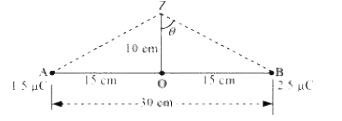
Two charges placed at points A and B are represented in the given figure. O is the mid point of the line joining the two charges.

Magnitude of charge located at a, `q_(1) = 1.5 mu C`
Magnitude of charge located at B, `q_(2) = 2.5 mu C`
Distance between the two charges, `d = 30 cm = 0.3 m`
(a) Let `V_(1)` and `E_(1)` are the potential and electric field respectively at O.
`V_(1)` = Potential due to charge at A+ Potential due to charge at B
`V_(1) = (q_(1))/(4pi in_(0) ((d)/(2)))+(q_(1))/(4pi in_(0)((d)/(2))) = (1)/(4pi in_(0)((d)/(2)))(q_(1)+q_(2))`
Where,
`in_(0)` = Permittivity of fre space
`(1)/(4pi in_(0)) = 9 xx 10^(9) NC^(2)m^(-2)`
`:. V_(1) = (9 xx 10^(9) xx 10^(-6))/(((0.30)/(2))) (2.5 + 1.5) = 2.4 xx 10^(5)V`
`E_(1)` = Electric field due to `q_(2)` - Electric field due to `q_(1)`
`= (q_(1))/(4pi epsilon_(0)((d)/(2))^(2))-(q_(1))/(4pi epsilon_(0)((d)/(2))^(2))`
`= (9 xx 10^(9))/((0.30)/(2))^(2) xx 10^(6) xx (2.5 - 1.5)`
`= 4 xx 10^(5) V m^(-1)`
Therefore, the potential at mid-point is `2.4 xx 10^(5)V` and the electric field at mid-point is `4 xx 10^(5) V m^(-1)`. The field is directed from the larger charge to the smaller charge.
(b) consider a point Z such that normal distance OZ = 10 cm = 0.1 m, as shown in the following figure.

`V_(2)` and `E_(2)` are the electric potential and electric field respectively at Z.
It can be observed from the figure distance,
`BZ = AZ = sqrt((0.1)^(2)+(0.15)^(2)) = 0.18 m`
`V_(2)` = Electric potential due to A + Electric Potential due to B
`= (q_(1))/(4pi epsilon_(0)(AZ))+(q_(1))/(4pi epsilon_(0)(BZ))`
`= (9 xx 10^(9) xx 10^(-6))/(0.18) (1.5+2.5)`
`= 2 xx 10^(5)V`
Electric field due to q at Z,
`E_(A) = (q_(1))/(4pi epsilon_(0) (AZ)^(2))`
`= (9 xx 10^(9) xx 1.5 xx 10^(-6))/((0.18)^(2))`
`= 0.416 xx 10^(6) V//m`
Electric field due to `q_(2)` at Z,
`E_(B) = (q_(2))/(4pi epsilon_(0)(BZ)^(2))`
`= (9 xx 10^(9) xx 10^(-6))/((0.18)^(2))`
`= 0.69 xx 10^(6) V m^(-1)`
The resultant field intensity at Z,
`E = sqrt(E_(A)^(2)+E_(B)^(2)+2E_(A)E_(B) cos 2 theta)`
Where, `2 theta` the angle `/_ AZ B`
From the figure, we obtain
`cos theta = (0.10)/(0.18) = (5)/(9) = 0.5556`
`theta = cos^(-1@)0.5556 = 56.25`
`:. 2 theta =112.5^(@)`
`cos 2theta = -0.38`
`sqrt((0.416 xx 10^(6))^(2) xx (0.69 xx 10^(6))^(2)+ 2 xx 0.416 xx 0.69 xx 10^(12) xx(0.38))`
`= 6.6 xx 10^(5) V m^(-1)`
Therefore, the potential at a point 10 cm (perpendicular to the mid-point) is `2.0 xx 10^(5) V` and electric field is `6.6 xx 10^(5)V m^(-1)`.
Promotional Banner

Topper's Solved these Questions

  • ELECTROSTATIC POTENTIAL AND CAPACITANCE

    NCERT|Exercise Exercise|37 Videos
  • ELECTROMAGNETIC WAVES

    NCERT|Exercise Exercise|15 Videos
  • MAGNETISM AND MATTER

    NCERT|Exercise Exercise|25 Videos

Similar Questions

Explore conceptually related problems

Two tiny spheres carrying charges 1.8 muC and 2.8 mu C are located at 40 cm apart. The potential at the mid-point of the line joining the two charges is

Two tiny spheres carrying charges 1.8 muC and 2.8 mu C are located at 40 cm apart. The potential at the mid-point of the line joining the two charges is In the above question, the potential at a point20cm from the mid-point of the line joining the two charges in a place normal to the line and passing through the mid-point is

Two point charges of +10muC and +20muC are placed in free space 2 cm apart. Find the electric potential at the middle point of the line joining the two charges.

Two charges + 10 muC and + 20 muC are placed at a. separation of 2 cm. Find the electric potential due to the. pair at the middle point of the line joining the two charges.

Two point charges one of +100 muC and another of -400 muC , are kept 30 cm apart. Find the point of zero potential on the line joining the two charges.

Find the mid point of the line joining the points (7, 6) and (-3, -4) .

Two charges +5mu C and +10 mu C are placed 20 cm apart. The net electric field at the mid-point between the two charges is

NCERT-ELECTROSTATIC POTENTIAL AND CAPACITANCE-Exercise
  1. A charge of 8 mC is located at the origin. Calculate the work done in ...

    Text Solution

    |

  2. A cube of side b has a charge q at each of its vertices. Determine the...

    Text Solution

    |

  3. Two tiny spheres carrying charges 1.5 muC and 2.5 muC are located 30 c...

    Text Solution

    |

  4. A spherical conducting shell of inner radius r(1) and outer radius r(2...

    Text Solution

    |

  5. (a) Show that the normal component of electrostatic field has a discon...

    Text Solution

    |

  6. A long charged cylinder of linear charge density lambda is surrounde...

    Text Solution

    |

  7. In a hydrogen atom, the electron and proton are bound at a distance of...

    Text Solution

    |

  8. If one of the two electrons of a hydrogen molecule is removed, we get ...

    Text Solution

    |

  9. Two charged conducting spheres of radii a and b are connected to eac...

    Text Solution

    |

  10. Two charges -q and +q are located at points (0, 0, –a) and (0, 0, a), ...

    Text Solution

    |

  11. Fig shows a charge array known as an 'electric quadrupole'. For a poin...

    Text Solution

    |

  12. An electrical technician requires a capacitance of 2 muF in a circuit ...

    Text Solution

    |

  13. What is the area of the plates of a 2 farad parallel plate air capac...

    Text Solution

    |

  14. Obtain equivalent capacitance of the following network, Fig. For a ...

    Text Solution

    |

  15. The plates of a parallel plate capacitor have an area of 90 cm^(2) ea...

    Text Solution

    |

  16. A 4 muF capacitor is charged by a 200 V supply. It is then disconnect...

    Text Solution

    |

  17. Show that the force on each plate of a parallel plate capacitor has a ...

    Text Solution

    |

  18. A spherical capacitor consists of two concentric spherical conductors...

    Text Solution

    |

  19. A spherical capacitor has an inner sphere of radius 12 cm and an oute...

    Text Solution

    |

  20. Answer carefully: (a) Two large conducting spheres carrying charges ...

    Text Solution

    |