


Home
Class 11
CHEMISTRY
Use Lewis symbols to show electron trans...

Use Lewis symbols to show electron transfer between the following atoms to form cations and anions : (a) K and S (b) Ca and O (c) Al and N.

Text Solution

Verified by Experts

(a) K and S:
The electronic configuration of K and S are as follows :
K:2,8,8,1
S:2,8,6
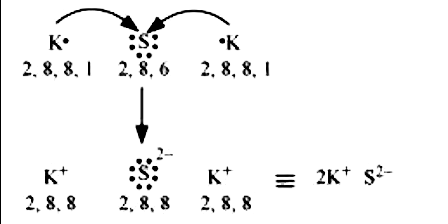
`K*" " :underset(..)overset(..)S:`
Sulphur (S) requires 2 more electrons to complete its octet. Potassium (K) requires one electrons more than the nearest noble gas i.e., Argon. Hence, the electron transfer can be shown as:

(b) Ca and O:
The electronic configuration of Ca and O are as follows:
Ca:2,8,8,2
O: 2,6
Oxygen requires two electrons more to complete its octet, whereas calcium has two electrons more than the nearest noble gas i.e., Argon. Hence, the electron transfer takes place as :

(c) Al and N:
The electronic configuration of Al and N are as follows:
Al:2,8,3
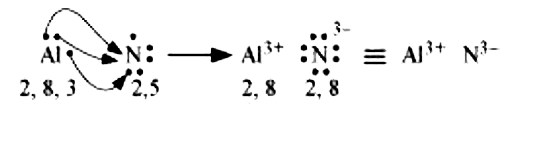
N:2,5
Nitrogen is three electrons short of the nearest noble gas (Neon), whereas aluminium has three electrons more than Neon. Hence, the electron transference can be shown as :
Promotional Banner

Topper's Solved these Questions

  • CHEMICAL BONDING AND MOLECULAR STRUCTURE

    NCERT|Exercise EXERCISE|40 Videos
  • CLASSIFICATION OF ELEMENTS AND PERIODICITY IN PROPERTIES

    NCERT|Exercise EXERCISE|40 Videos

Similar Questions

Explore conceptually related problems

Use Lewis symbols to show electron transfer between the following atoms to form cations and anions: (a) K , (b) O and ( c) Al and N .

Use Lewis dot symbols to show electron transfer between the following atoms to form cations and anions : (a) Na and Cl (b) K and S (c ) Ca and O (d ) Al and N (e ) Li and H

Using Lewis dot symbols, show electron transfer between the following atoms to form cations and anions : (a) Na and Cl (b) K and S (c ) Ca and O (d) Al and N.

Write Lewis symbols for the following atoms and ions: S and S^(2-) , Al , and Al^(3+) , H and H^(ө)

Write Lewis dot symbols for the following atoms and ions : (i) S and S^(2-) (ii) P and P^(3-) (iii) Al and Al^(3+) (iv) H and H^(-) (v) Na and Na^(+)

Write the Lewis dot symbole of the following atoms and ions : S and S^(2-) ,P and P^(3-) , Na and Na^(+) , Al and Al^(3+) , H nad H^(-)

NCERT-CHEMICAL BONDING AND MOLECULAR STRUCTURE-EXERCISE
  1. H(3)PO(3) can be represented by structure (a) and (b) shown below. Can...

    Text Solution

    |

  2. Write the resonance structures for SO(3),NO(2), and NO(3)^(ө).

    Text Solution

    |

  3. Use Lewis symbols to show electron transfer between the following atom...

    Text Solution

    |

  4. Although both CO(2) and H(2)O are triatomic molecules, the shape of H(...

    Text Solution

    |

  5. Write the significance/applications of dipole moment

    Text Solution

    |

  6. Define electronegativity. How does it differ from electron gain enthal...

    Text Solution

    |

  7. Explain with the help of suitable example polar covalent bond.

    Text Solution

    |

  8. Arrange the bonds in order of increasing ionic character in the molecu...

    Text Solution

    |

  9. The skeletal structure of CH(3)COOH as shown below is correct, but som...

    Text Solution

    |

  10. Apart from tetrahedral geometry, another possible geometry for CH(4) i...

    Text Solution

    |

  11. Explain why BeH(2) molecule has a zero dipole moment although the Be-H...

    Text Solution

    |

  12. Out of NH(3) and NF(3) which has a higher Dipole moment?

    Text Solution

    |

  13. What is meant by hybridisation of atomic orbitals? Describe the shape ...

    Text Solution

    |

  14. Describe the change in hybridization (if any) of the Al atom in the fo...

    Text Solution

    |

  15. Is there any change in hybridisation of the B and N atom as a result o...

    Text Solution

    |

  16. Draw diagrams showing the formation of a double bond and a triple bond...

    Text Solution

    |

  17. What is the total number of sigma and pi bonds in the following molecu...

    Text Solution

    |

  18. Considering X axis as the inter nuclear axis, which out of the followi...

    Text Solution

    |

  19. Which hybrid orbitals are used by carbon atoms in the following molecu...

    Text Solution

    |

  20. What do you understand by bond pairs and lone pairs of electrons? Illu...

    Text Solution

    |