

Home
Class 11
CHEMISTRY
Write the significance/applications of d...

Write the significance/applications of dipole moment

Text Solution

Verified by Experts

In heteronuclear molecules, polarization arises due to a difference in the electronegativities of the constituents of atoms. As a result, one end of the molecule acquires a positive charge while the other end becomes negative. Hence , a molecule is said to possess a dipole.
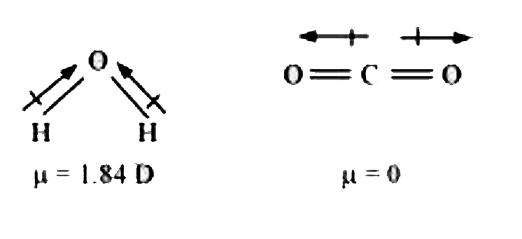
The product of the magnitude of the charge and the distance between the centres of positive-negative charges is called the dipole moment `(mu)` of the molecules. It is a vector quantity and is represented by an arrow with its tail at the positive centre and head pointing towards a negative centre.
Dipole moment `(mu)="charge (Q)"xx "distance of seperation (r)"`
The SI unit of a dipole moment is 'esu'.
1 esui=`3.335xx10^(-30) cm`
Dipole moment is the measure of the polarity of a bond. It is used to differentiate between polar and non-polar bonds since all non-polar molecules (e.g `HG_(2),O_(2)`) have zero dipole moment. It is also helpful in calculating the percentage ionic character of a molecule.
Promotional Banner

Topper's Solved these Questions

  • CHEMICAL BONDING AND MOLECULAR STRUCTURE

    NCERT|Exercise EXERCISE|40 Videos
  • CLASSIFICATION OF ELEMENTS AND PERIODICITY IN PROPERTIES

    NCERT|Exercise EXERCISE|40 Videos

Similar Questions

Explore conceptually related problems

(I) Discuss the significance/applications of dipole moment. (ii) Represent diagrammatically the bond moments and the resultant dipole moment in CO_(2), NF_(3).

a) Discuss the significance/applications of dipole moment. b) Represent diagrammatically the bond moments and the resultant dipole moment in CO_(2), NF_(3) and CHCl_(3)

Application Of Dipole Moment

Applications Of Dipole Moment Continued

A polar covalent bond with positive and negative charge centres at its ends is called a dipole. The polarity of a dipole is measured by its dipole moment. Mathematically it is expressed as dipole moment, mu=q xx d where q and d are the net charge and the distance between the two charges respectively. Dipole moment is a vector quantity. The net dipole moment of a polyatomic molecule is the resultant of the various bond moments present in the molecule. The values of dipole moment are expressed in Debye (D) or in SI units in terms of coulomb- metre (Cm). One of the most important applications of dipole moment is in the determination of geometry and shape of molecules besides prediction of a number of properties of the molecules. Which of the following has net dipole moment?

A polar covalent bond with positive and negative charge centres at its ends is called a dipole. The polarity of a dipole is measured by its dipole moment. Mathematically it is expressed as dipole moment, mu=q xx d where q and d are the net charge and the distance between the two charges respectively. Dipole moment is a vector quantity. The net dipole moment of a polyatomic molecule is the resultant of the various bond moments present in the molecule. The values of dipole moment are expressed in Debye (D) or in SI units in terms of coulomb- metre (Cm). One of the most important applications of dipole moment is in the determination of geometry and shape of molecules besides prediction of a number of properties of the molecules. Maximum dipole moment is shown by

A polar covalent bond with positive and negative charge centres at its ends is called a dipole. The polarity of a dipole is measured by its dipole moment. Mathematically it is expressed as dipole moment, mu=q xx d where q and d are the net charge and the distance between the two charges respectively. Dipole moment is a vector quantity. The net dipole moment of a polyatomic molecule is the resultant of the various bond moments present in the molecule. The values of dipole moment are expressed in Debye (D) or in SI units in terms of coulomb- metre (Cm). One of the most important applications of dipole moment is in the determination of geometry and shape of molecules besides prediction of a number of properties of the molecules. H_2O has a dipole moment while BeF, has zero dipole moment because

A polar covalent bond with positive and negative charge centres at its ends is called a dipole. The polarity of a dipole is measured by its dipole moment. Mathematically it is expressed as dipole moment, mu=q xx d where q and d are the net charge and the distance between the two charges respectively. Dipole moment is a vector quantity. The net dipole moment of a polyatomic molecule is the resultant of the various bond moments present in the molecule. The values of dipole moment are expressed in Debye (D) or in SI units in terms of coulomb- metre (Cm). One of the most important applications of dipole moment is in the determination of geometry and shape of molecules besides prediction of a number of properties of the molecules. NH_3 has a net dipole moment, while BF_3 has zero dipole moment because

NCERT-CHEMICAL BONDING AND MOLECULAR STRUCTURE-EXERCISE
  1. Use Lewis symbols to show electron transfer between the following atom...

    Text Solution

    |

  2. Although both CO(2) and H(2)O are triatomic molecules, the shape of H(...

    Text Solution

    |

  3. Write the significance/applications of dipole moment

    Text Solution

    |

  4. Define electronegativity. How does it differ from electron gain enthal...

    Text Solution

    |

  5. Explain with the help of suitable example polar covalent bond.

    Text Solution

    |

  6. Arrange the bonds in order of increasing ionic character in the molecu...

    Text Solution

    |

  7. The skeletal structure of CH(3)COOH as shown below is correct, but som...

    Text Solution

    |

  8. Apart from tetrahedral geometry, another possible geometry for CH(4) i...

    Text Solution

    |

  9. Explain why BeH(2) molecule has a zero dipole moment although the Be-H...

    Text Solution

    |

  10. Out of NH(3) and NF(3) which has a higher Dipole moment?

    Text Solution

    |

  11. What is meant by hybridisation of atomic orbitals? Describe the shape ...

    Text Solution

    |

  12. Describe the change in hybridization (if any) of the Al atom in the fo...

    Text Solution

    |

  13. Is there any change in hybridisation of the B and N atom as a result o...

    Text Solution

    |

  14. Draw diagrams showing the formation of a double bond and a triple bond...

    Text Solution

    |

  15. What is the total number of sigma and pi bonds in the following molecu...

    Text Solution

    |

  16. Considering X axis as the inter nuclear axis, which out of the followi...

    Text Solution

    |

  17. Which hybrid orbitals are used by carbon atoms in the following molecu...

    Text Solution

    |

  18. What do you understand by bond pairs and lone pairs of electrons? Illu...

    Text Solution

    |

  19. Distinguish between a sigma and a pi bond.

    Text Solution

    |

  20. Explain the formation of H(2) molecule on the basis of valence bond th...

    Text Solution

    |