

Home
Class 11
CHEMISTRY
Explain with the help of suitable exampl...

Explain with the help of suitable example polar covalent bond.

Text Solution

Verified by Experts

When two dissimilar atoms having different electronegativities combine to form a covalent bond, the bond pair of electrons is not shared equally. The bond pair shifts towards the nucleus of the atom having greater electronegativity. As a result, electron distribution gets dstorted andn the electron cloud is displaced towards the electronegative atom.
As a result, the electronegative atom because slightly negativel charged while the other atom becomes slightly positively charged. Thus ,opposite poles are developed in the molecule and this type of a bond is called a polar covalent bond.
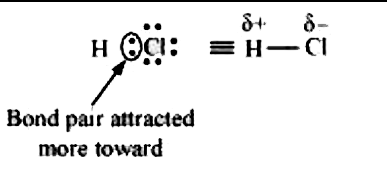
HCl, for example, contains a polar covalent bond. Chlorine atom is more electronegative than hydrogen atom. Hence, the bond pari lies towareds chlorine and therefore, it acquires a partial negative charge
Promotional Banner

Topper's Solved these Questions

  • CHEMICAL BONDING AND MOLECULAR STRUCTURE

    NCERT|Exercise EXERCISE|40 Videos
  • CLASSIFICATION OF ELEMENTS AND PERIODICITY IN PROPERTIES

    NCERT|Exercise EXERCISE|40 Videos

Similar Questions

Explore conceptually related problems

What is an incomplete ecosystem? Explain with the help of suitable example.

What are resonant oscillations? Explain with the help of suitable examples.

What are coupled oscillations? Explain with the help of suitable examples.

What are Pseudounimolecular reactions ? Explain with the help of a suitable example.

(a) What is polygenic inheritance? Explain with the help of a suitable example. (b) How are pleiotropy inheritance different from polygenic pattern of inheritance ?

How do homologous organs represent divergent evolution? Explain with the help of a suitable example.

With the help of a suitable example, explain protandry.

What is codominance ? Explain it with the help of a suitable example.

NCERT-CHEMICAL BONDING AND MOLECULAR STRUCTURE-EXERCISE
  1. Write the significance/applications of dipole moment

    Text Solution

    |

  2. Define electronegativity. How does it differ from electron gain enthal...

    Text Solution

    |

  3. Explain with the help of suitable example polar covalent bond.

    Text Solution

    |

  4. Arrange the bonds in order of increasing ionic character in the molecu...

    Text Solution

    |

  5. The skeletal structure of CH(3)COOH as shown below is correct, but som...

    Text Solution

    |

  6. Apart from tetrahedral geometry, another possible geometry for CH(4) i...

    Text Solution

    |

  7. Explain why BeH(2) molecule has a zero dipole moment although the Be-H...

    Text Solution

    |

  8. Out of NH(3) and NF(3) which has a higher Dipole moment?

    Text Solution

    |

  9. What is meant by hybridisation of atomic orbitals? Describe the shape ...

    Text Solution

    |

  10. Describe the change in hybridization (if any) of the Al atom in the fo...

    Text Solution

    |

  11. Is there any change in hybridisation of the B and N atom as a result o...

    Text Solution

    |

  12. Draw diagrams showing the formation of a double bond and a triple bond...

    Text Solution

    |

  13. What is the total number of sigma and pi bonds in the following molecu...

    Text Solution

    |

  14. Considering X axis as the inter nuclear axis, which out of the followi...

    Text Solution

    |

  15. Which hybrid orbitals are used by carbon atoms in the following molecu...

    Text Solution

    |

  16. What do you understand by bond pairs and lone pairs of electrons? Illu...

    Text Solution

    |

  17. Distinguish between a sigma and a pi bond.

    Text Solution

    |

  18. Explain the formation of H(2) molecule on the basis of valence bond th...

    Text Solution

    |

  19. Write the important conditions required for the linear combination of ...

    Text Solution

    |

  20. Use molecular orbital theory to explain why the Be(2) molecules do not...

    Text Solution

    |