

Home
Class 11
CHEMISTRY
Explain the formation of H(2) molecule o...

Explain the formation of `H_(2)` molecule on the basis of valence bond theory.

Text Solution

Verified by Experts

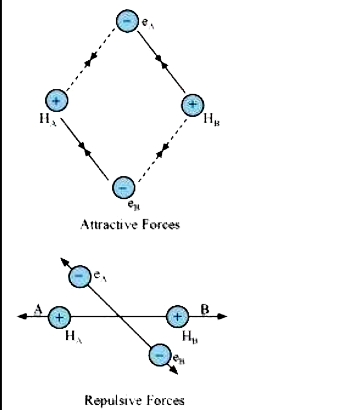
Let us assume that two hydrogen atoms (A and B) with nucleil `(N_(A) " and " N_(B))` and electrons `(e_(A)" and "e_(B))` are taken to undergo a reaction to form a hydrogen molecule.
When A and B are at a large distance, there is no interation between them. As they being to approach each other, the attractive and repulsive forces starts operating.
Attractive force arises between:
(a) Nucleus of one atom and its own electron i.e., `N_(A)-e_(A) " and " N_(B)-e_(B)`.
(b) Nucleus of one atom adn electron of another atom i.e., `N_(A)-e_(B) " and " N_(B)-e_(A)`.
Repulsive force arises between :
(a) Electrons of two atoms i.e., `e_(A)-e_(B)`.
(b) Nuclei of two atoms i.e. , `N_(A)-N_(B)`.
The force of attraction brings the two atoms together, whereas the force of repulsion tends to push them apart.

The magnitude of the attractive forces is more than that of the repulsive forces. Hence, the two atoms approach each other. As a result, the potential energy decreases. Finally, a state is reached when the attactive forces balance the repulsive forces and the system acquires minimum energy. This leads to the formation of a dihydrogen molecule.
Promotional Banner

Topper's Solved these Questions

  • CHEMICAL BONDING AND MOLECULAR STRUCTURE

    NCERT|Exercise EXERCISE|40 Videos
  • CLASSIFICATION OF ELEMENTS AND PERIODICITY IN PROPERTIES

    NCERT|Exercise EXERCISE|40 Videos

Similar Questions

Explore conceptually related problems

Explain the formation of H_(2) molecule on the basis of valance bond theory.

Formation OF Molecules on the Basis OF Valence Bond Theory (VBT)

Explain the diamagnetic behaviour of F_(2) molecule on the basis of molecular orbital theory.

Describe the structure and magnetic behaviour of [Ni(CN)_4]^(2-) ion on the basis of valence bond theory.

Limitations Of Valence Bond Theory

NCERT-CHEMICAL BONDING AND MOLECULAR STRUCTURE-EXERCISE
  1. Apart from tetrahedral geometry, another possible geometry for CH(4) i...

    Text Solution

    |

  2. Explain why BeH(2) molecule has a zero dipole moment although the Be-H...

    Text Solution

    |

  3. Out of NH(3) and NF(3) which has a higher Dipole moment?

    Text Solution

    |

  4. What is meant by hybridisation of atomic orbitals? Describe the shape ...

    Text Solution

    |

  5. Describe the change in hybridization (if any) of the Al atom in the fo...

    Text Solution

    |

  6. Is there any change in hybridisation of the B and N atom as a result o...

    Text Solution

    |

  7. Draw diagrams showing the formation of a double bond and a triple bond...

    Text Solution

    |

  8. What is the total number of sigma and pi bonds in the following molecu...

    Text Solution

    |

  9. Considering X axis as the inter nuclear axis, which out of the followi...

    Text Solution

    |

  10. Which hybrid orbitals are used by carbon atoms in the following molecu...

    Text Solution

    |

  11. What do you understand by bond pairs and lone pairs of electrons? Illu...

    Text Solution

    |

  12. Distinguish between a sigma and a pi bond.

    Text Solution

    |

  13. Explain the formation of H(2) molecule on the basis of valence bond th...

    Text Solution

    |

  14. Write the important conditions required for the linear combination of ...

    Text Solution

    |

  15. Use molecular orbital theory to explain why the Be(2) molecules do not...

    Text Solution

    |

  16. Compare the relative stability of the following species and indicate t...

    Text Solution

    |

  17. Write the significance of a plus and a minus sign shown in representin...

    Text Solution

    |

  18. Describe the hydribisation in case of PCl(5). Why are the axial bonds ...

    Text Solution

    |

  19. Define hydrogen bond. Is it weaker or stronger than the van der Waals ...

    Text Solution

    |

  20. What is meant by the term bond order? Calculate the bond order of N(2)...

    Text Solution

    |