

Home
Class 11
CHEMISTRY
Describe the hydribisation in case of PC...

Describe the hydribisation in case of `PCl_(5)`. Why are the axial bonds longer as compared to equatorial bonds?

Text Solution

Verified by Experts

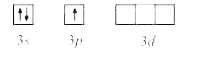
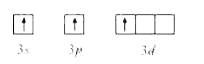
The ground state and excited state outer electronic configuration of phosphorus (Z=15) are :
Ground state :

Excited state:

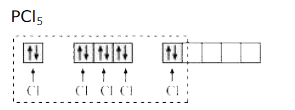
Phosphorus atom is `sp^(3)d` hybridized in the excited state. These orbitals are filled by the electron pairs donated by five Cl atoms as :
`PCl_(5)`

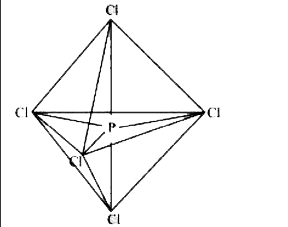
The five `sp^(3)d` hybrid orbitals are directed towards the five corners of the trigonal bypyramidals. Hence, the geometry of `PCl_(5)` can be represented as:

There are five P-Cl sigma bonds is `PCl_(5)`. Three P-Cl bonds lie in one plane and make an angle of `120^(@)` with each other. These bonds are called equatorial bonds.
The remaining two P-Cl bond lie above and below the equatorial plane and make an angle of `90^(@)` with the plane. These bonds are called axial bonds.
As the axial bond pairs suffer more repulsion from the equatorial bond pairs, axial bonds are slightly longer than equatorial bonds.
Promotional Banner

Topper's Solved these Questions

  • CHEMICAL BONDING AND MOLECULAR STRUCTURE

    NCERT|Exercise EXERCISE|40 Videos
  • CLASSIFICATION OF ELEMENTS AND PERIODICITY IN PROPERTIES

    NCERT|Exercise EXERCISE|40 Videos

Similar Questions

Explore conceptually related problems

Describe the hybridisation in case of PCl_(2). Why are the axial bonds longer as compared to equatorial bonds ?

Describe hybridisation in the case of PCl_(5) and SF_(6) The axial bonds are longer as compared to equatorial bonds in PCl_(5) whereas in SF_(6) both axial bonds and equatorial bonds and have the same bond length. Explain.

Assertion : In trigonal bipyramidal structure two axial bonds are longer than the equatorial bonds. Reason : Axial bonds suffer more repulsion as compared to equatorial bonds.

In the case of Cl_(2) , the bond is formed by

All bonds in the molecule of PCl_(5) are not equivalent. Explain.

NCERT-CHEMICAL BONDING AND MOLECULAR STRUCTURE-EXERCISE
  1. Apart from tetrahedral geometry, another possible geometry for CH(4) i...

    Text Solution

    |

  2. Explain why BeH(2) molecule has a zero dipole moment although the Be-H...

    Text Solution

    |

  3. Out of NH(3) and NF(3) which has a higher Dipole moment?

    Text Solution

    |

  4. What is meant by hybridisation of atomic orbitals? Describe the shape ...

    Text Solution

    |

  5. Describe the change in hybridization (if any) of the Al atom in the fo...

    Text Solution

    |

  6. Is there any change in hybridisation of the B and N atom as a result o...

    Text Solution

    |

  7. Draw diagrams showing the formation of a double bond and a triple bond...

    Text Solution

    |

  8. What is the total number of sigma and pi bonds in the following molecu...

    Text Solution

    |

  9. Considering X axis as the inter nuclear axis, which out of the followi...

    Text Solution

    |

  10. Which hybrid orbitals are used by carbon atoms in the following molecu...

    Text Solution

    |

  11. What do you understand by bond pairs and lone pairs of electrons? Illu...

    Text Solution

    |

  12. Distinguish between a sigma and a pi bond.

    Text Solution

    |

  13. Explain the formation of H(2) molecule on the basis of valence bond th...

    Text Solution

    |

  14. Write the important conditions required for the linear combination of ...

    Text Solution

    |

  15. Use molecular orbital theory to explain why the Be(2) molecules do not...

    Text Solution

    |

  16. Compare the relative stability of the following species and indicate t...

    Text Solution

    |

  17. Write the significance of a plus and a minus sign shown in representin...

    Text Solution

    |

  18. Describe the hydribisation in case of PCl(5). Why are the axial bonds ...

    Text Solution

    |

  19. Define hydrogen bond. Is it weaker or stronger than the van der Waals ...

    Text Solution

    |

  20. What is meant by the term bond order? Calculate the bond order of N(2)...

    Text Solution

    |